

As mentioned in Chap. 1 (§ 1.3), GPCRs form a very large family of receptors (~800 members
in man) that transmit information from the exterior of the cell to the cytosol by virtue of shifting their
conformation upon ligand binding. They mediate most of our responses to hormones and
neurotransmitters and are also responsible for our perception of the outside world through vision,
olfaction, and taste. All GPCRs share a common evolutionary origin and a TM region folded into seven
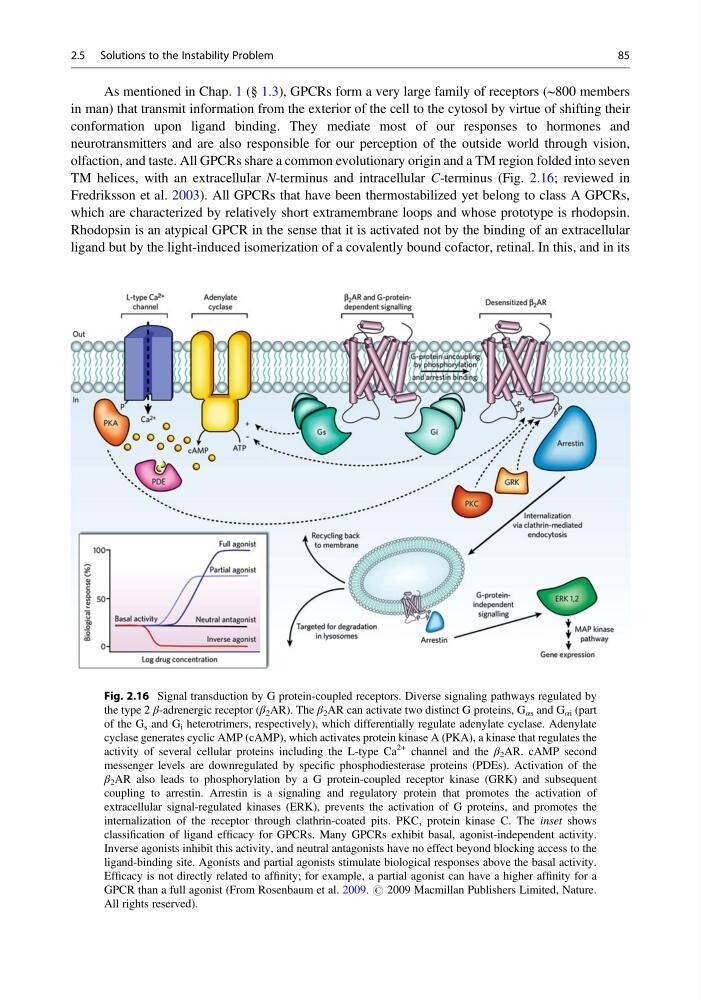
TM helices, with an extracellular N-terminus and intracellular C-terminus (Fig. 2.16; reviewed in
Fredriksson et al. 2003). All GPCRs that have been thermostabilized yet belong to class A GPCRs,
which are characterized by relatively short extramembrane loops and whose prototype is rhodopsin.
Rhodopsin is an atypical GPCR in the sense that it is activated not by the binding of an extracellular
ligand but by the light-induced isomerization of a covalently bound cofactor, retinal. In this, and in its
Fig. 2.16 Signal transduction by G protein-coupled receptors. Diverse signaling pathways regulated by
the type 2 β-adrenergic receptor (β 2 AR). The β 2 AR can activate two distinct G proteins, G αs and G αi (part
of the G s and G i heterotrimers, respectively), which differentially regulate adenylate cyclase. Adenylate
cyclase generates cyclic AMP (cAMP), which activates protein kinase A (PKA), a kinase that regulates the
activity of several cellular proteins including the L-type Ca
2+ channel and the β 2 AR. cAMP second
messenger levels are downregulated by specific phosphodiesterase proteins (PDEs). Activation of the
β 2 AR also leads to phosphorylation by a G protein-coupled receptor kinase (GRK) and subsequent
coupling to arrestin. Arrestin is a signaling and regulatory protein that promotes the activation of
extracellular signal-regulated kinases (ERK), prevents the activation of G proteins, and promotes the
internalization of the receptor through clathrin-coated pits. PKC, protein kinase C. The inset shows
classification of ligand efficacy for GPCRs. Many GPCRs exhibit basal, agonist-independent activity.
Inverse agonists inhibit this activity, and neutral antagonists have no effect beyond blocking access to the
ligand-binding site. Agonists and partial agonists stimulate biological responses above the basal activity.
Efficacy is not directly related to affinity; for example, a partial agonist can have a higher affinity for a
GPCR than a full agonist (From Rosenbaum et al. 2009. # 2009 Macmillan Publishers Limited, Nature.
All rights reserved).
2.5 Solutions to the Instability Problem
85
in man) that transmit information from the exterior of the cell to the cytosol by virtue of shifting their
conformation upon ligand binding. They mediate most of our responses to hormones and
neurotransmitters and are also responsible for our perception of the outside world through vision,
olfaction, and taste. All GPCRs share a common evolutionary origin and a TM region folded into seven
TM helices, with an extracellular N-terminus and intracellular C-terminus (Fig. 2.16; reviewed in
Fredriksson et al. 2003). All GPCRs that have been thermostabilized yet belong to class A GPCRs,
which are characterized by relatively short extramembrane loops and whose prototype is rhodopsin.
Rhodopsin is an atypical GPCR in the sense that it is activated not by the binding of an extracellular
ligand but by the light-induced isomerization of a covalently bound cofactor, retinal. In this, and in its
Fig. 2.16 Signal transduction by G protein-coupled receptors. Diverse signaling pathways regulated by
the type 2 β-adrenergic receptor (β 2 AR). The β 2 AR can activate two distinct G proteins, G αs and G αi (part
of the G s and G i heterotrimers, respectively), which differentially regulate adenylate cyclase. Adenylate
cyclase generates cyclic AMP (cAMP), which activates protein kinase A (PKA), a kinase that regulates the
activity of several cellular proteins including the L-type Ca
2+ channel and the β 2 AR. cAMP second
messenger levels are downregulated by specific phosphodiesterase proteins (PDEs). Activation of the
β 2 AR also leads to phosphorylation by a G protein-coupled receptor kinase (GRK) and subsequent
coupling to arrestin. Arrestin is a signaling and regulatory protein that promotes the activation of
extracellular signal-regulated kinases (ERK), prevents the activation of G proteins, and promotes the
internalization of the receptor through clathrin-coated pits. PKC, protein kinase C. The inset shows
classification of ligand efficacy for GPCRs. Many GPCRs exhibit basal, agonist-independent activity.
Inverse agonists inhibit this activity, and neutral antagonists have no effect beyond blocking access to the
ligand-binding site. Agonists and partial agonists stimulate biological responses above the basal activity.
Efficacy is not directly related to affinity; for example, a partial agonist can have a higher affinity for a
GPCR than a full agonist (From Rosenbaum et al. 2009. # 2009 Macmillan Publishers Limited, Nature.
All rights reserved).
2.5 Solutions to the Instability Problem
85