

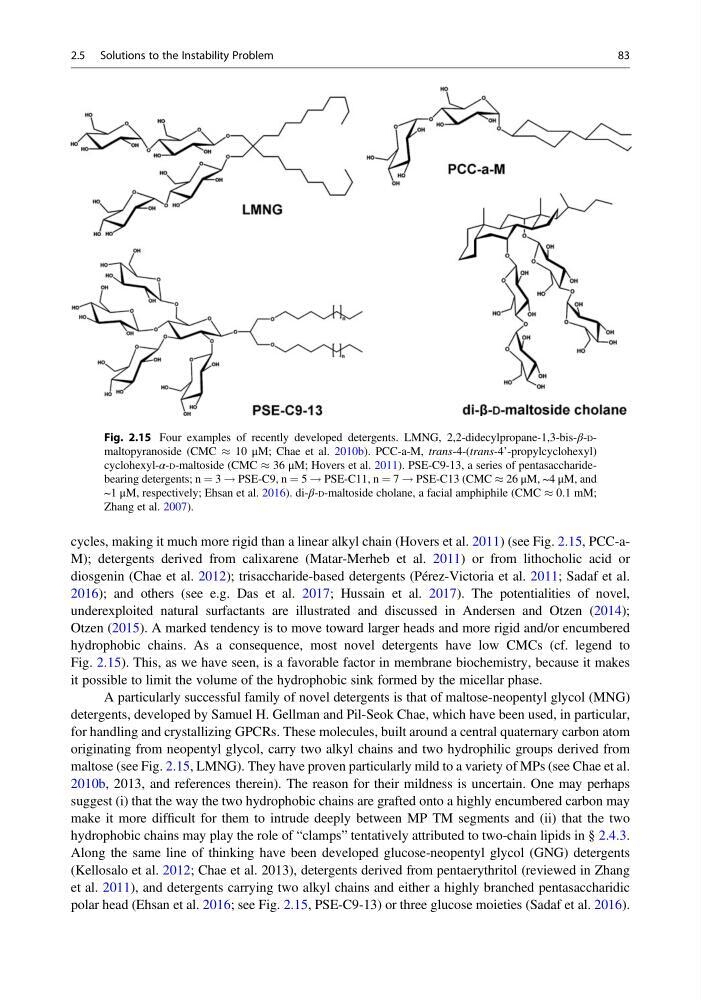
cycles, making it much more rigid than a linear alkyl chain (Hovers et al. 2011) (see Fig. 2.15, PCC-aM); detergents derived from calixarene (Matar-Merheb et al. 2011) or from lithocholic acid or
diosgenin (Chae et al. 2012); trisaccharide-based detergents (Pérez-Victoria et al. 2011; Sadaf et al.
2016); and others (see e.g. Das et al. 2017; Hussain et al. 2017). The potentialities of novel,
underexploited natural surfactants are illustrated and discussed in Andersen and Otzen (2014);
Otzen (2015). A marked tendency is to move toward larger heads and more rigid and/or encumbered
hydrophobic chains. As a consequence, most novel detergents have low CMCs (cf. legend to
Fig. 2.15). This, as we have seen, is a favorable factor in membrane biochemistry, because it makes
it possible to limit the volume of the hydrophobic sink formed by the micellar phase.
A particularly successful family of novel detergents is that of maltose-neopentyl glycol (MNG)
detergents, developed by Samuel H. Gellman and Pil-Seok Chae, which have been used, in particular,
for handling and crystallizing GPCRs. These molecules, built around a central quaternary carbon atom
originating from neopentyl glycol, carry two alkyl chains and two hydrophilic groups derived from
maltose (see Fig. 2.15, LMNG). They have proven particularly mild to a variety of MPs (see Chae et al.
2010b, 2013, and references therein). The reason for their mildness is uncertain. One may perhaps
suggest (i) that the way the two hydrophobic chains are grafted onto a highly encumbered carbon may
make it more difficult for them to intrude deeply between MP TM segments and (ii) that the two
hydrophobic chains may play the role of “clamps” tentatively attributed to two-chain lipids in § 2.4.3.
Along the same line of thinking have been developed glucose-neopentyl glycol (GNG) detergents
(Kellosalo et al. 2012; Chae et al. 2013), detergents derived from pentaerythritol (reviewed in Zhang
et al. 2011), and detergents carrying two alkyl chains and either a highly branched pentasaccharidic
polar head (Ehsan et al. 2016; see Fig. 2.15, PSE-C9-13) or three glucose moieties (Sadaf et al. 2016).
Fig. 2.15 Four examples of recently developed detergents. LMNG, 2,2-didecylpropane-1,3-bis-β-Dmaltopyranoside (CMC % 10 μM; Chae et al. 2010b). PCC-a-M, trans-4-(trans-4’-propylcyclohexyl)
cyclohexyl-α-D-maltoside (CMC % 36 μM; Hovers et al. 2011). PSE-C9-13, a series of pentasaccharidebearing detergents; n ¼ 3 ! PSE-C9, n ¼ 5 ! PSE-C11, n ¼ 7 ! PSE-C13 (CMC % 26 μM, ~4 μM, and
~1 μM, respectively; Ehsan et al. 2016). di-β-D-maltoside cholane, a facial amphiphile (CMC % 0.1 mM;
Zhang et al. 2007).
2.5 Solutions to the Instability Problem
83
diosgenin (Chae et al. 2012); trisaccharide-based detergents (Pérez-Victoria et al. 2011; Sadaf et al.
2016); and others (see e.g. Das et al. 2017; Hussain et al. 2017). The potentialities of novel,
underexploited natural surfactants are illustrated and discussed in Andersen and Otzen (2014);
Otzen (2015). A marked tendency is to move toward larger heads and more rigid and/or encumbered
hydrophobic chains. As a consequence, most novel detergents have low CMCs (cf. legend to
Fig. 2.15). This, as we have seen, is a favorable factor in membrane biochemistry, because it makes
it possible to limit the volume of the hydrophobic sink formed by the micellar phase.
A particularly successful family of novel detergents is that of maltose-neopentyl glycol (MNG)
detergents, developed by Samuel H. Gellman and Pil-Seok Chae, which have been used, in particular,
for handling and crystallizing GPCRs. These molecules, built around a central quaternary carbon atom
originating from neopentyl glycol, carry two alkyl chains and two hydrophilic groups derived from
maltose (see Fig. 2.15, LMNG). They have proven particularly mild to a variety of MPs (see Chae et al.
2010b, 2013, and references therein). The reason for their mildness is uncertain. One may perhaps
suggest (i) that the way the two hydrophobic chains are grafted onto a highly encumbered carbon may
make it more difficult for them to intrude deeply between MP TM segments and (ii) that the two
hydrophobic chains may play the role of “clamps” tentatively attributed to two-chain lipids in § 2.4.3.
Along the same line of thinking have been developed glucose-neopentyl glycol (GNG) detergents
(Kellosalo et al. 2012; Chae et al. 2013), detergents derived from pentaerythritol (reviewed in Zhang
et al. 2011), and detergents carrying two alkyl chains and either a highly branched pentasaccharidic
polar head (Ehsan et al. 2016; see Fig. 2.15, PSE-C9-13) or three glucose moieties (Sadaf et al. 2016).
Fig. 2.15 Four examples of recently developed detergents. LMNG, 2,2-didecylpropane-1,3-bis-β-Dmaltopyranoside (CMC % 10 μM; Chae et al. 2010b). PCC-a-M, trans-4-(trans-4’-propylcyclohexyl)
cyclohexyl-α-D-maltoside (CMC % 36 μM; Hovers et al. 2011). PSE-C9-13, a series of pentasaccharidebearing detergents; n ¼ 3 ! PSE-C9, n ¼ 5 ! PSE-C11, n ¼ 7 ! PSE-C13 (CMC % 26 μM, ~4 μM, and
~1 μM, respectively; Ehsan et al. 2016). di-β-D-maltoside cholane, a facial amphiphile (CMC % 0.1 mM;
Zhang et al. 2007).
2.5 Solutions to the Instability Problem
83