

A þ B
v À1
!
v þ1
C
Chemical reaction requires collision of molecules. Frequency of collision is
proportional to kinetic energy and molecular concentration. Pair of A and B must
overcome activation energy to be converted to C. At molecular level, chemical
reaction is reversible, and finally becomes equilibrium state in isolated system
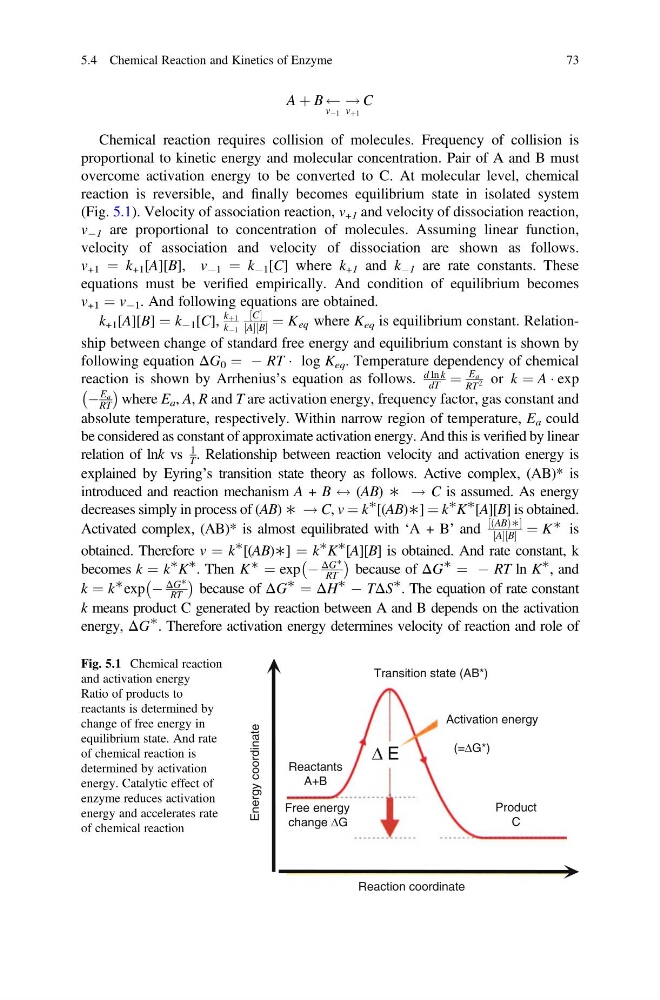
(Fig. 5.1). Velocity of association reaction, v +1 and velocity of dissociation reaction,
v À1 are proportional to concentration of molecules. Assuming linear function,
velocity of association and velocity of dissociation are shown as follows.
v +1 ¼ k +1 [A][B], v À1 ¼ k À1 [C] where k +1 and k À1 are rate constants. These
equations must be verified empirically. And condition of equilibrium becomes
v +1 ¼ v À1 . And following equations are obtained.
k +1 [A][B] ¼ k À1 [C],
k þ1
k À1
C
½
A
½ B
½ ¼ K eq where K eq is equilibrium constant. Relationship between change of standard free energy and equilibrium constant is shown by
following equation ΔG 0 ¼ À RT Á log K eq . Temperature dependency of chemical
reaction is shown by Arrhenius’s equation as follows.
d ln k
dT ¼
E a
RT
2 or k ¼ A Á exp
À
E a
RT
À
Á
where E a , A, R and T are activation energy, frequency factor, gas constant and
absolute temperature, respectively. Within narrow region of temperature, E a could
be considered as constant of approximate activation energy. And this is verified by linear
relation of lnk vs
1
T . Relationship between reaction velocity and activation energy is
explained by Eyring’s transition state theory as follows. Active complex, (AB)* is
introduced and reaction mechanism A + B $ (AB) ∗ ! C is assumed. As energy
decreases simply in process of (AB) ∗ ! C, v ¼ k
∗
[(AB)∗] ¼ k
∗
K
∗
[A][B] is obtained.
Activated complex, (AB)* is almost equilibrated with ‘A + B’ and
AB
ð Þ∗
½
A
½ B
½ ¼ K
∗ is
obtained. Therefore v ¼ k
∗
[(AB)∗] ¼ k
∗
K
∗
[A][B] is obtained. And rate constant, k
becomes k ¼ k
∗
K
∗
. Then K
∗
¼ exp À
ΔG
∗
RT
À
Á
because of ΔG
∗
¼ À RT ln K
∗
, and
k ¼ k
∗ exp À
ΔG
∗
RT
À
Á
because of ΔG
∗
¼ ΔH
∗
À TΔS
∗
. The equation of rate constant
k means product C generated by reaction between A and B depends on the activation
energy, ΔG
∗
. Therefore activation energy determines velocity of reaction and role of
Reaction coordinate
Product
C
Reactants
A+B
Transition state (AB*)
Activation energy
Energy coordinate
(=ΔG*)
Free energy
change ΔG
Δ E
Fig. 5.1 Chemical reaction
and activation energy
Ratio of products to
reactants is determined by
change of free energy in
equilibrium state. And rate
of chemical reaction is
determined by activation
energy. Catalytic effect of
enzyme reduces activation
energy and accelerates rate
of chemical reaction
5.4 Chemical Reaction and Kinetics of Enzyme
73
v À1
!
v þ1
C
Chemical reaction requires collision of molecules. Frequency of collision is
proportional to kinetic energy and molecular concentration. Pair of A and B must
overcome activation energy to be converted to C. At molecular level, chemical
reaction is reversible, and finally becomes equilibrium state in isolated system
(Fig. 5.1). Velocity of association reaction, v +1 and velocity of dissociation reaction,
v À1 are proportional to concentration of molecules. Assuming linear function,
velocity of association and velocity of dissociation are shown as follows.
v +1 ¼ k +1 [A][B], v À1 ¼ k À1 [C] where k +1 and k À1 are rate constants. These
equations must be verified empirically. And condition of equilibrium becomes
v +1 ¼ v À1 . And following equations are obtained.
k +1 [A][B] ¼ k À1 [C],
k þ1
k À1
C
½
A
½ B
½ ¼ K eq where K eq is equilibrium constant. Relationship between change of standard free energy and equilibrium constant is shown by
following equation ΔG 0 ¼ À RT Á log K eq . Temperature dependency of chemical
reaction is shown by Arrhenius’s equation as follows.
d ln k
dT ¼
E a
RT
2 or k ¼ A Á exp
À
E a
RT
À
Á
where E a , A, R and T are activation energy, frequency factor, gas constant and
absolute temperature, respectively. Within narrow region of temperature, E a could
be considered as constant of approximate activation energy. And this is verified by linear
relation of lnk vs
1
T . Relationship between reaction velocity and activation energy is
explained by Eyring’s transition state theory as follows. Active complex, (AB)* is
introduced and reaction mechanism A + B $ (AB) ∗ ! C is assumed. As energy
decreases simply in process of (AB) ∗ ! C, v ¼ k
∗
[(AB)∗] ¼ k
∗
K
∗
[A][B] is obtained.
Activated complex, (AB)* is almost equilibrated with ‘A + B’ and
AB
ð Þ∗
½
A
½ B
½ ¼ K
∗ is
obtained. Therefore v ¼ k
∗
[(AB)∗] ¼ k
∗
K
∗
[A][B] is obtained. And rate constant, k
becomes k ¼ k
∗
K
∗
. Then K
∗
¼ exp À
ΔG
∗
RT
À
Á
because of ΔG
∗
¼ À RT ln K
∗
, and
k ¼ k
∗ exp À
ΔG
∗
RT
À
Á
because of ΔG
∗
¼ ΔH
∗
À TΔS
∗
. The equation of rate constant
k means product C generated by reaction between A and B depends on the activation
energy, ΔG
∗
. Therefore activation energy determines velocity of reaction and role of
Reaction coordinate
Product
C
Reactants
A+B
Transition state (AB*)
Activation energy
Energy coordinate
(=ΔG*)
Free energy
change ΔG
Δ E
Fig. 5.1 Chemical reaction
and activation energy
Ratio of products to
reactants is determined by
change of free energy in
equilibrium state. And rate
of chemical reaction is
determined by activation
energy. Catalytic effect of
enzyme reduces activation
energy and accelerates rate
of chemical reaction
5.4 Chemical Reaction and Kinetics of Enzyme
73