

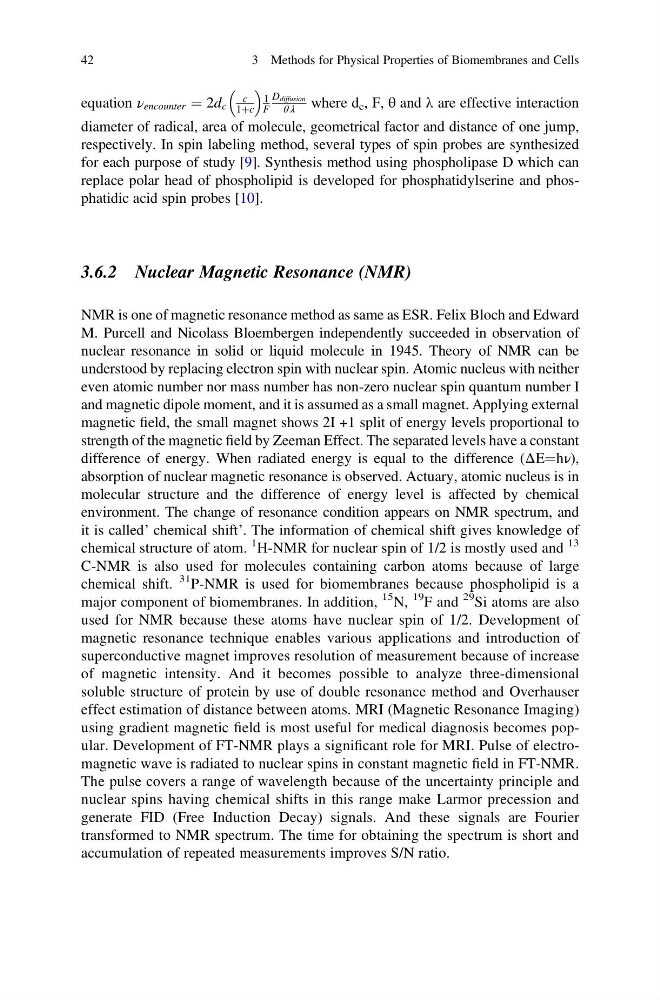
equation ν encounter ¼ 2d c
c
1þc
1
F
D diffusion
θ λ
where d c , F, θ and λ are effective interaction
diameter of radical, area of molecule, geometrical factor and distance of one jump,
respectively. In spin labeling method, several types of spin probes are synthesized
for each purpose of study [9]. Synthesis method using phospholipase D which can
replace polar head of phospholipid is developed for phosphatidylserine and phosphatidic acid spin probes [10].
3.6.2 Nuclear Magnetic Resonance (NMR)
NMR is one of magnetic resonance method as same as ESR. Felix Bloch and Edward
M. Purcell and Nicolass Bloembergen independently succeeded in observation of
nuclear resonance in solid or liquid molecule in 1945. Theory of NMR can be
understood by replacing electron spin with nuclear spin. Atomic nucleus with neither
even atomic number nor mass number has non-zero nuclear spin quantum number I
and magnetic dipole moment, and it is assumed as a small magnet. Applying external
magnetic field, the small magnet shows 2I +1 split of energy levels proportional to
strength of the magnetic field by Zeeman Effect. The separated levels have a constant
difference of energy. When radiated energy is equal to the difference (ΔE¼hν),
absorption of nuclear magnetic resonance is observed. Actuary, atomic nucleus is in
molecular structure and the difference of energy level is affected by chemical
environment. The change of resonance condition appears on NMR spectrum, and
it is called’ chemical shift’. The information of chemical shift gives knowledge of
chemical structure of atom.
1 H-NMR for nuclear spin of 1/2 is mostly used and
13
C-NMR is also used for molecules containing carbon atoms because of large
chemical shift.
31 P-NMR is used for biomembranes because phospholipid is a
major component of biomembranes. In addition,
15 N,
19 F and
29 Si atoms are also
used for NMR because these atoms have nuclear spin of 1/2. Development of
magnetic resonance technique enables various applications and introduction of
superconductive magnet improves resolution of measurement because of increase
of magnetic intensity. And it becomes possible to analyze three-dimensional
soluble structure of protein by use of double resonance method and Overhauser
effect estimation of distance between atoms. MRI (Magnetic Resonance Imaging)
using gradient magnetic field is most useful for medical diagnosis becomes popular. Development of FT-NMR plays a significant role for MRI. Pulse of electromagnetic wave is radiated to nuclear spins in constant magnetic field in FT-NMR.
The pulse covers a range of wavelength because of the uncertainty principle and
nuclear spins having chemical shifts in this range make Larmor precession and
generate FID (Free Induction Decay) signals. And these signals are Fourier
transformed to NMR spectrum. The time for obtaining the spectrum is short and
accumulation of repeated measurements improves S/N ratio.
42
3 Methods for Physical Properties of Biomembranes and Cells
c
1þc
1
F
D diffusion
θ λ
where d c , F, θ and λ are effective interaction
diameter of radical, area of molecule, geometrical factor and distance of one jump,
respectively. In spin labeling method, several types of spin probes are synthesized
for each purpose of study [9]. Synthesis method using phospholipase D which can
replace polar head of phospholipid is developed for phosphatidylserine and phosphatidic acid spin probes [10].
3.6.2 Nuclear Magnetic Resonance (NMR)
NMR is one of magnetic resonance method as same as ESR. Felix Bloch and Edward
M. Purcell and Nicolass Bloembergen independently succeeded in observation of
nuclear resonance in solid or liquid molecule in 1945. Theory of NMR can be
understood by replacing electron spin with nuclear spin. Atomic nucleus with neither
even atomic number nor mass number has non-zero nuclear spin quantum number I
and magnetic dipole moment, and it is assumed as a small magnet. Applying external
magnetic field, the small magnet shows 2I +1 split of energy levels proportional to
strength of the magnetic field by Zeeman Effect. The separated levels have a constant
difference of energy. When radiated energy is equal to the difference (ΔE¼hν),
absorption of nuclear magnetic resonance is observed. Actuary, atomic nucleus is in
molecular structure and the difference of energy level is affected by chemical
environment. The change of resonance condition appears on NMR spectrum, and
it is called’ chemical shift’. The information of chemical shift gives knowledge of
chemical structure of atom.
1 H-NMR for nuclear spin of 1/2 is mostly used and
13
C-NMR is also used for molecules containing carbon atoms because of large
chemical shift.
31 P-NMR is used for biomembranes because phospholipid is a
major component of biomembranes. In addition,
15 N,
19 F and
29 Si atoms are also
used for NMR because these atoms have nuclear spin of 1/2. Development of
magnetic resonance technique enables various applications and introduction of
superconductive magnet improves resolution of measurement because of increase
of magnetic intensity. And it becomes possible to analyze three-dimensional
soluble structure of protein by use of double resonance method and Overhauser
effect estimation of distance between atoms. MRI (Magnetic Resonance Imaging)
using gradient magnetic field is most useful for medical diagnosis becomes popular. Development of FT-NMR plays a significant role for MRI. Pulse of electromagnetic wave is radiated to nuclear spins in constant magnetic field in FT-NMR.
The pulse covers a range of wavelength because of the uncertainty principle and
nuclear spins having chemical shifts in this range make Larmor precession and
generate FID (Free Induction Decay) signals. And these signals are Fourier
transformed to NMR spectrum. The time for obtaining the spectrum is short and
accumulation of repeated measurements improves S/N ratio.
42
3 Methods for Physical Properties of Biomembranes and Cells