

system. Produced entropy flows out and the entropy in the system is kept constant.
On contrary, entropy production becomes finally zero in equilibrium state.
1.3.2 Nonequilibrium Thermodynamics
Considering stability and fluctuation of structure in non-equilibrium thermodynamics, P. Glandorff and Ilya Prigosine have studied what living state is thermodynamically [9]. Prigosine received Nobel Prize in chemistry "for his contributions to nonequilibrium thermodynamics, particularly the theory of dissipative structures". He
has also proved principle of minimum entropy production in statistical physics.
Quasi-static change near equilibrium state was considered in early theory of
non-equilibrium thermodynamics, and it only indicated direction of change but did
not include temporal factor. Onsegar and Prigogine have developed linear nonequilibrium thermodynamics by introducing assumption of ‘local equilibrium’ and
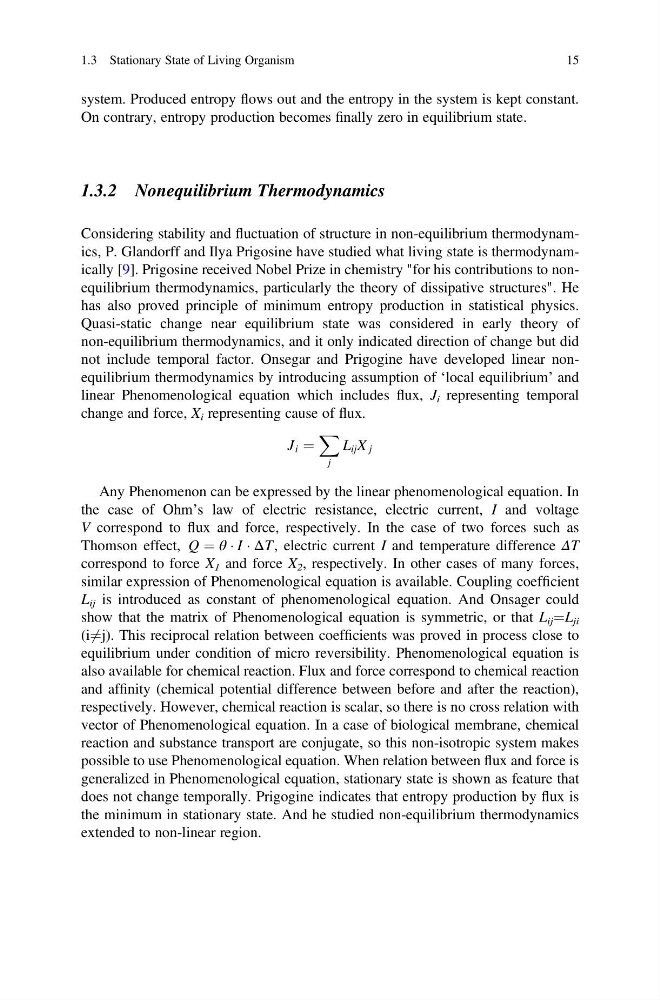
linear Phenomenological equation which includes flux, J i representing temporal
change and force, X i representing cause of flux.
J i ¼
X
j
L ij X j
Any Phenomenon can be expressed by the linear phenomenological equation. In
the case of Ohm’s law of electric resistance, electric current, I and voltage
V correspond to flux and force, respectively. In the case of two forces such as
Thomson effect, Q ¼ θ Á I Á ΔT, electric current I and temperature difference ΔT
correspond to force X 1 and force X 2 , respectively. In other cases of many forces,
similar expression of Phenomenological equation is available. Coupling coefficient
L ij is introduced as constant of phenomenological equation. And Onsager could
show that the matrix of Phenomenological equation is symmetric, or that L ij ¼L ji
(i6 ¼j). This reciprocal relation between coefficients was proved in process close to
equilibrium under condition of micro reversibility. Phenomenological equation is
also available for chemical reaction. Flux and force correspond to chemical reaction
and affinity (chemical potential difference between before and after the reaction),
respectively. However, chemical reaction is scalar, so there is no cross relation with
vector of Phenomenological equation. In a case of biological membrane, chemical
reaction and substance transport are conjugate, so this non-isotropic system makes
possible to use Phenomenological equation. When relation between flux and force is
generalized in Phenomenological equation, stationary state is shown as feature that
does not change temporally. Prigogine indicates that entropy production by flux is
the minimum in stationary state. And he studied non-equilibrium thermodynamics
extended to non-linear region.
1.3 Stationary State of Living Organism
15
On contrary, entropy production becomes finally zero in equilibrium state.
1.3.2 Nonequilibrium Thermodynamics
Considering stability and fluctuation of structure in non-equilibrium thermodynamics, P. Glandorff and Ilya Prigosine have studied what living state is thermodynamically [9]. Prigosine received Nobel Prize in chemistry "for his contributions to nonequilibrium thermodynamics, particularly the theory of dissipative structures". He
has also proved principle of minimum entropy production in statistical physics.
Quasi-static change near equilibrium state was considered in early theory of
non-equilibrium thermodynamics, and it only indicated direction of change but did
not include temporal factor. Onsegar and Prigogine have developed linear nonequilibrium thermodynamics by introducing assumption of ‘local equilibrium’ and
linear Phenomenological equation which includes flux, J i representing temporal
change and force, X i representing cause of flux.
J i ¼
X
j
L ij X j
Any Phenomenon can be expressed by the linear phenomenological equation. In
the case of Ohm’s law of electric resistance, electric current, I and voltage
V correspond to flux and force, respectively. In the case of two forces such as
Thomson effect, Q ¼ θ Á I Á ΔT, electric current I and temperature difference ΔT
correspond to force X 1 and force X 2 , respectively. In other cases of many forces,
similar expression of Phenomenological equation is available. Coupling coefficient
L ij is introduced as constant of phenomenological equation. And Onsager could
show that the matrix of Phenomenological equation is symmetric, or that L ij ¼L ji
(i6 ¼j). This reciprocal relation between coefficients was proved in process close to
equilibrium under condition of micro reversibility. Phenomenological equation is
also available for chemical reaction. Flux and force correspond to chemical reaction
and affinity (chemical potential difference between before and after the reaction),
respectively. However, chemical reaction is scalar, so there is no cross relation with
vector of Phenomenological equation. In a case of biological membrane, chemical
reaction and substance transport are conjugate, so this non-isotropic system makes
possible to use Phenomenological equation. When relation between flux and force is
generalized in Phenomenological equation, stationary state is shown as feature that
does not change temporally. Prigogine indicates that entropy production by flux is
the minimum in stationary state. And he studied non-equilibrium thermodynamics
extended to non-linear region.
1.3 Stationary State of Living Organism
15