

of 11.1 Å and bonding energy E¼À5.88 kcal/mol, and three hydrogen bonds
connect between guanine and cytosine at distance of 10.5 Å and bonding energy
E¼À19.18 kcal/mol. The ordered structure of DNA double helix formed by hydrogen bonds is disrupted by raising temperature. And lowering temperature makes the
single strand to form double helix by complementary base pairs of A-T and G-C.
From viewpoint of genetic information development on DNA, Temperature dependent formation and disruption of base pairs makes it possible to polymerization of
nucleotides under the reaction mechanism like PCR (polymerase chain reaction)
Table 1.3 Catalytic function of enzyme
Substrate
Active amino acid residue in thermal
polymer
Activity [μM/mg/
min]
Hydrolysis
p-Nitrophenyl acetate
His, Lys, Asp-imide, Glu, Asp, Ser, Tyr
1.5 Â 10
À3
p-Nitrophenyl phosphate Basidc and neutral amino acids
2 Â 10
À3
ATP
Zn, Lysine-rich polymer
~10
À4
Decarboxylation
Glucose, Gluclonic acid
Lys
~10
À4
Pyruvic acid
Glu, Thr
~10
À4
Oxaloacetic acid
Lys
0.3
Aminization・deamination
α-Ketoglutaric acid
Lys, Basic amino acid
2 Â 10
À3
H2 N-donor:Glutamic
acid
~10
À4
Redox reaction
H 2 0 2 (catalase)
Hemoproteinoid Phe inhibitor
~10
À4
H 2 0 2 and H 2 -donor
Lys-rich hemoproteinoid
0.2
Catalytic activity of enzyme functions at active center
Active center of Chymotrypsin (protease) is composed of only three amino acids (Ser-195, His-57
and Asp-102) while molecular weight of the protein is 25,000
Under the involvement of aspartic acid, the nitrogen atom (N) of the histidine takes the proton (H
+ )
from hydroxyl group (-OH) of the serine, and a moiety (-O-) which is easy to give the electron is
formed
The enzyme forms the route where the electron is easy to move on internal bonds of a molecule
rapidly by lowering the activation energy
HO P
O
OH
O
OH
O
OH
OH OH
P
P
O
O
O
O
N
N
N
NH 2
N
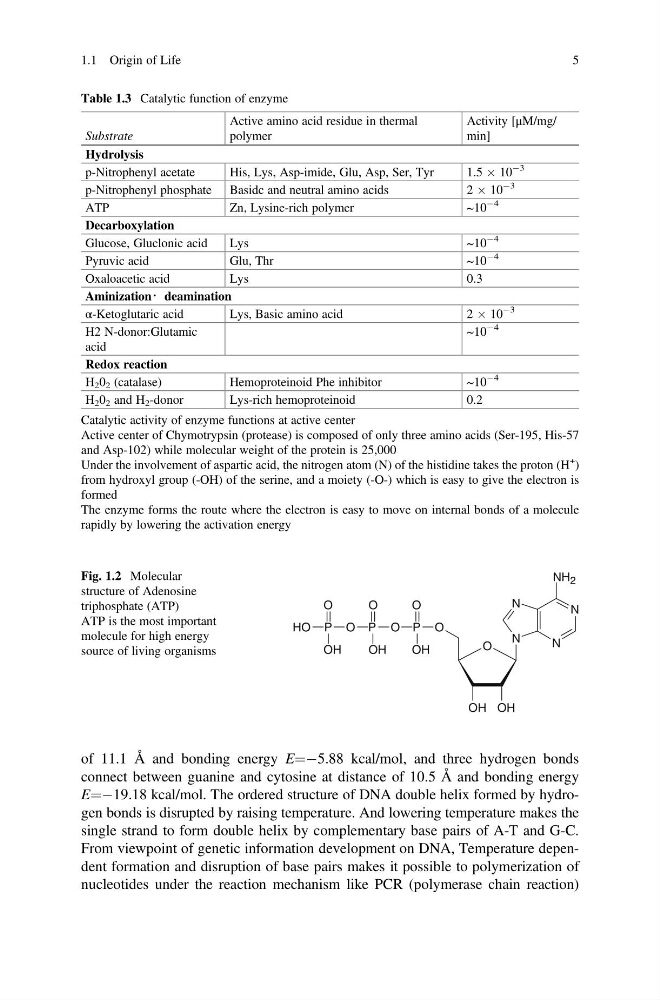
Fig. 1.2 Molecular
structure of Adenosine
triphosphate (ATP)
ATP is the most important
molecule for high energy
source of living organisms
1.1 Origin of Life
5
connect between guanine and cytosine at distance of 10.5 Å and bonding energy
E¼À19.18 kcal/mol. The ordered structure of DNA double helix formed by hydrogen bonds is disrupted by raising temperature. And lowering temperature makes the
single strand to form double helix by complementary base pairs of A-T and G-C.
From viewpoint of genetic information development on DNA, Temperature dependent formation and disruption of base pairs makes it possible to polymerization of
nucleotides under the reaction mechanism like PCR (polymerase chain reaction)
Table 1.3 Catalytic function of enzyme
Substrate
Active amino acid residue in thermal
polymer
Activity [μM/mg/
min]
Hydrolysis
p-Nitrophenyl acetate
His, Lys, Asp-imide, Glu, Asp, Ser, Tyr
1.5 Â 10
À3
p-Nitrophenyl phosphate Basidc and neutral amino acids
2 Â 10
À3
ATP
Zn, Lysine-rich polymer
~10
À4
Decarboxylation
Glucose, Gluclonic acid
Lys
~10
À4
Pyruvic acid
Glu, Thr
~10
À4
Oxaloacetic acid
Lys
0.3
Aminization・deamination
α-Ketoglutaric acid
Lys, Basic amino acid
2 Â 10
À3
H2 N-donor:Glutamic
acid
~10
À4
Redox reaction
H 2 0 2 (catalase)
Hemoproteinoid Phe inhibitor
~10
À4
H 2 0 2 and H 2 -donor
Lys-rich hemoproteinoid
0.2
Catalytic activity of enzyme functions at active center
Active center of Chymotrypsin (protease) is composed of only three amino acids (Ser-195, His-57
and Asp-102) while molecular weight of the protein is 25,000
Under the involvement of aspartic acid, the nitrogen atom (N) of the histidine takes the proton (H
+ )
from hydroxyl group (-OH) of the serine, and a moiety (-O-) which is easy to give the electron is
formed
The enzyme forms the route where the electron is easy to move on internal bonds of a molecule
rapidly by lowering the activation energy
HO P
O
OH
O
OH
O
OH
OH OH
P
P
O
O
O
O
N
N
N
NH 2
N
Fig. 1.2 Molecular
structure of Adenosine
triphosphate (ATP)
ATP is the most important
molecule for high energy
source of living organisms
1.1 Origin of Life
5