

important roles in metal enzymes or hormone. Formaldehyde and hydrogen cyanide
could be generated by Lyman alpha ray and lightening, respectively during the long
history of the earth. The age of universe is estimated 138 Â 10
9 years and the age of
the earth is estimated 45 Â 10
9 years. It is enough time for chemical evolution on the
earth. Formaldehyde and hydrogen cyanide are important basic molecules to produce amino acid, sugar and pyrimidine from following chemical reactions. Glycine,
the simplest amino acid could be generated from formaldehyde and hydrogen
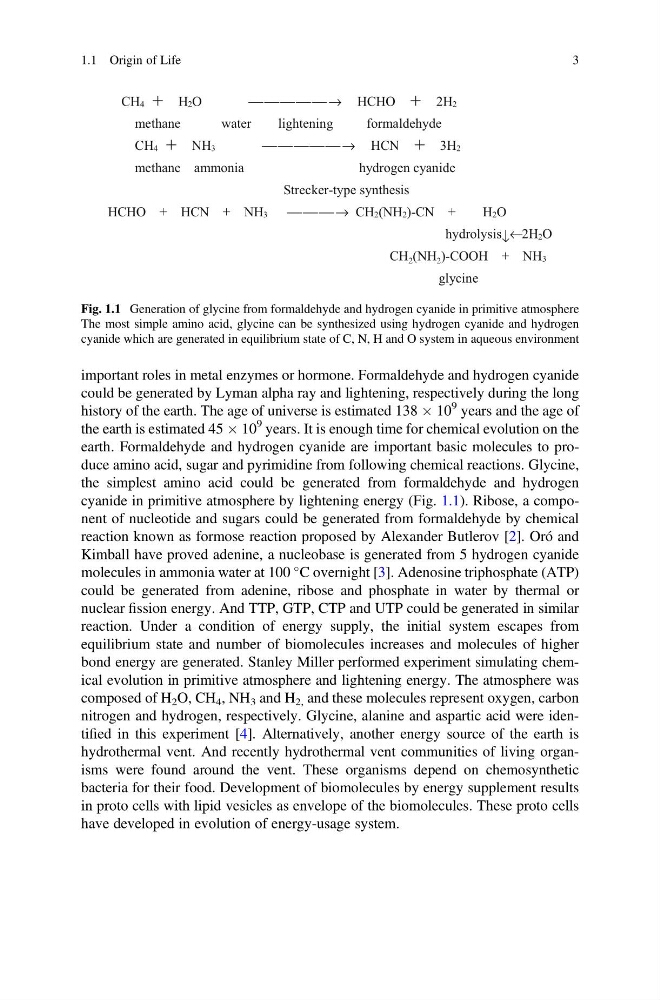
cyanide in primitive atmosphere by lightening energy (Fig. 1.1). Ribose, a component of nucleotide and sugars could be generated from formaldehyde by chemical
reaction known as formose reaction proposed by Alexander Butlerov [2]. Oró and
Kimball have proved adenine, a nucleobase is generated from 5 hydrogen cyanide
molecules in ammonia water at 100
C overnight [3]. Adenosine triphosphate (ATP)
could be generated from adenine, ribose and phosphate in water by thermal or
nuclear fission energy. And TTP, GTP, CTP and UTP could be generated in similar
reaction. Under a condition of energy supply, the initial system escapes from
equilibrium state and number of biomolecules increases and molecules of higher
bond energy are generated. Stanley Miller performed experiment simulating chemical evolution in primitive atmosphere and lightening energy. The atmosphere was
composed of H 2 O, CH 4 , NH 3 and H 2, and these molecules represent oxygen, carbon
nitrogen and hydrogen, respectively. Glycine, alanine and aspartic acid were identified in this experiment [4]. Alternatively, another energy source of the earth is
hydrothermal vent. And recently hydrothermal vent communities of living organisms were found around the vent. These organisms depend on chemosynthetic
bacteria for their food. Development of biomolecules by energy supplement results
in proto cells with lipid vesicles as envelope of the biomolecules. These proto cells
have developed in evolution of energy-usage system.
CH4 H2O
⎯ ⎯ ⎯ ⎯ ⎯ → HCHO 2H2
methane
water
lightening
formaldehyde
CH4 NH3
⎯ ⎯ ⎯ ⎯ ⎯ → HCN 3H2
methane ammonia
hydrogen cyanide
Strecker-type synthesis
HCHO + HCN + NH3 ⎯ ⎯ ⎯ → CH2(NH2)-CN +
H2O
hydrolysis ↓ ←2H2O
CH 2 (NH 2 )-COOH + NH3
glycine
Fig. 1.1 Generation of glycine from formaldehyde and hydrogen cyanide in primitive atmosphere
The most simple amino acid, glycine can be synthesized using hydrogen cyanide and hydrogen
cyanide which are generated in equilibrium state of C, N, H and O system in aqueous environment
1.1 Origin of Life
3
could be generated by Lyman alpha ray and lightening, respectively during the long
history of the earth. The age of universe is estimated 138 Â 10
9 years and the age of
the earth is estimated 45 Â 10
9 years. It is enough time for chemical evolution on the
earth. Formaldehyde and hydrogen cyanide are important basic molecules to produce amino acid, sugar and pyrimidine from following chemical reactions. Glycine,
the simplest amino acid could be generated from formaldehyde and hydrogen
cyanide in primitive atmosphere by lightening energy (Fig. 1.1). Ribose, a component of nucleotide and sugars could be generated from formaldehyde by chemical
reaction known as formose reaction proposed by Alexander Butlerov [2]. Oró and
Kimball have proved adenine, a nucleobase is generated from 5 hydrogen cyanide
molecules in ammonia water at 100
C overnight [3]. Adenosine triphosphate (ATP)
could be generated from adenine, ribose and phosphate in water by thermal or
nuclear fission energy. And TTP, GTP, CTP and UTP could be generated in similar
reaction. Under a condition of energy supply, the initial system escapes from
equilibrium state and number of biomolecules increases and molecules of higher
bond energy are generated. Stanley Miller performed experiment simulating chemical evolution in primitive atmosphere and lightening energy. The atmosphere was
composed of H 2 O, CH 4 , NH 3 and H 2, and these molecules represent oxygen, carbon
nitrogen and hydrogen, respectively. Glycine, alanine and aspartic acid were identified in this experiment [4]. Alternatively, another energy source of the earth is
hydrothermal vent. And recently hydrothermal vent communities of living organisms were found around the vent. These organisms depend on chemosynthetic
bacteria for their food. Development of biomolecules by energy supplement results
in proto cells with lipid vesicles as envelope of the biomolecules. These proto cells
have developed in evolution of energy-usage system.
CH4 H2O
⎯ ⎯ ⎯ ⎯ ⎯ → HCHO 2H2
methane
water
lightening
formaldehyde
CH4 NH3
⎯ ⎯ ⎯ ⎯ ⎯ → HCN 3H2
methane ammonia
hydrogen cyanide
Strecker-type synthesis
HCHO + HCN + NH3 ⎯ ⎯ ⎯ → CH2(NH2)-CN +
H2O
hydrolysis ↓ ←2H2O
CH 2 (NH 2 )-COOH + NH3
glycine
Fig. 1.1 Generation of glycine from formaldehyde and hydrogen cyanide in primitive atmosphere
The most simple amino acid, glycine can be synthesized using hydrogen cyanide and hydrogen
cyanide which are generated in equilibrium state of C, N, H and O system in aqueous environment
1.1 Origin of Life
3