

effect of molecular shape of lipid and induced by cone type lipid molecule. Lipid
bilayer membrane prefers non-bilayer membrane structure when cylinder type lipids
of the membrane are converted to cone type lipids, diacylglycerol molecules by
phospholipase C because of increase of curvature of the membrane [46]. Phenomenon like endocytosis which was independent of ATP was observed when CHO cells
were treated with sphingomyelinase. This phenomenon is supposed that conversion
of cylindrical sphingomyelin to cone shape ceramide induces curved plasma membrane to assist endocytosis [47]. Release of cytochrome from mitochondria is
observed in apoptosis and related gene tBid is identified for the release. And addition
of product from tBid to liposomes including cardiolipin and phosphatidylethanolamine induced increase of membrane permeability, membrane fusion and formation
of non-bilayer membrane in correlating with change of membrane curvature
[48]. These results imply participation of tBid in formation of non-bilayer membrane
structure and permeation of biomolecules through biomembranes. There is standard
theory, area-difference elasticity for models in curvature of bilayer membrane
spontaneously formed by amphipathic lipid molecules in aqueous environment
[49, 50]. Balance between forces acting lipid molecule in lipid bilayer membrane
is explained by considering each inter molecular force acting inner and outer layer of
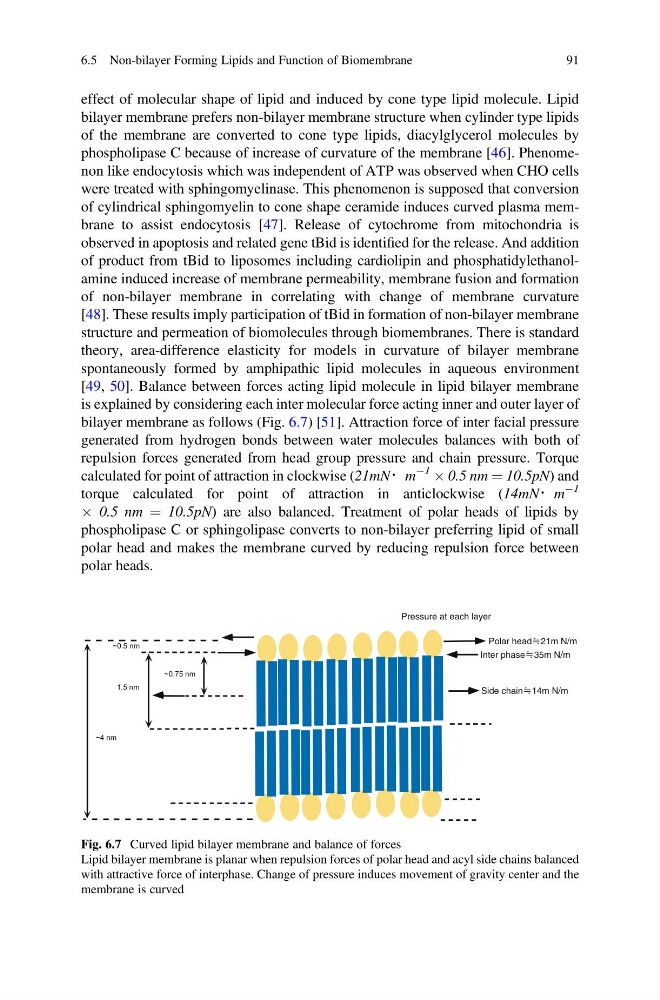
bilayer membrane as follows (Fig. 6.7) [51]. Attraction force of inter facial pressure
generated from hydrogen bonds between water molecules balances with both of
repulsion forces generated from head group pressure and chain pressure. Torque
calculated for point of attraction in clockwise (21mN・m
À1
 0.5 nm ¼ 10.5pN) and
torque calculated for point of attraction in anticlockwise (14mN・m
À1
 0.5 nm ¼ 10.5pN) are also balanced. Treatment of polar heads of lipids by
phospholipase C or sphingolipase converts to non-bilayer preferring lipid of small
polar head and makes the membrane curved by reducing repulsion force between
polar heads.
Polar head 21m N/m
~0.5 nm
~0.75 nm
1.5 nm
~4 nm
Inter phase 35m N/m
Side chain 14m N/m
Pressure at each layer
Fig. 6.7 Curved lipid bilayer membrane and balance of forces
Lipid bilayer membrane is planar when repulsion forces of polar head and acyl side chains balanced
with attractive force of interphase. Change of pressure induces movement of gravity center and the
membrane is curved
6.5 Non-bilayer Forming Lipids and Function of Biomembrane
91
bilayer membrane prefers non-bilayer membrane structure when cylinder type lipids
of the membrane are converted to cone type lipids, diacylglycerol molecules by
phospholipase C because of increase of curvature of the membrane [46]. Phenomenon like endocytosis which was independent of ATP was observed when CHO cells
were treated with sphingomyelinase. This phenomenon is supposed that conversion
of cylindrical sphingomyelin to cone shape ceramide induces curved plasma membrane to assist endocytosis [47]. Release of cytochrome from mitochondria is
observed in apoptosis and related gene tBid is identified for the release. And addition
of product from tBid to liposomes including cardiolipin and phosphatidylethanolamine induced increase of membrane permeability, membrane fusion and formation
of non-bilayer membrane in correlating with change of membrane curvature
[48]. These results imply participation of tBid in formation of non-bilayer membrane
structure and permeation of biomolecules through biomembranes. There is standard
theory, area-difference elasticity for models in curvature of bilayer membrane
spontaneously formed by amphipathic lipid molecules in aqueous environment
[49, 50]. Balance between forces acting lipid molecule in lipid bilayer membrane
is explained by considering each inter molecular force acting inner and outer layer of
bilayer membrane as follows (Fig. 6.7) [51]. Attraction force of inter facial pressure
generated from hydrogen bonds between water molecules balances with both of
repulsion forces generated from head group pressure and chain pressure. Torque
calculated for point of attraction in clockwise (21mN・m
À1
 0.5 nm ¼ 10.5pN) and
torque calculated for point of attraction in anticlockwise (14mN・m
À1
 0.5 nm ¼ 10.5pN) are also balanced. Treatment of polar heads of lipids by
phospholipase C or sphingolipase converts to non-bilayer preferring lipid of small
polar head and makes the membrane curved by reducing repulsion force between
polar heads.
Polar head 21m N/m
~0.5 nm
~0.75 nm
1.5 nm
~4 nm
Inter phase 35m N/m
Side chain 14m N/m
Pressure at each layer
Fig. 6.7 Curved lipid bilayer membrane and balance of forces
Lipid bilayer membrane is planar when repulsion forces of polar head and acyl side chains balanced
with attractive force of interphase. Change of pressure induces movement of gravity center and the
membrane is curved
6.5 Non-bilayer Forming Lipids and Function of Biomembrane
91