

134
3 eThekwini’s Green and Ecological Infrastructure Policy Landscape
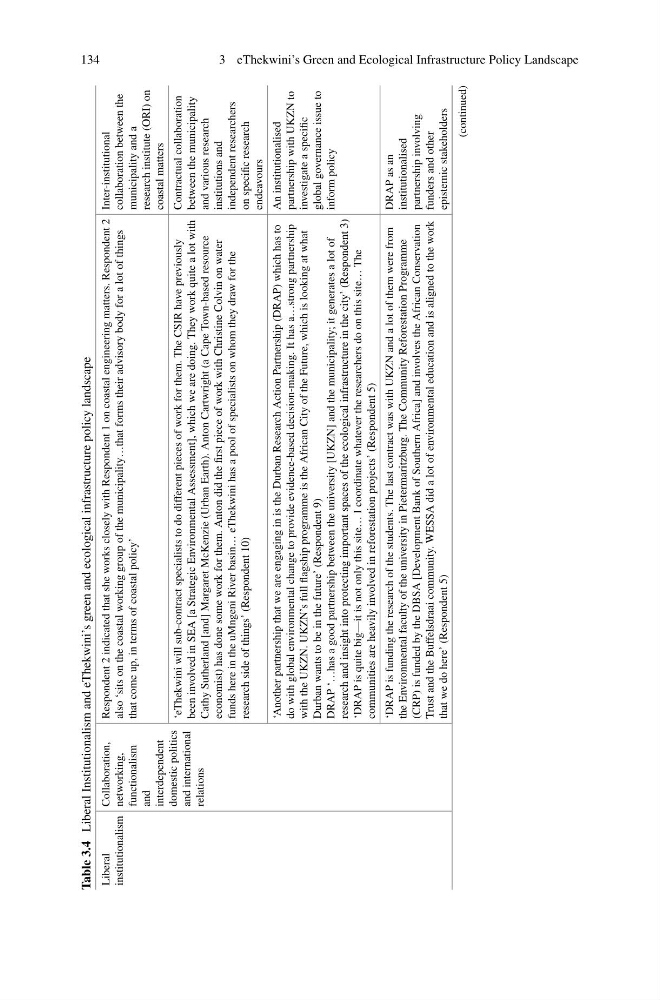
Table 3.4
Liberal Institutionalism and eThekwini’s green and ecological infrastructure policy landscape
Liberal
institutionalism
Collaboration,
networking,
functionalism
and
interdependent
domestic politics
and international
relations
Respondent 2 indicated that she works closely with Respondent 1 on coastal engineering matters. Respondent 2
also ‘sits on the coastal working group of the municipality…that forms their advisory body for a lot of things
that come up, in terms of coastal policy’
Inter-institutional
collaboration between the
municipality and a
research institute (ORI) on
coastal matters
‘eThekwini will sub-contract specialists to do different pieces of work for them. The CSIR have previously
been involved in SEA [a Strategic Environmental Assessment], which we are doing. They work quite a lot with
Cathy Sutherland [and] Margaret McKenzie (Urban Earth). Anton Cartwright (a Cape Town-based resource
economist) has done some work for them. Anton did the first piece of work with Christine Colvin on water
funds here in the uMngeni River basin… eThekwini has a pool of specialists on whom they draw for the
research side of things’ (Respondent 10)
Contractual collaboration
between the municipality
and various research
institutions and
independent researchers
on specific research
endeavours
‘Another partnership that we are engaging in is the Durban Research Action Partnership (DRAP) which has to
do with global environmental change to provide evidence-based decision-making. It has a…strong partnership
with the UKZN. UKZN’s full flagship programme is the African City of the Future, which is looking at what
Durban wants to be in the future’ (Respondent 9)
DRAP ‘…has a good partnership between the university [UKZN] and the municipality; it generates a lot of
research and insight into protecting important spaces of the ecological infrastructure in the city’ (Respondent 3)
‘DRAP is quite big—it is not only this site… I coordinate whatever the researchers do on this site… The
communities are heavily involved in reforestation projects’ (Respondent 5)
An institutionalised
partnership with UKZN to
investigate a specific
global governance issue to
inform policy
‘DRAP is funding the research of the students. The last contract was with UKZN and a lot of them were from
the Environmental faculty of the university in Pietermaritzburg. The Community Reforestation Programme
(CRP) is funded by the DBSA [Development Bank of Southern Africa] and involves the African Conservation
Trust and the Buffelsdraai community. WESSA did a lot of environmental education and is aligned to the work
that we do here’ (Respondent 5)
DRAP as an
institutionalised
partnership involving
funders and other
epistemic stakeholders
(continued)
3 eThekwini’s Green and Ecological Infrastructure Policy Landscape
Table 3.4
Liberal Institutionalism and eThekwini’s green and ecological infrastructure policy landscape
Liberal
institutionalism
Collaboration,
networking,
functionalism
and
interdependent
domestic politics
and international
relations
Respondent 2 indicated that she works closely with Respondent 1 on coastal engineering matters. Respondent 2
also ‘sits on the coastal working group of the municipality…that forms their advisory body for a lot of things
that come up, in terms of coastal policy’
Inter-institutional
collaboration between the
municipality and a
research institute (ORI) on
coastal matters
‘eThekwini will sub-contract specialists to do different pieces of work for them. The CSIR have previously
been involved in SEA [a Strategic Environmental Assessment], which we are doing. They work quite a lot with
Cathy Sutherland [and] Margaret McKenzie (Urban Earth). Anton Cartwright (a Cape Town-based resource
economist) has done some work for them. Anton did the first piece of work with Christine Colvin on water
funds here in the uMngeni River basin… eThekwini has a pool of specialists on whom they draw for the
research side of things’ (Respondent 10)
Contractual collaboration
between the municipality
and various research
institutions and
independent researchers
on specific research
endeavours
‘Another partnership that we are engaging in is the Durban Research Action Partnership (DRAP) which has to
do with global environmental change to provide evidence-based decision-making. It has a…strong partnership
with the UKZN. UKZN’s full flagship programme is the African City of the Future, which is looking at what
Durban wants to be in the future’ (Respondent 9)
DRAP ‘…has a good partnership between the university [UKZN] and the municipality; it generates a lot of
research and insight into protecting important spaces of the ecological infrastructure in the city’ (Respondent 3)
‘DRAP is quite big—it is not only this site… I coordinate whatever the researchers do on this site… The
communities are heavily involved in reforestation projects’ (Respondent 5)
An institutionalised
partnership with UKZN to
investigate a specific
global governance issue to
inform policy
‘DRAP is funding the research of the students. The last contract was with UKZN and a lot of them were from
the Environmental faculty of the university in Pietermaritzburg. The Community Reforestation Programme
(CRP) is funded by the DBSA [Development Bank of Southern Africa] and involves the African Conservation
Trust and the Buffelsdraai community. WESSA did a lot of environmental education and is aligned to the work
that we do here’ (Respondent 5)
DRAP as an
institutionalised
partnership involving
funders and other
epistemic stakeholders
(continued)