

3.4 Analysis
127
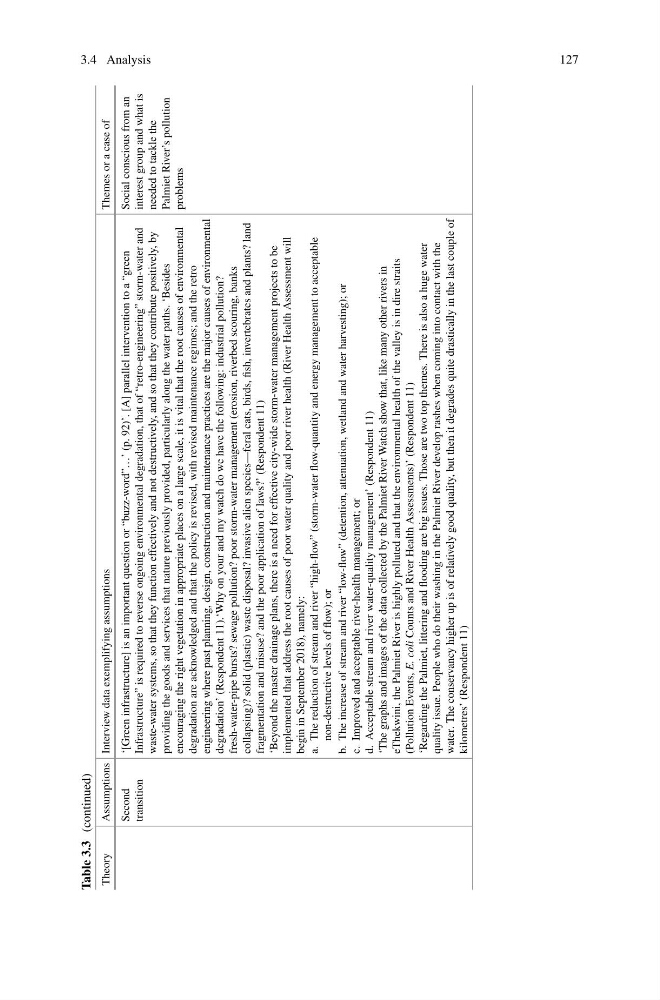
Table 3.3
(continued)
Theory
Assumptions Interview data exemplifying assumptions
Themes or a case of
Second
transition
‘[Green infrastructure] is an important question or “buzz-word”…’ (p. 92)’. [A] parallel intervention to a “green
Infrastructure” is required to reverse ongoing environmental degradation, that of “retro-engineering” storm-water and
waste-water systems, so that they function effectively and not destructively, and so that they contribute positively, by
providing the goods and services that nature previously provided, particularly along the water paths. ‘Besides
encouraging the right vegetation in appropriate places on a large scale, it is vital that the root causes of environmental
degradation are acknowledged and that the policy is revised, with revised maintenance regimes; and the retro
engineering where past planning, design, construction and maintenance practices are the major causes of environmental
degradation’ (Respondent 11).‘Why on your and my watch do we have the following: industrial pollution?
fresh-water-pipe bursts? sewage pollution? poor storm-water management (erosion, riverbed scouring, banks
collapsing)? solid (plastic) waste disposal? invasive alien species—feral cats, birds, fish, invertebrates and plants? land
fragmentation and misuse? and the poor application of laws?’ (Respondent 11)
‘Beyond the master drainage plans, there is a need for effective city-wide storm-water management projects to be
implemented that address the root causes of poor water quality and poor river health (River Health Assessment will
begin in September 2018), namely:
a. The reduction of stream and river “high-flow” (storm-water flow-quantity and energy management to acceptable
non-destructive levels of flow); or
b. The increase of stream and river “low-flow” (detention, attenuation, wetland and water harvesting); or
c. Improved and acceptable river-health management; or
d. Acceptable stream and river water-quality management’ (Respondent 11)
‘The graphs and images of the data collected by the Palmiet River Watch show that, like many other rivers in
eThekwini, the Palmiet River is highly polluted and that the environmental health of the valley is in dire straits
(Pollution Events, E. coli
Counts and River Health Assessments)’ (Respondent 11)
‘Regarding the Palmiet, littering and flooding are big issues. Those are two top themes. There is also a huge water
quality issue. People who do their washing in the Palmiet River develop rashes when coming into contact with the
water. The conservancy higher up is of relatively good quality, but then it degrades quite drastically in the last couple of
kilometres’ (Respondent 11)
Social conscious from an
interest group and what is
needed to tackle the
Palmiet River’s pollution
problems
127
Table 3.3
(continued)
Theory
Assumptions Interview data exemplifying assumptions
Themes or a case of
Second
transition
‘[Green infrastructure] is an important question or “buzz-word”…’ (p. 92)’. [A] parallel intervention to a “green
Infrastructure” is required to reverse ongoing environmental degradation, that of “retro-engineering” storm-water and
waste-water systems, so that they function effectively and not destructively, and so that they contribute positively, by
providing the goods and services that nature previously provided, particularly along the water paths. ‘Besides
encouraging the right vegetation in appropriate places on a large scale, it is vital that the root causes of environmental
degradation are acknowledged and that the policy is revised, with revised maintenance regimes; and the retro
engineering where past planning, design, construction and maintenance practices are the major causes of environmental
degradation’ (Respondent 11).‘Why on your and my watch do we have the following: industrial pollution?
fresh-water-pipe bursts? sewage pollution? poor storm-water management (erosion, riverbed scouring, banks
collapsing)? solid (plastic) waste disposal? invasive alien species—feral cats, birds, fish, invertebrates and plants? land
fragmentation and misuse? and the poor application of laws?’ (Respondent 11)
‘Beyond the master drainage plans, there is a need for effective city-wide storm-water management projects to be
implemented that address the root causes of poor water quality and poor river health (River Health Assessment will
begin in September 2018), namely:
a. The reduction of stream and river “high-flow” (storm-water flow-quantity and energy management to acceptable
non-destructive levels of flow); or
b. The increase of stream and river “low-flow” (detention, attenuation, wetland and water harvesting); or
c. Improved and acceptable river-health management; or
d. Acceptable stream and river water-quality management’ (Respondent 11)
‘The graphs and images of the data collected by the Palmiet River Watch show that, like many other rivers in
eThekwini, the Palmiet River is highly polluted and that the environmental health of the valley is in dire straits
(Pollution Events, E. coli
Counts and River Health Assessments)’ (Respondent 11)
‘Regarding the Palmiet, littering and flooding are big issues. Those are two top themes. There is also a huge water
quality issue. People who do their washing in the Palmiet River develop rashes when coming into contact with the
water. The conservancy higher up is of relatively good quality, but then it degrades quite drastically in the last couple of
kilometres’ (Respondent 11)
Social conscious from an
interest group and what is
needed to tackle the
Palmiet River’s pollution
problems