

3.4 Analysis
125
Table 3.3
(continued)
Theory
Assumptions Interview data exemplifying assumptions
Themes or a case of
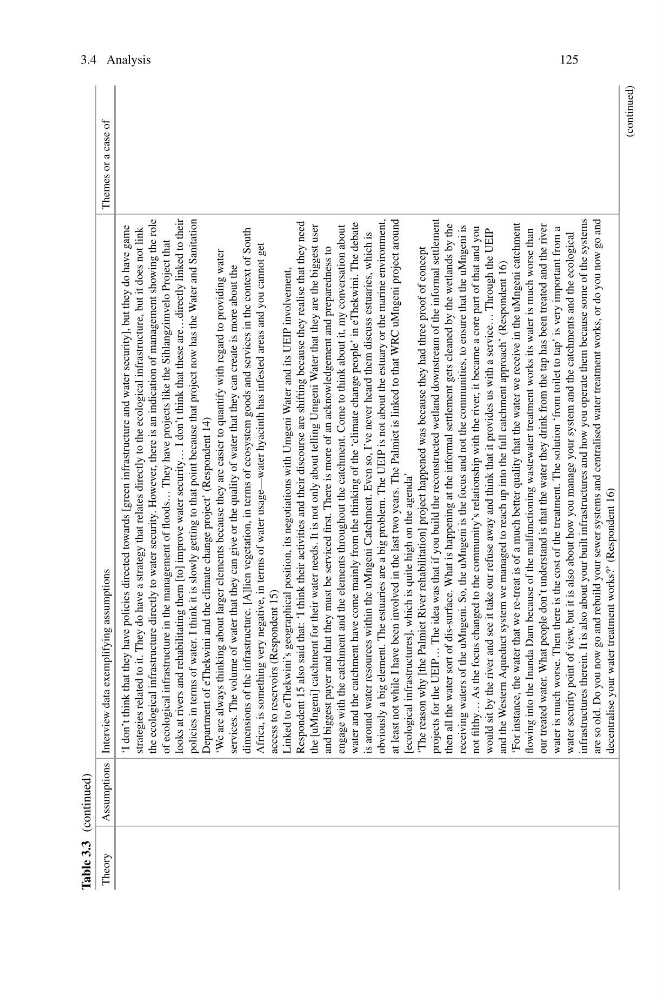
‘I don’t think that they have policies directed towards [green infrastructure and water security], but they do have game
strategies related to it. They do have a strategy that relates directly to the ecological infrastructure, but it does not link
the ecological infrastructure directly to water security. However, there is an indication of management showing the role
of ecological infrastructure in the management of floods… They have projects like the Sihlangzimvelo Project that
looks at rivers and rehabilitating them [to] improve water security… I don’t think that these are…directly linked to their
policies in terms of water. I think it is slowly getting to that point because that project now has the Water and Sanitation
Department of eThekwini and the climate change project’ (Respondent 14)
‘We are always thinking about larger elements because they are easier to quantify with regard to providing water
services. The volume of water that they can give or the quality of water that they can create is more about the
dimensions of the infrastructure. [A]lien vegetation, in terms of ecosystem goods and services in the context of South
Africa, is something very negative, in terms of water usage—water hyacinth has infested areas and you cannot get
access to reservoirs (Respondent 15)
Linked to eThekwini’s geographical position, its negotiations with Umgeni Water and its UEIP involvement,
Respondent 15 also said that: ‘I think their activities and their discourse are shifting because they realise that they need
the [uMngeni] catchment for their water needs. It is not only about telling Umgeni Water that they are the biggest user
and biggest payer and that they must be serviced first. There is more of an acknowledgement and preparedness to
engage with the catchment and the elements throughout the catchment. Come to think about it, my conversation about
water and the catchment have come mainly from the thinking of the ‘climate change people’ in eThekwini. The debate
is around water resources within the uMngeni Catchment. Even so, I’ve never heard them discuss estuaries, which is
obviously a big element. The estuaries are a big problem. The UEIP is not about the estuary or the marine environment,
at least not while I have been involved in the last two years. The Palmiet is linked to that WRC uMngeni project around
[ecological infrastructures], which is quite high on the agenda’
‘The reason why [the Palmiet River rehabilitation] project happened was because they had three proof of concept
projects for the UEIP… The idea was that if you build the reconstructed wetland downstream of the informal settlement
then all the water sort of dis-surface. What is happening at the informal settlement gets cleaned by the wetlands by the
receiving waters of the uMngeni. So, the uMngeni is the focus and not the communities, to ensure that the uMngeni is
not filthy… As the focus changed to the community’s relationship with the river, it became a core part of that and you
would sit by the river and see it take our refuse away and think that it provides us with a service… Through the UEIP
and the Western Aqueduct system we managed to reach up into the full catchment approach’ (Respondent 16)
‘For instance, the water that we re-treat is of a much better quality that the water we receive in the uMngeni catchment
flowing into the Inanda Dam because of the malfunctioning wastewater treatment works its water is much worse than
our treated water. What people don’t understand is that the water they drink from the tap has been treated and the river
water is much worse. Then there is the cost of the treatment. The solution ‘from toilet to tap’ is very important from a
water security point of view, but it is also about how you manage your system and the catchments and the ecological
infrastructures therein. It is also about your built infrastructures and how you operate them because some of the systems
are so old. Do you now go and rebuild your sewer systems and centralised water treatment works, or do you now go and
decentralise your water treatment works?’ (Respondent 16)
(continued)
125
Table 3.3
(continued)
Theory
Assumptions Interview data exemplifying assumptions
Themes or a case of
‘I don’t think that they have policies directed towards [green infrastructure and water security], but they do have game
strategies related to it. They do have a strategy that relates directly to the ecological infrastructure, but it does not link
the ecological infrastructure directly to water security. However, there is an indication of management showing the role
of ecological infrastructure in the management of floods… They have projects like the Sihlangzimvelo Project that
looks at rivers and rehabilitating them [to] improve water security… I don’t think that these are…directly linked to their
policies in terms of water. I think it is slowly getting to that point because that project now has the Water and Sanitation
Department of eThekwini and the climate change project’ (Respondent 14)
‘We are always thinking about larger elements because they are easier to quantify with regard to providing water
services. The volume of water that they can give or the quality of water that they can create is more about the
dimensions of the infrastructure. [A]lien vegetation, in terms of ecosystem goods and services in the context of South
Africa, is something very negative, in terms of water usage—water hyacinth has infested areas and you cannot get
access to reservoirs (Respondent 15)
Linked to eThekwini’s geographical position, its negotiations with Umgeni Water and its UEIP involvement,
Respondent 15 also said that: ‘I think their activities and their discourse are shifting because they realise that they need
the [uMngeni] catchment for their water needs. It is not only about telling Umgeni Water that they are the biggest user
and biggest payer and that they must be serviced first. There is more of an acknowledgement and preparedness to
engage with the catchment and the elements throughout the catchment. Come to think about it, my conversation about
water and the catchment have come mainly from the thinking of the ‘climate change people’ in eThekwini. The debate
is around water resources within the uMngeni Catchment. Even so, I’ve never heard them discuss estuaries, which is
obviously a big element. The estuaries are a big problem. The UEIP is not about the estuary or the marine environment,
at least not while I have been involved in the last two years. The Palmiet is linked to that WRC uMngeni project around
[ecological infrastructures], which is quite high on the agenda’
‘The reason why [the Palmiet River rehabilitation] project happened was because they had three proof of concept
projects for the UEIP… The idea was that if you build the reconstructed wetland downstream of the informal settlement
then all the water sort of dis-surface. What is happening at the informal settlement gets cleaned by the wetlands by the
receiving waters of the uMngeni. So, the uMngeni is the focus and not the communities, to ensure that the uMngeni is
not filthy… As the focus changed to the community’s relationship with the river, it became a core part of that and you
would sit by the river and see it take our refuse away and think that it provides us with a service… Through the UEIP
and the Western Aqueduct system we managed to reach up into the full catchment approach’ (Respondent 16)
‘For instance, the water that we re-treat is of a much better quality that the water we receive in the uMngeni catchment
flowing into the Inanda Dam because of the malfunctioning wastewater treatment works its water is much worse than
our treated water. What people don’t understand is that the water they drink from the tap has been treated and the river
water is much worse. Then there is the cost of the treatment. The solution ‘from toilet to tap’ is very important from a
water security point of view, but it is also about how you manage your system and the catchments and the ecological
infrastructures therein. It is also about your built infrastructures and how you operate them because some of the systems
are so old. Do you now go and rebuild your sewer systems and centralised water treatment works, or do you now go and
decentralise your water treatment works?’ (Respondent 16)
(continued)