

3.4 Analysis
123
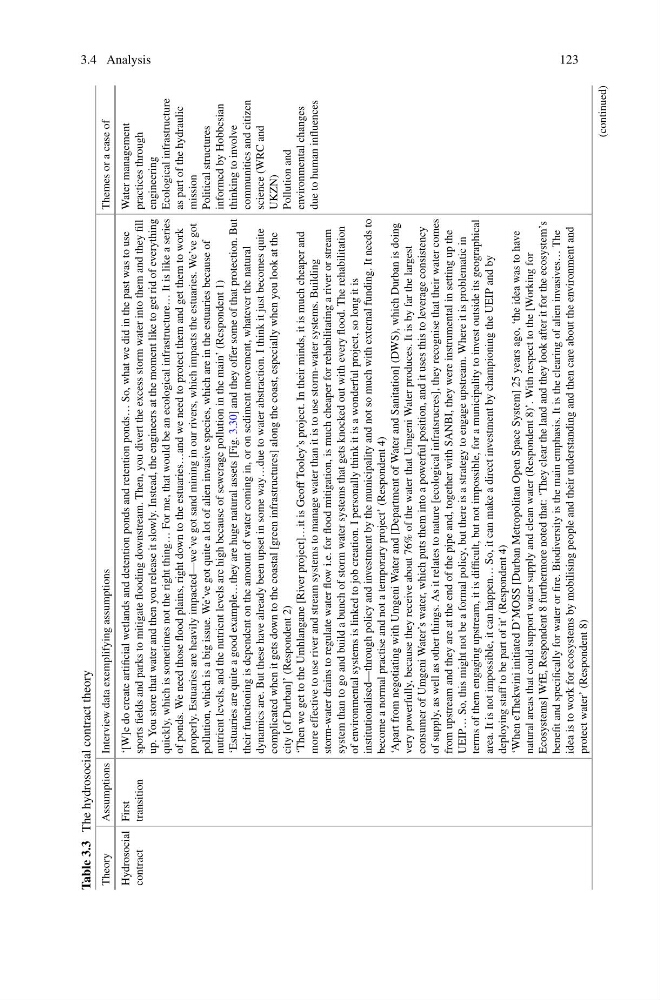
Table 3.3
The hydrosocial contract theory
Theory
Assumptions Interview data exemplifying assumptions
Themes or a case of
Hydrosocial
contract
First
transition
‘[W]e do create artificial wetlands and detention ponds and retention ponds… So, what we did in the past was to use
sports fields and parks to mitigate flooding downstream. Then, you divert the excess storm water into them and they fill
up. You store that water and then you release it slowly. Instead, the engineers at the moment like to get rid of everything
quickly, which is sometimes not the right thing… For me, that would be an ecological infrastructure… It is like a series
of ponds. We need those flood plains, right down to the estuaries…and we need to protect them and get them to work
properly. Estuaries are heavily impacted—we’ve got sand mining in our rivers, which impacts the estuaries. We’ve got
pollution, which is a big issue. We’ve got quite a lot of alien invasive species, which are in the estuaries because of
nutrient levels, and the nutrient levels are high because of sewerage pollution in the main’ (Respondent 1)
‘Estuaries are quite a good example…they are huge natural assets [Fig. 3.30] and they offer some of that protection. But
their functioning is dependent on the amount of water coming in, or on sediment movement, whatever the natural
dynamics are. But these have already been upset in some way…due to water abstraction. I think it just becomes quite
complicated when it gets down to the coastal [green infrastructures] along the coast, especially when you look at the
city [of Durban]’ (Respondent 2)
‘Then we get to the Umhlangane [River project]…it is Geoff Tooley’s project. In their minds, it is much cheaper and
more effective to use river and stream systems to manage water than it is to use storm-water systems. Building
storm-water drains to regulate water flow i.e. for flood mitigation, is much cheaper for rehabilitating a river or stream
system than to go and build a bunch of storm water systems that gets knocked out with every flood. The rehabilitation
of environmental systems is linked to job creation. I personally think it is a wonderful project, so long it is
institutionalised—through policy and investment by the municipality and not so much with external funding. It needs to
become a normal practise and not a temporary project’ (Respondent 4)
‘Apart from negotiating with Umgeni Water and [Department of Water and Sanitation] (DWS), which Durban is doing
very powerfully, because they receive about 76% of the water that Umgeni Water produces. It is by far the largest
consumer of Umgeni Water’s water, which puts them into a powerful position, and it uses this to leverage consistency
of supply, as well as other things. As it relates to nature [ecological infratsrucres], they recognise that their water comes
from upstream and they are at the end of the pipe and, together with SANBI, they were instrumental in setting up the
UEIP… So, this might not be a formal policy, but there is a strategy to engage upstream. Where it is problematic in
terms of them engaging upstream, it is difficult, but not impossible, for a municipality to invest outside its geographical
area. It is not impossible, it can happen… So, it can make a direct investment by championing the UEIP and by
deploying staff to be part of it’ (Respondent 4)
‘When eThekwini initiated D’MOSS [Durban Metropolitan Open Space System] 25 years ago, ‘the idea was to have
natural areas that could support water supply and clean water (Respondent 8)’. With respect to the [Working for
Ecosystems] WfE, Respondent 8 furthermore noted that: ‘They clear the land and they look after it for the ecosystem’s
benefit and specifically for water or fire. Biodiversity is the main emphasis. It is the clearing of alien invasives… The
idea is to work for ecosystems by mobilising people and their understanding and then care about the environment and
protect water’ (Respondent 8)
Water management
practices through
engineering
Ecological infrastructure
as part of the hydraulic
mission
Political structures
informed by Hobbesian
thinking to involve
communities and citizen
science (WRC and
UKZN)
Pollution and
environmental changes
due to human influences
(continued)
123
Table 3.3
The hydrosocial contract theory
Theory
Assumptions Interview data exemplifying assumptions
Themes or a case of
Hydrosocial
contract
First
transition
‘[W]e do create artificial wetlands and detention ponds and retention ponds… So, what we did in the past was to use
sports fields and parks to mitigate flooding downstream. Then, you divert the excess storm water into them and they fill
up. You store that water and then you release it slowly. Instead, the engineers at the moment like to get rid of everything
quickly, which is sometimes not the right thing… For me, that would be an ecological infrastructure… It is like a series
of ponds. We need those flood plains, right down to the estuaries…and we need to protect them and get them to work
properly. Estuaries are heavily impacted—we’ve got sand mining in our rivers, which impacts the estuaries. We’ve got
pollution, which is a big issue. We’ve got quite a lot of alien invasive species, which are in the estuaries because of
nutrient levels, and the nutrient levels are high because of sewerage pollution in the main’ (Respondent 1)
‘Estuaries are quite a good example…they are huge natural assets [Fig. 3.30] and they offer some of that protection. But
their functioning is dependent on the amount of water coming in, or on sediment movement, whatever the natural
dynamics are. But these have already been upset in some way…due to water abstraction. I think it just becomes quite
complicated when it gets down to the coastal [green infrastructures] along the coast, especially when you look at the
city [of Durban]’ (Respondent 2)
‘Then we get to the Umhlangane [River project]…it is Geoff Tooley’s project. In their minds, it is much cheaper and
more effective to use river and stream systems to manage water than it is to use storm-water systems. Building
storm-water drains to regulate water flow i.e. for flood mitigation, is much cheaper for rehabilitating a river or stream
system than to go and build a bunch of storm water systems that gets knocked out with every flood. The rehabilitation
of environmental systems is linked to job creation. I personally think it is a wonderful project, so long it is
institutionalised—through policy and investment by the municipality and not so much with external funding. It needs to
become a normal practise and not a temporary project’ (Respondent 4)
‘Apart from negotiating with Umgeni Water and [Department of Water and Sanitation] (DWS), which Durban is doing
very powerfully, because they receive about 76% of the water that Umgeni Water produces. It is by far the largest
consumer of Umgeni Water’s water, which puts them into a powerful position, and it uses this to leverage consistency
of supply, as well as other things. As it relates to nature [ecological infratsrucres], they recognise that their water comes
from upstream and they are at the end of the pipe and, together with SANBI, they were instrumental in setting up the
UEIP… So, this might not be a formal policy, but there is a strategy to engage upstream. Where it is problematic in
terms of them engaging upstream, it is difficult, but not impossible, for a municipality to invest outside its geographical
area. It is not impossible, it can happen… So, it can make a direct investment by championing the UEIP and by
deploying staff to be part of it’ (Respondent 4)
‘When eThekwini initiated D’MOSS [Durban Metropolitan Open Space System] 25 years ago, ‘the idea was to have
natural areas that could support water supply and clean water (Respondent 8)’. With respect to the [Working for
Ecosystems] WfE, Respondent 8 furthermore noted that: ‘They clear the land and they look after it for the ecosystem’s
benefit and specifically for water or fire. Biodiversity is the main emphasis. It is the clearing of alien invasives… The
idea is to work for ecosystems by mobilising people and their understanding and then care about the environment and
protect water’ (Respondent 8)
Water management
practices through
engineering
Ecological infrastructure
as part of the hydraulic
mission
Political structures
informed by Hobbesian
thinking to involve
communities and citizen
science (WRC and
UKZN)
Pollution and
environmental changes
due to human influences
(continued)