

106
3 eThekwini’s Green and Ecological Infrastructure Policy Landscape
in their bylaws, and we are hoping to learn from them. One of the challenges that they have
is maintaining their standards, but is anybody going back to see if those standards are being
met by the SuDS? This is part of what we and the [WRC], are trying to monitor. So, there are
some assumed numbers; for example, if you have a wetland then you will be getting certain
benefits, and if you have a roof garden, then you will benefit in another way. But no-one
has sat down to qualify the benefits. Therefore, we are learning from the WRC and they are
learning from us.
Considering the qualification of the benefits, eThekwini is in the process of
attaining a fuller understanding by learning from Cape Town and the WRC about
storm-water quality and how these will influence future bylaws. This means that
eThekwini is aspiring to gain a fuller understanding through the WRC’s empirical
research and best practices in Cape Town. The notion of an ecological infrastructure also plays a role here, and specifically how wetlands will play a future role in
the SuDS. We see that eThekwini has an ‘incomplete understanding’ of the role of
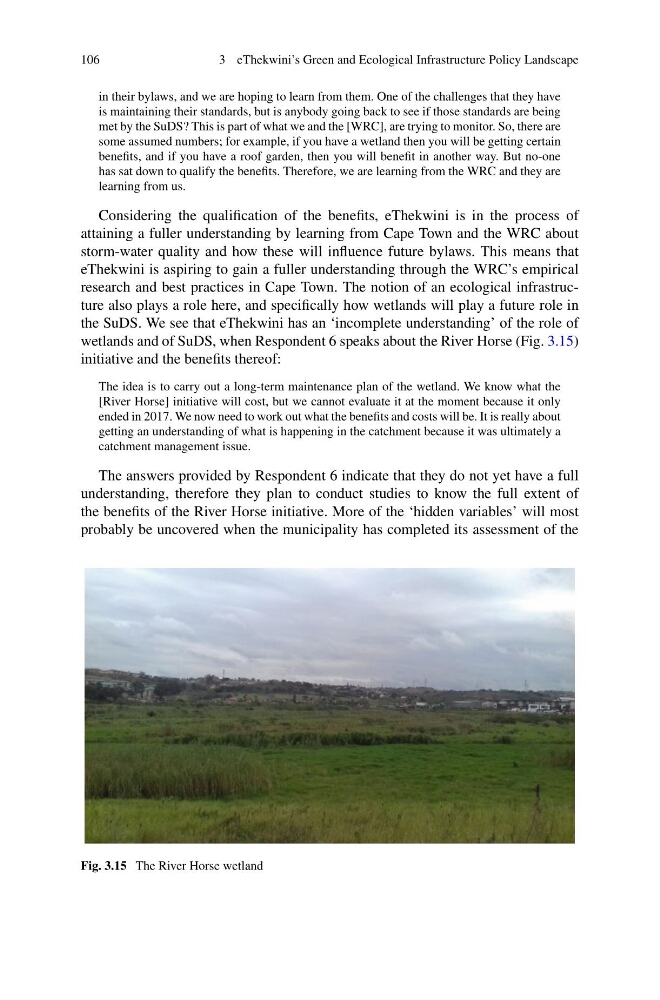
wetlands and of SuDS, when Respondent 6 speaks about the River Horse (Fig. 3.15)
initiative and the benefits thereof:
The idea is to carry out a long-term maintenance plan of the wetland. We know what the
[River Horse] initiative will cost, but we cannot evaluate it at the moment because it only
ended in 2017. We now need to work out what the benefits and costs will be. It is really about
getting an understanding of what is happening in the catchment because it was ultimately a
catchment management issue.
The answers provided by Respondent 6 indicate that they do not yet have a full
understanding, therefore they plan to conduct studies to know the full extent of
the benefits of the River Horse initiative. More of the ‘hidden variables’ will most
probably be uncovered when the municipality has completed its assessment of the
Fig. 3.15 The River Horse wetland
3 eThekwini’s Green and Ecological Infrastructure Policy Landscape
in their bylaws, and we are hoping to learn from them. One of the challenges that they have
is maintaining their standards, but is anybody going back to see if those standards are being
met by the SuDS? This is part of what we and the [WRC], are trying to monitor. So, there are
some assumed numbers; for example, if you have a wetland then you will be getting certain
benefits, and if you have a roof garden, then you will benefit in another way. But no-one
has sat down to qualify the benefits. Therefore, we are learning from the WRC and they are
learning from us.
Considering the qualification of the benefits, eThekwini is in the process of
attaining a fuller understanding by learning from Cape Town and the WRC about
storm-water quality and how these will influence future bylaws. This means that
eThekwini is aspiring to gain a fuller understanding through the WRC’s empirical
research and best practices in Cape Town. The notion of an ecological infrastructure also plays a role here, and specifically how wetlands will play a future role in
the SuDS. We see that eThekwini has an ‘incomplete understanding’ of the role of
wetlands and of SuDS, when Respondent 6 speaks about the River Horse (Fig. 3.15)
initiative and the benefits thereof:
The idea is to carry out a long-term maintenance plan of the wetland. We know what the
[River Horse] initiative will cost, but we cannot evaluate it at the moment because it only
ended in 2017. We now need to work out what the benefits and costs will be. It is really about
getting an understanding of what is happening in the catchment because it was ultimately a
catchment management issue.
The answers provided by Respondent 6 indicate that they do not yet have a full
understanding, therefore they plan to conduct studies to know the full extent of
the benefits of the River Horse initiative. More of the ‘hidden variables’ will most
probably be uncovered when the municipality has completed its assessment of the
Fig. 3.15 The River Horse wetland