

utilizing its chemical, physical, and biological properties. Chemical modifications of
chitosan and its subsequent nanotechnological application are hardly seen. Similarly, the variations in the properties of chitosan obtained from various sources are
not yet well documented. This chapter will describe the various sources of chitosan
and its multifaceted characteristics and the synthesis, characterization, and biomedical applications of chitosan-based nanocomposites in the form of nanoparticles,
nanogels, and nanospheres.
2 Sources of Chitin and Chitosan
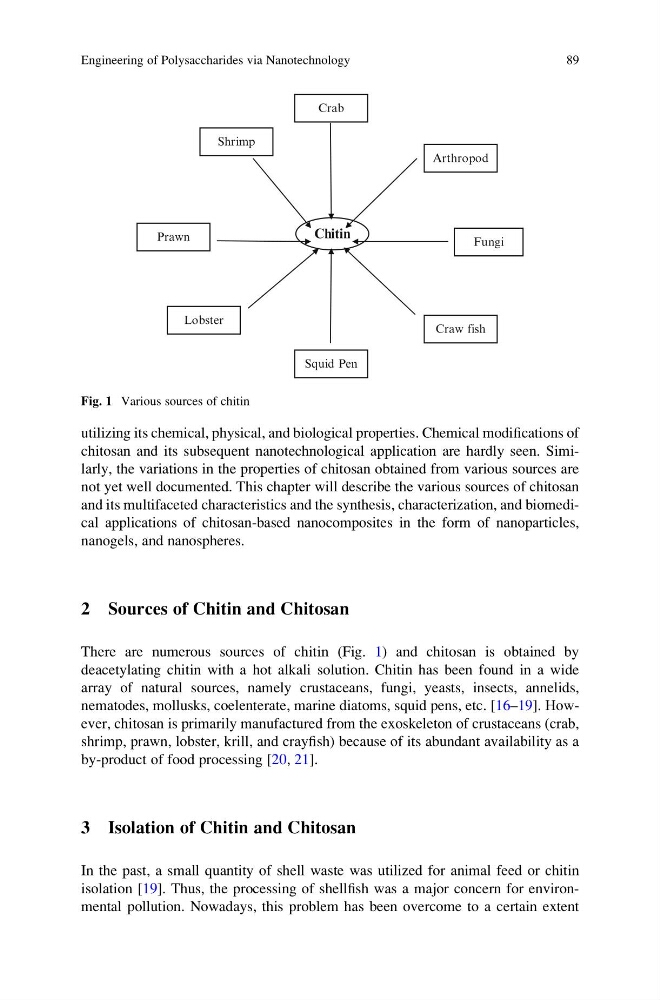
There are numerous sources of chitin (Fig. 1) and chitosan is obtained by
deacetylating chitin with a hot alkali solution. Chitin has been found in a wide
array of natural sources, namely crustaceans, fungi, yeasts, insects, annelids,
nematodes, mollusks, coelenterate, marine diatoms, squid pens, etc. [16–19]. However, chitosan is primarily manufactured from the exoskeleton of crustaceans (crab,
shrimp, prawn, lobster, krill, and crayfish) because of its abundant availability as a
by-product of food processing [20, 21].
3 Isolation of Chitin and Chitosan
In the past, a small quantity of shell waste was utilized for animal feed or chitin
isolation [19]. Thus, the processing of shellfish was a major concern for environmental pollution. Nowadays, this problem has been overcome to a certain extent
Chitin
Arthropod
Fungi
Crab
Shrimp
Prawn
Lobster
Squid Pen
Craw fish
Fig. 1 Various sources of chitin
Engineering of Polysaccharides via Nanotechnology
89
chitosan and its subsequent nanotechnological application are hardly seen. Similarly, the variations in the properties of chitosan obtained from various sources are
not yet well documented. This chapter will describe the various sources of chitosan
and its multifaceted characteristics and the synthesis, characterization, and biomedical applications of chitosan-based nanocomposites in the form of nanoparticles,
nanogels, and nanospheres.
2 Sources of Chitin and Chitosan
There are numerous sources of chitin (Fig. 1) and chitosan is obtained by
deacetylating chitin with a hot alkali solution. Chitin has been found in a wide
array of natural sources, namely crustaceans, fungi, yeasts, insects, annelids,
nematodes, mollusks, coelenterate, marine diatoms, squid pens, etc. [16–19]. However, chitosan is primarily manufactured from the exoskeleton of crustaceans (crab,
shrimp, prawn, lobster, krill, and crayfish) because of its abundant availability as a
by-product of food processing [20, 21].
3 Isolation of Chitin and Chitosan
In the past, a small quantity of shell waste was utilized for animal feed or chitin
isolation [19]. Thus, the processing of shellfish was a major concern for environmental pollution. Nowadays, this problem has been overcome to a certain extent
Chitin
Arthropod
Fungi
Crab
Shrimp
Prawn
Lobster
Squid Pen
Craw fish
Fig. 1 Various sources of chitin
Engineering of Polysaccharides via Nanotechnology
89