

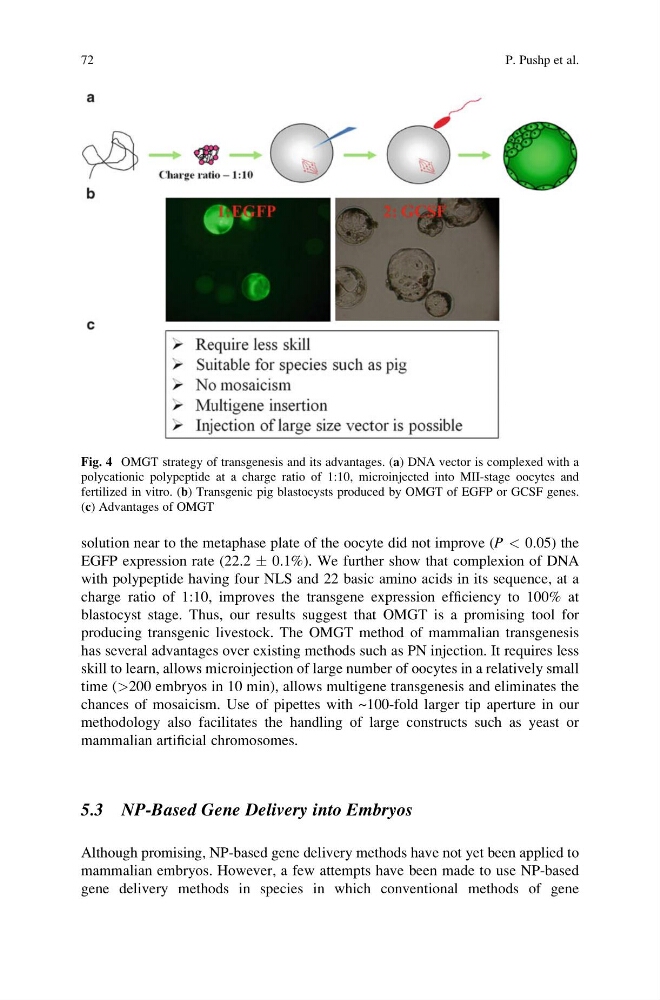
solution near to the metaphase plate of the oocyte did not improve (P < 0.05) the
EGFP expression rate (22.2 Æ 0.1%). We further show that complexion of DNA
with polypeptide having four NLS and 22 basic amino acids in its sequence, at a
charge ratio of 1:10, improves the transgene expression efficiency to 100% at
blastocyst stage. Thus, our results suggest that OMGT is a promising tool for
producing transgenic livestock. The OMGT method of mammalian transgenesis
has several advantages over existing methods such as PN injection. It requires less
skill to learn, allows microinjection of large number of oocytes in a relatively small
time (>200 embryos in 10 min), allows multigene transgenesis and eliminates the
chances of mosaicism. Use of pipettes with ~100-fold larger tip aperture in our
methodology also facilitates the handling of large constructs such as yeast or
mammalian artificial chromosomes.
5.3 NP-Based Gene Delivery into Embryos
Although promising, NP-based gene delivery methods have not yet been applied to
mammalian embryos. However, a few attempts have been made to use NP-based
gene delivery methods in species in which conventional methods of gene
Fig. 4 OMGT strategy of transgenesis and its advantages. (a) DNA vector is complexed with a
polycationic polypeptide at a charge ratio of 1:10, microinjected into MII-stage oocytes and
fertilized in vitro. (b) Transgenic pig blastocysts produced by OMGT of EGFP or GCSF genes.
(c) Advantages of OMGT
72
P. Pushp et al.
EGFP expression rate (22.2 Æ 0.1%). We further show that complexion of DNA
with polypeptide having four NLS and 22 basic amino acids in its sequence, at a
charge ratio of 1:10, improves the transgene expression efficiency to 100% at
blastocyst stage. Thus, our results suggest that OMGT is a promising tool for
producing transgenic livestock. The OMGT method of mammalian transgenesis
has several advantages over existing methods such as PN injection. It requires less
skill to learn, allows microinjection of large number of oocytes in a relatively small
time (>200 embryos in 10 min), allows multigene transgenesis and eliminates the
chances of mosaicism. Use of pipettes with ~100-fold larger tip aperture in our
methodology also facilitates the handling of large constructs such as yeast or
mammalian artificial chromosomes.
5.3 NP-Based Gene Delivery into Embryos
Although promising, NP-based gene delivery methods have not yet been applied to
mammalian embryos. However, a few attempts have been made to use NP-based
gene delivery methods in species in which conventional methods of gene
Fig. 4 OMGT strategy of transgenesis and its advantages. (a) DNA vector is complexed with a
polycationic polypeptide at a charge ratio of 1:10, microinjected into MII-stage oocytes and
fertilized in vitro. (b) Transgenic pig blastocysts produced by OMGT of EGFP or GCSF genes.
(c) Advantages of OMGT
72
P. Pushp et al.