

chemical methods in order to use them as gene delivery vehicles. NP-based
gene delivery methods can also be designed to have additional functionality such
as cell-specific gene targeting, multigene delivery, controlled gene delivery,
enhanced cellular uptake of genes and environment-sensitive degradability. Several
types of NPs, including magnetic NPs, carbon nanotubes and several well-known
synthetic cationic polymers and copolymers such as polyethyleneimine (PEI), poly
(L-lysine) (PLL), polyamidoamine dendrimer, dextran, derivatized chitosan, poly
[(2-methylamino) ethyl methacrylate], polylactide (PLA), polylactide-co-glycolide
(PLGA), etc., have been explored for their commercial utilization for effective
gene delivery in vitro as well as in vivo.
2 Non-viral Options for In Vitro Gene Delivery into Cells
2.1 Naked DNA
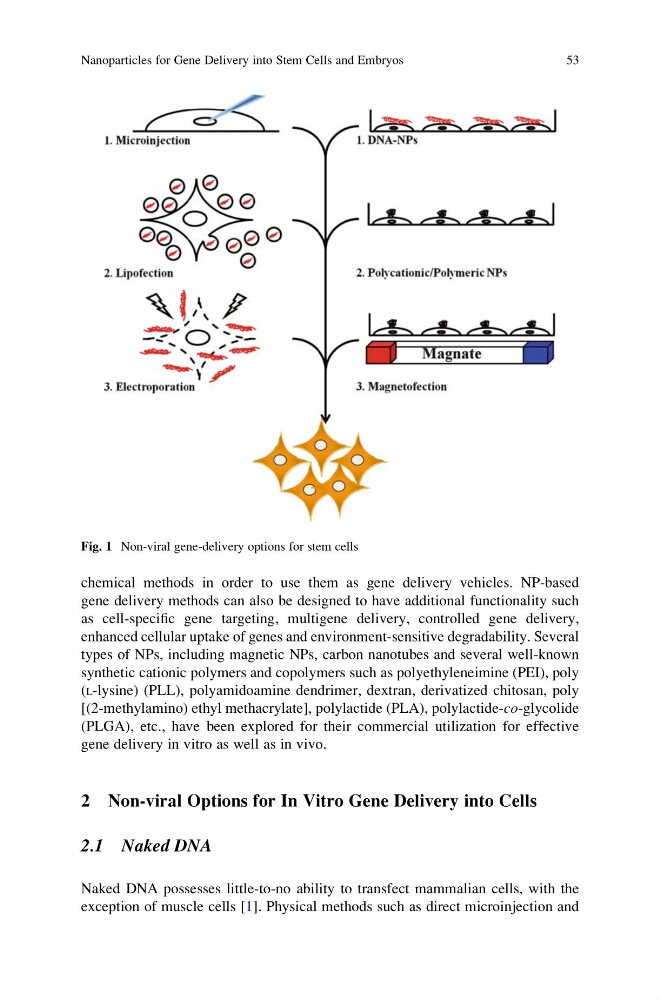
Naked DNA possesses little-to-no ability to transfect mammalian cells, with the
exception of muscle cells [1]. Physical methods such as direct microinjection and
Fig. 1 Non-viral gene-delivery options for stem cells
Nanoparticles for Gene Delivery into Stem Cells and Embryos
53
gene delivery methods can also be designed to have additional functionality such
as cell-specific gene targeting, multigene delivery, controlled gene delivery,
enhanced cellular uptake of genes and environment-sensitive degradability. Several
types of NPs, including magnetic NPs, carbon nanotubes and several well-known
synthetic cationic polymers and copolymers such as polyethyleneimine (PEI), poly
(L-lysine) (PLL), polyamidoamine dendrimer, dextran, derivatized chitosan, poly
[(2-methylamino) ethyl methacrylate], polylactide (PLA), polylactide-co-glycolide
(PLGA), etc., have been explored for their commercial utilization for effective
gene delivery in vitro as well as in vivo.
2 Non-viral Options for In Vitro Gene Delivery into Cells
2.1 Naked DNA
Naked DNA possesses little-to-no ability to transfect mammalian cells, with the
exception of muscle cells [1]. Physical methods such as direct microinjection and
Fig. 1 Non-viral gene-delivery options for stem cells
Nanoparticles for Gene Delivery into Stem Cells and Embryos
53