

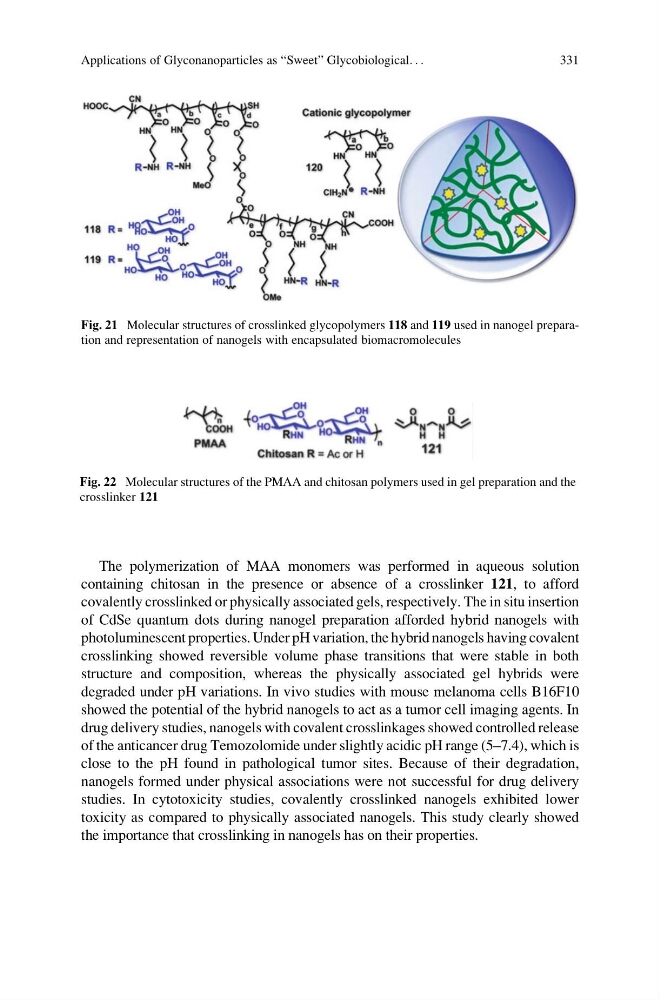
The polymerization of MAA monomers was performed in aqueous solution
containing chitosan in the presence or absence of a crosslinker 121, to afford
covalently crosslinked or physically associated gels, respectively. The in situ insertion
of CdSe quantum dots during nanogel preparation afforded hybrid nanogels with
photoluminescent properties. Under pH variation, the hybrid nanogels having covalent
crosslinking showed reversible volume phase transitions that were stable in both
structure and composition, whereas the physically associated gel hybrids were
degraded under pH variations. In vivo studies with mouse melanoma cells B16F10
showed the potential of the hybrid nanogels to act as a tumor cell imaging agents. In
drug delivery studies, nanogels with covalent crosslinkages showed controlled release
of the anticancer drug Temozolomide under slightly acidic pH range (5–7.4), which is
close to the pH found in pathological tumor sites. Because of their degradation,
nanogels formed under physical associations were not successful for drug delivery
studies. In cytotoxicity studies, covalently crosslinked nanogels exhibited lower
toxicity as compared to physically associated nanogels. This study clearly showed
the importance that crosslinking in nanogels has on their properties.
Fig. 21 Molecular structures of crosslinked glycopolymers 118 and 119 used in nanogel preparation and representation of nanogels with encapsulated biomacromolecules
Fig. 22 Molecular structures of the PMAA and chitosan polymers used in gel preparation and the
crosslinker 121
Applications of Glyconanoparticles as “Sweet” Glycobiological. . .
331
containing chitosan in the presence or absence of a crosslinker 121, to afford
covalently crosslinked or physically associated gels, respectively. The in situ insertion
of CdSe quantum dots during nanogel preparation afforded hybrid nanogels with
photoluminescent properties. Under pH variation, the hybrid nanogels having covalent
crosslinking showed reversible volume phase transitions that were stable in both
structure and composition, whereas the physically associated gel hybrids were
degraded under pH variations. In vivo studies with mouse melanoma cells B16F10
showed the potential of the hybrid nanogels to act as a tumor cell imaging agents. In
drug delivery studies, nanogels with covalent crosslinkages showed controlled release
of the anticancer drug Temozolomide under slightly acidic pH range (5–7.4), which is
close to the pH found in pathological tumor sites. Because of their degradation,
nanogels formed under physical associations were not successful for drug delivery
studies. In cytotoxicity studies, covalently crosslinked nanogels exhibited lower
toxicity as compared to physically associated nanogels. This study clearly showed
the importance that crosslinking in nanogels has on their properties.
Fig. 21 Molecular structures of crosslinked glycopolymers 118 and 119 used in nanogel preparation and representation of nanogels with encapsulated biomacromolecules
Fig. 22 Molecular structures of the PMAA and chitosan polymers used in gel preparation and the
crosslinker 121
Applications of Glyconanoparticles as “Sweet” Glycobiological. . .
331