

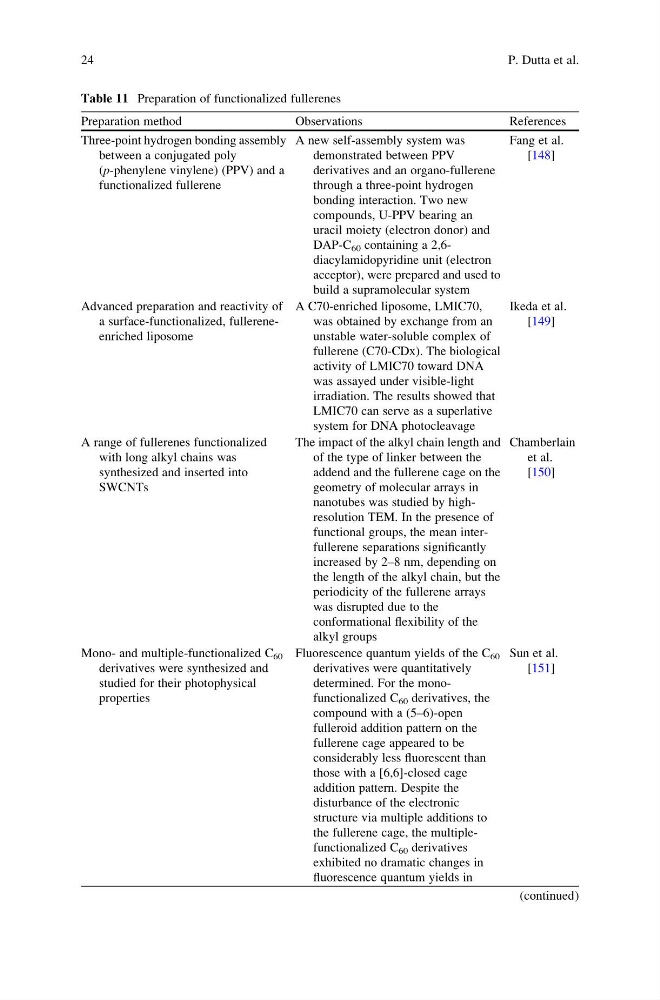
Table 11 Preparation of functionalized fullerenes
Preparation method
Observations
References
Three-point hydrogen bonding assembly
between a conjugated poly
(p-phenylene vinylene) (PPV) and a
functionalized fullerene
A new self-assembly system was
demonstrated between PPV
derivatives and an organo-fullerene
through a three-point hydrogen
bonding interaction. Two new
compounds, U-PPV bearing an
uracil moiety (electron donor) and
DAP-C 60 containing a 2,6diacylamidopyridine unit (electron
acceptor), were prepared and used to
build a supramolecular system
Fang et al.
[148]
Advanced preparation and reactivity of
a surface-functionalized, fullereneenriched liposome
A C70-enriched liposome, LMIC70,
was obtained by exchange from an
unstable water-soluble complex of
fullerene (C70-CDx). The biological
activity of LMIC70 toward DNA
was assayed under visible-light
irradiation. The results showed that
LMIC70 can serve as a superlative
system for DNA photocleavage
Ikeda et al.
[149]
A range of fullerenes functionalized
with long alkyl chains was
synthesized and inserted into
SWCNTs
The impact of the alkyl chain length and
of the type of linker between the
addend and the fullerene cage on the
geometry of molecular arrays in
nanotubes was studied by highresolution TEM. In the presence of
functional groups, the mean interfullerene separations significantly
increased by 2–8 nm, depending on
the length of the alkyl chain, but the
periodicity of the fullerene arrays
was disrupted due to the
conformational flexibility of the
alkyl groups
Chamberlain
et al.
[150]
Mono- and multiple-functionalized C 60
derivatives were synthesized and
studied for their photophysical
properties
Fluorescence quantum yields of the C 60
derivatives were quantitatively
determined. For the monofunctionalized C 60 derivatives, the
compound with a (5–6)-open
fulleroid addition pattern on the
fullerene cage appeared to be
considerably less fluorescent than
those with a [6,6]-closed cage
addition pattern. Despite the
disturbance of the electronic
structure via multiple additions to
the fullerene cage, the multiplefunctionalized C 60 derivatives
exhibited no dramatic changes in
fluorescence quantum yields in
Sun et al.
[151]
(continued)
24
P. Dutta et al.
Preparation method
Observations
References
Three-point hydrogen bonding assembly
between a conjugated poly
(p-phenylene vinylene) (PPV) and a
functionalized fullerene
A new self-assembly system was
demonstrated between PPV
derivatives and an organo-fullerene
through a three-point hydrogen
bonding interaction. Two new
compounds, U-PPV bearing an
uracil moiety (electron donor) and
DAP-C 60 containing a 2,6diacylamidopyridine unit (electron
acceptor), were prepared and used to
build a supramolecular system
Fang et al.
[148]
Advanced preparation and reactivity of
a surface-functionalized, fullereneenriched liposome
A C70-enriched liposome, LMIC70,
was obtained by exchange from an
unstable water-soluble complex of
fullerene (C70-CDx). The biological
activity of LMIC70 toward DNA
was assayed under visible-light
irradiation. The results showed that
LMIC70 can serve as a superlative
system for DNA photocleavage
Ikeda et al.
[149]
A range of fullerenes functionalized
with long alkyl chains was
synthesized and inserted into
SWCNTs
The impact of the alkyl chain length and
of the type of linker between the
addend and the fullerene cage on the
geometry of molecular arrays in
nanotubes was studied by highresolution TEM. In the presence of
functional groups, the mean interfullerene separations significantly
increased by 2–8 nm, depending on
the length of the alkyl chain, but the
periodicity of the fullerene arrays
was disrupted due to the
conformational flexibility of the
alkyl groups
Chamberlain
et al.
[150]
Mono- and multiple-functionalized C 60
derivatives were synthesized and
studied for their photophysical
properties
Fluorescence quantum yields of the C 60
derivatives were quantitatively
determined. For the monofunctionalized C 60 derivatives, the
compound with a (5–6)-open
fulleroid addition pattern on the
fullerene cage appeared to be
considerably less fluorescent than
those with a [6,6]-closed cage
addition pattern. Despite the
disturbance of the electronic
structure via multiple additions to
the fullerene cage, the multiplefunctionalized C 60 derivatives
exhibited no dramatic changes in
fluorescence quantum yields in
Sun et al.
[151]
(continued)
24
P. Dutta et al.