

Another elegant application of glycosylated SWNT devices has recently been
reported that involved their preparation into electrolyte-gated field-effect transistors
(FETs) to afford nanoelectronic detection of lectins [77]. Towards this goal, noncovalently functionalized SWNTs incorporating tetravalent porphyrin-based
glycoconjugates 29 porphyrin , 30 porphyrin , and 31 porphyrin acted as conducting channels
that transduced the specific binding between glycoconjugates and lectins into electrical signals. Therefore, specific molecular recognition was efficiently probed between
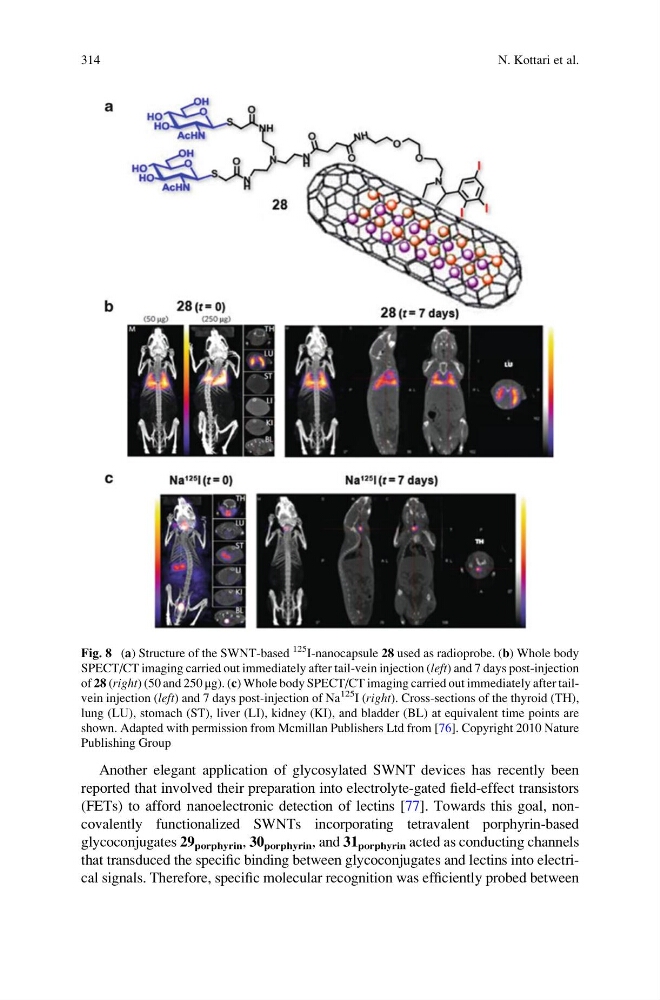
Fig. 8 (a) Structure of the SWNT-based
125
I-nanocapsule 28 used as radioprobe. (b) Whole body
SPECT/CT imaging carried out immediately after tail-vein injection (left) and 7 days post-injection
of 28 (right) (50 and 250 μg). (c) Whole body SPECT/CT imaging carried out immediately after tailvein injection (left) and 7 days post-injection of Na
125
I (right). Cross-sections of the thyroid (TH),
lung (LU), stomach (ST), liver (LI), kidney (KI), and bladder (BL) at equivalent time points are
shown. Adapted with permission from Mcmillan Publishers Ltd from [76]. Copyright 2010 Nature
Publishing Group
314
N. Kottari et al.
reported that involved their preparation into electrolyte-gated field-effect transistors
(FETs) to afford nanoelectronic detection of lectins [77]. Towards this goal, noncovalently functionalized SWNTs incorporating tetravalent porphyrin-based
glycoconjugates 29 porphyrin , 30 porphyrin , and 31 porphyrin acted as conducting channels
that transduced the specific binding between glycoconjugates and lectins into electrical signals. Therefore, specific molecular recognition was efficiently probed between
Fig. 8 (a) Structure of the SWNT-based
125
I-nanocapsule 28 used as radioprobe. (b) Whole body
SPECT/CT imaging carried out immediately after tail-vein injection (left) and 7 days post-injection
of 28 (right) (50 and 250 μg). (c) Whole body SPECT/CT imaging carried out immediately after tailvein injection (left) and 7 days post-injection of Na
125
I (right). Cross-sections of the thyroid (TH),
lung (LU), stomach (ST), liver (LI), kidney (KI), and bladder (BL) at equivalent time points are
shown. Adapted with permission from Mcmillan Publishers Ltd from [76]. Copyright 2010 Nature
Publishing Group
314
N. Kottari et al.