

on the CNT hybrids become multivalent carbohydrate ligands showing potential
biological activities as well as glycoconjugate polymers. Hence, multivalent presentation of simple sugar residues or clustered wedges have been described via a
non-covalent stabilization process through favorable hydrophobic π–π stacking, or
electrostatic interactions in water between the absorbates and CNTs, or in a more
controllable fashion involving covalent functionalization [22, 72, 73].
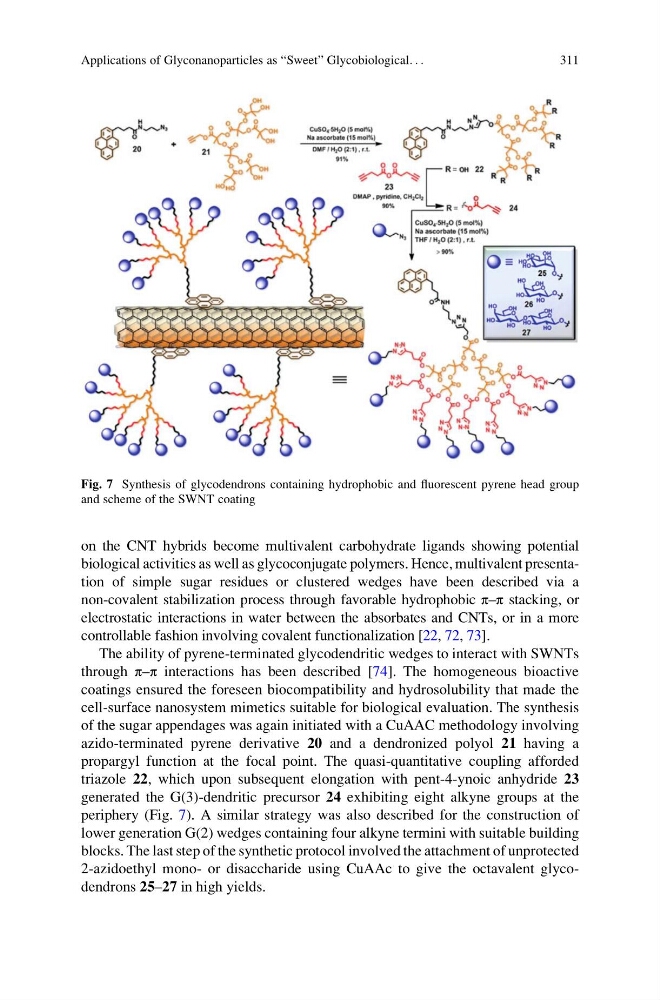
The ability of pyrene-terminated glycodendritic wedges to interact with SWNTs
through π–π interactions has been described [74]. The homogeneous bioactive
coatings ensured the foreseen biocompatibility and hydrosolubility that made the
cell-surface nanosystem mimetics suitable for biological evaluation. The synthesis
of the sugar appendages was again initiated with a CuAAC methodology involving
azido-terminated pyrene derivative 20 and a dendronized polyol 21 having a
propargyl function at the focal point. The quasi-quantitative coupling afforded
triazole 22, which upon subsequent elongation with pent-4-ynoic anhydride 23
generated the G(3)-dendritic precursor 24 exhibiting eight alkyne groups at the
periphery (Fig. 7). A similar strategy was also described for the construction of
lower generation G(2) wedges containing four alkyne termini with suitable building
blocks. The last step of the synthetic protocol involved the attachment of unprotected
2-azidoethyl mono- or disaccharide using CuAAc to give the octavalent glycodendrons 25–27 in high yields.
Fig. 7 Synthesis of glycodendrons containing hydrophobic and fluorescent pyrene head group
and scheme of the SWNT coating
Applications of Glyconanoparticles as “Sweet” Glycobiological. . .
311
biological activities as well as glycoconjugate polymers. Hence, multivalent presentation of simple sugar residues or clustered wedges have been described via a
non-covalent stabilization process through favorable hydrophobic π–π stacking, or
electrostatic interactions in water between the absorbates and CNTs, or in a more
controllable fashion involving covalent functionalization [22, 72, 73].
The ability of pyrene-terminated glycodendritic wedges to interact with SWNTs
through π–π interactions has been described [74]. The homogeneous bioactive
coatings ensured the foreseen biocompatibility and hydrosolubility that made the
cell-surface nanosystem mimetics suitable for biological evaluation. The synthesis
of the sugar appendages was again initiated with a CuAAC methodology involving
azido-terminated pyrene derivative 20 and a dendronized polyol 21 having a
propargyl function at the focal point. The quasi-quantitative coupling afforded
triazole 22, which upon subsequent elongation with pent-4-ynoic anhydride 23
generated the G(3)-dendritic precursor 24 exhibiting eight alkyne groups at the
periphery (Fig. 7). A similar strategy was also described for the construction of
lower generation G(2) wedges containing four alkyne termini with suitable building
blocks. The last step of the synthetic protocol involved the attachment of unprotected
2-azidoethyl mono- or disaccharide using CuAAc to give the octavalent glycodendrons 25–27 in high yields.
Fig. 7 Synthesis of glycodendrons containing hydrophobic and fluorescent pyrene head group
and scheme of the SWNT coating
Applications of Glyconanoparticles as “Sweet” Glycobiological. . .
311