

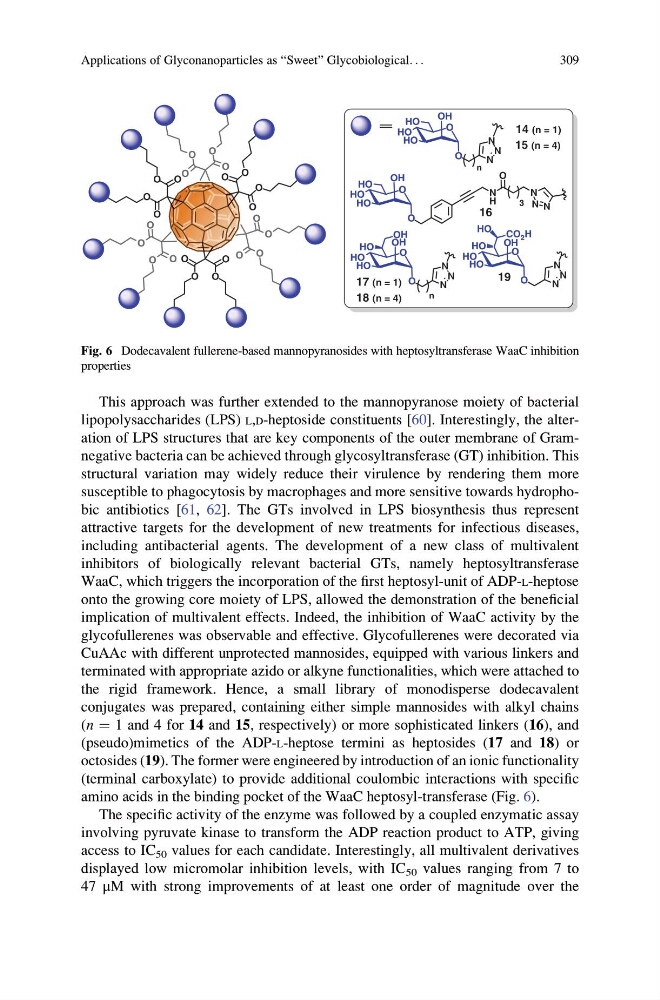
This approach was further extended to the mannopyranose moiety of bacterial
lipopolysaccharides (LPS) L,D-heptoside constituents [60]. Interestingly, the alteration of LPS structures that are key components of the outer membrane of Gramnegative bacteria can be achieved through glycosyltransferase (GT) inhibition. This
structural variation may widely reduce their virulence by rendering them more
susceptible to phagocytosis by macrophages and more sensitive towards hydrophobic antibiotics [61, 62]. The GTs involved in LPS biosynthesis thus represent
attractive targets for the development of new treatments for infectious diseases,
including antibacterial agents. The development of a new class of multivalent
inhibitors of biologically relevant bacterial GTs, namely heptosyltransferase
WaaC, which triggers the incorporation of the first heptosyl-unit of ADP-L-heptose
onto the growing core moiety of LPS, allowed the demonstration of the beneficial
implication of multivalent effects. Indeed, the inhibition of WaaC activity by the
glycofullerenes was observable and effective. Glycofullerenes were decorated via
CuAAc with different unprotected mannosides, equipped with various linkers and
terminated with appropriate azido or alkyne functionalities, which were attached to
the rigid framework. Hence, a small library of monodisperse dodecavalent
conjugates was prepared, containing either simple mannosides with alkyl chains
(n ¼ 1 and 4 for 14 and 15, respectively) or more sophisticated linkers (16), and
(pseudo)mimetics of the ADP-L-heptose termini as heptosides (17 and 18) or
octosides (19). The former were engineered by introduction of an ionic functionality
(terminal carboxylate) to provide additional coulombic interactions with specific
amino acids in the binding pocket of the WaaC heptosyl-transferase (Fig. 6).
The specific activity of the enzyme was followed by a coupled enzymatic assay
involving pyruvate kinase to transform the ADP reaction product to ATP, giving
access to IC 50 values for each candidate. Interestingly, all multivalent derivatives
displayed low micromolar inhibition levels, with IC 50 values ranging from 7 to
47 μM with strong improvements of at least one order of magnitude over the
O
O
O
O
O
O
O
O
O
O
O
O
O
O
O
O
O
O
O
O
O
O
O O
O
HO
HO
OH
O
N
N
N
n
HO
O
HO
HO
OH
O
HO
N
H
O
N
N N
3
16
O
HO
HO
OH
O
HO
OH
N
N
N
O
HO
HO
OH
O
HO
CO 2 H
N
N
N
HO
n
17 (n = 1)
18 (n = 4)
14 (n = 1)
15 (n = 4)
19
Fig. 6 Dodecavalent fullerene-based mannopyranosides with heptosyltransferase WaaC inhibition
properties
Applications of Glyconanoparticles as “Sweet” Glycobiological. . .
309
lipopolysaccharides (LPS) L,D-heptoside constituents [60]. Interestingly, the alteration of LPS structures that are key components of the outer membrane of Gramnegative bacteria can be achieved through glycosyltransferase (GT) inhibition. This
structural variation may widely reduce their virulence by rendering them more
susceptible to phagocytosis by macrophages and more sensitive towards hydrophobic antibiotics [61, 62]. The GTs involved in LPS biosynthesis thus represent
attractive targets for the development of new treatments for infectious diseases,
including antibacterial agents. The development of a new class of multivalent
inhibitors of biologically relevant bacterial GTs, namely heptosyltransferase
WaaC, which triggers the incorporation of the first heptosyl-unit of ADP-L-heptose
onto the growing core moiety of LPS, allowed the demonstration of the beneficial
implication of multivalent effects. Indeed, the inhibition of WaaC activity by the
glycofullerenes was observable and effective. Glycofullerenes were decorated via
CuAAc with different unprotected mannosides, equipped with various linkers and
terminated with appropriate azido or alkyne functionalities, which were attached to
the rigid framework. Hence, a small library of monodisperse dodecavalent
conjugates was prepared, containing either simple mannosides with alkyl chains
(n ¼ 1 and 4 for 14 and 15, respectively) or more sophisticated linkers (16), and
(pseudo)mimetics of the ADP-L-heptose termini as heptosides (17 and 18) or
octosides (19). The former were engineered by introduction of an ionic functionality
(terminal carboxylate) to provide additional coulombic interactions with specific
amino acids in the binding pocket of the WaaC heptosyl-transferase (Fig. 6).
The specific activity of the enzyme was followed by a coupled enzymatic assay
involving pyruvate kinase to transform the ADP reaction product to ATP, giving
access to IC 50 values for each candidate. Interestingly, all multivalent derivatives
displayed low micromolar inhibition levels, with IC 50 values ranging from 7 to
47 μM with strong improvements of at least one order of magnitude over the
O
O
O
O
O
O
O
O
O
O
O
O
O
O
O
O
O
O
O
O
O
O
O O
O
HO
HO
OH
O
N
N
N
n
HO
O
HO
HO
OH
O
HO
N
H
O
N
N N
3
16
O
HO
HO
OH
O
HO
OH
N
N
N
O
HO
HO
OH
O
HO
CO 2 H
N
N
N
HO
n
17 (n = 1)
18 (n = 4)
14 (n = 1)
15 (n = 4)
19
Fig. 6 Dodecavalent fullerene-based mannopyranosides with heptosyltransferase WaaC inhibition
properties
Applications of Glyconanoparticles as “Sweet” Glycobiological. . .
309