

cluster displayed in the synthetic vaccine that efficiently recognized the native form of
T N antigen presented on human tumor cells, as determined by flow cytometry between
the immune serum IgG and the common breast cancer cell line MCF7. The efficient
stimulation of T cells was also observed, together with tumor regression and significant
increase of survival in mice inoculated with MO5 carcinoma cells in both immunotherapeutic and immunoprophylactic settings [43]. These results clearly evidenced
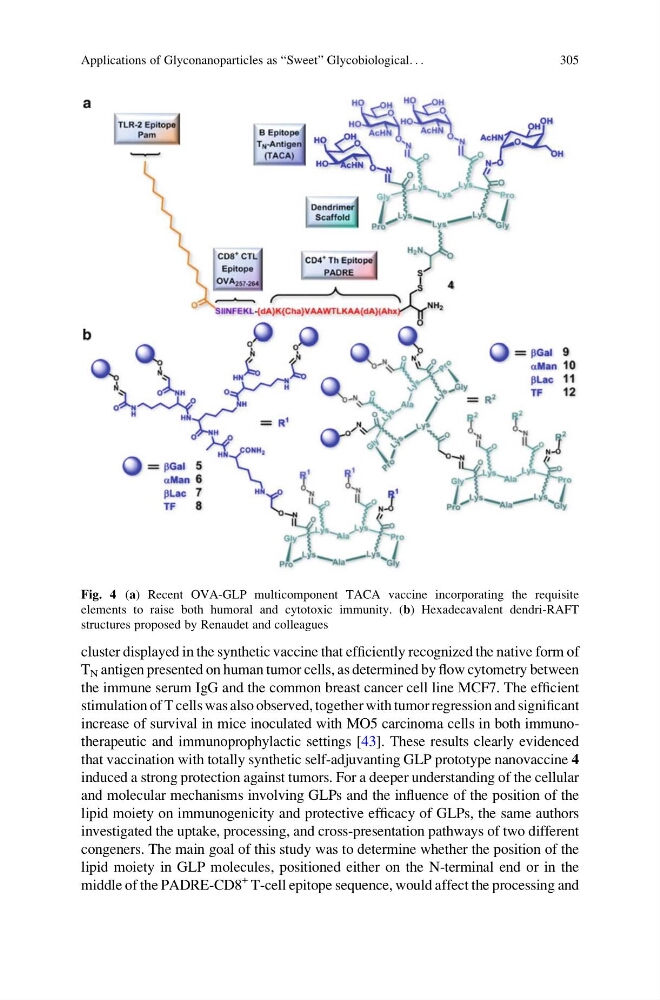
that vaccination with totally synthetic self-adjuvanting GLP prototype nanovaccine 4
induced a strong protection against tumors. For a deeper understanding of the cellular
and molecular mechanisms involving GLPs and the influence of the position of the
lipid moiety on immunogenicity and protective efficacy of GLPs, the same authors
investigated the uptake, processing, and cross-presentation pathways of two different
congeners. The main goal of this study was to determine whether the position of the
lipid moiety in GLP molecules, positioned either on the N-terminal end or in the
middle of the PADRE-CD8
+ T-cell epitope sequence, would affect the processing and
Fig. 4 (a) Recent OVA-GLP multicomponent TACA vaccine incorporating the requisite
elements to raise both humoral and cytotoxic immunity. (b) Hexadecavalent dendri-RAFT
structures proposed by Renaudet and colleagues
Applications of Glyconanoparticles as “Sweet” Glycobiological. . .
305
T N antigen presented on human tumor cells, as determined by flow cytometry between
the immune serum IgG and the common breast cancer cell line MCF7. The efficient
stimulation of T cells was also observed, together with tumor regression and significant
increase of survival in mice inoculated with MO5 carcinoma cells in both immunotherapeutic and immunoprophylactic settings [43]. These results clearly evidenced
that vaccination with totally synthetic self-adjuvanting GLP prototype nanovaccine 4
induced a strong protection against tumors. For a deeper understanding of the cellular
and molecular mechanisms involving GLPs and the influence of the position of the
lipid moiety on immunogenicity and protective efficacy of GLPs, the same authors
investigated the uptake, processing, and cross-presentation pathways of two different
congeners. The main goal of this study was to determine whether the position of the
lipid moiety in GLP molecules, positioned either on the N-terminal end or in the
middle of the PADRE-CD8
+ T-cell epitope sequence, would affect the processing and
Fig. 4 (a) Recent OVA-GLP multicomponent TACA vaccine incorporating the requisite
elements to raise both humoral and cytotoxic immunity. (b) Hexadecavalent dendri-RAFT
structures proposed by Renaudet and colleagues
Applications of Glyconanoparticles as “Sweet” Glycobiological. . .
305