

is finally achieved by centrifugation, followed by successive washing steps with hot
and cold water. In one study, Lin et al. describe a different approach: the formation
of particles is obtained after addition of sodium sulfate solution to chitosan solution
under mild agitation and continuous sonication for 30 min.
The coacervation technique is analogous to the method of desolvation because it
works by mingling of the aqueous protein solution with an organic solvent like
acetone or ethanol, which produces minute coacervates. [52]. Numerous parameters
such as initial protein concentration, temperature, pH, crosslinker concentration,
agitation speed, molar ratio of protein to organic solvent and organic solvent adding
rate affect the balance between coacervation and desolvation, which affects the
process of providing anticipated assets to the nanoparticles.
4.4 Inclusion Complexation
Inclusion complexation is the entrapment of smaller molecules inside the hollow cavity
of a larger molecule [47, 53, 54]. Relatively few food-appropriate molecules exist
with such cavities; however, cyclodextrins are commonly used in the food industry.
Cyclodextrins are typically used as coating molecules and are formed by the
enzymatic hydrolysis of starch molecules [55]. Glycosyl transferase cleaves starch
molecules to form linear fragments, which are then joined to form circular
structures with hollow cavities inside. Cyclodextrins can form inclusion complexes
with compounds that are small enough to fit inside the cavity. Although the internal
diameter varies between cyclodextrins, the typical diameter is 5–8 A ˚ , which is large
enough to hold 6–17 molecules of water. Small molecules may displace the water to
form thermodynamically stable complexes. The inner cavity is typically hydrophobic, and core molecules are stabilized inside the cavity by van der Waals forces,
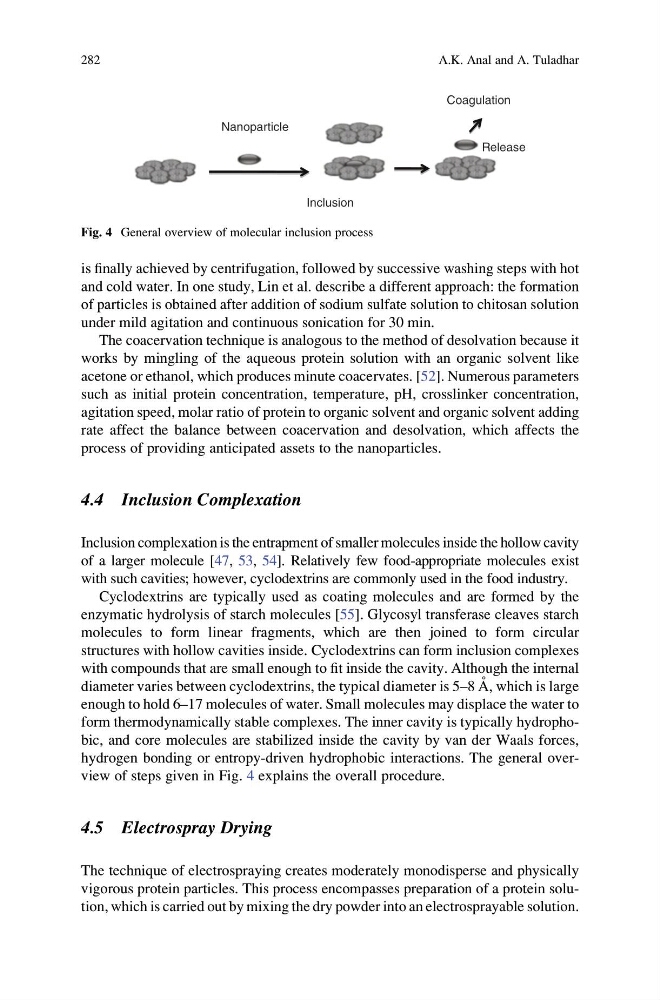
hydrogen bonding or entropy-driven hydrophobic interactions. The general overview of steps given in Fig. 4 explains the overall procedure.
4.5 Electrospray Drying
The technique of electrospraying creates moderately monodisperse and physically
vigorous protein particles. This process encompasses preparation of a protein solution, which is carried out by mixing the dry powder into an electrosprayable solution.
Nanoparticle
Inclusion
Coagulation
Release
Fig. 4 General overview of molecular inclusion process
282
A.K. Anal and A. Tuladhar
and cold water. In one study, Lin et al. describe a different approach: the formation
of particles is obtained after addition of sodium sulfate solution to chitosan solution
under mild agitation and continuous sonication for 30 min.
The coacervation technique is analogous to the method of desolvation because it
works by mingling of the aqueous protein solution with an organic solvent like
acetone or ethanol, which produces minute coacervates. [52]. Numerous parameters
such as initial protein concentration, temperature, pH, crosslinker concentration,
agitation speed, molar ratio of protein to organic solvent and organic solvent adding
rate affect the balance between coacervation and desolvation, which affects the
process of providing anticipated assets to the nanoparticles.
4.4 Inclusion Complexation
Inclusion complexation is the entrapment of smaller molecules inside the hollow cavity
of a larger molecule [47, 53, 54]. Relatively few food-appropriate molecules exist
with such cavities; however, cyclodextrins are commonly used in the food industry.
Cyclodextrins are typically used as coating molecules and are formed by the
enzymatic hydrolysis of starch molecules [55]. Glycosyl transferase cleaves starch
molecules to form linear fragments, which are then joined to form circular
structures with hollow cavities inside. Cyclodextrins can form inclusion complexes
with compounds that are small enough to fit inside the cavity. Although the internal
diameter varies between cyclodextrins, the typical diameter is 5–8 A ˚ , which is large
enough to hold 6–17 molecules of water. Small molecules may displace the water to
form thermodynamically stable complexes. The inner cavity is typically hydrophobic, and core molecules are stabilized inside the cavity by van der Waals forces,
hydrogen bonding or entropy-driven hydrophobic interactions. The general overview of steps given in Fig. 4 explains the overall procedure.
4.5 Electrospray Drying
The technique of electrospraying creates moderately monodisperse and physically
vigorous protein particles. This process encompasses preparation of a protein solution, which is carried out by mixing the dry powder into an electrosprayable solution.
Nanoparticle
Inclusion
Coagulation
Release
Fig. 4 General overview of molecular inclusion process
282
A.K. Anal and A. Tuladhar