

2.1.2 Functional Properties of Chitosan
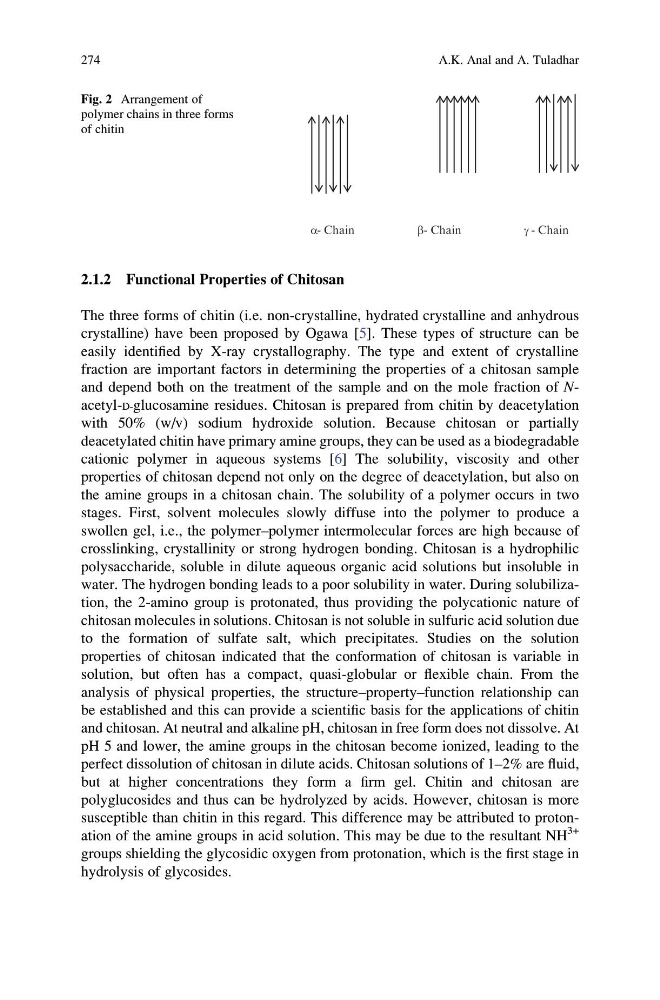
The three forms of chitin (i.e. non-crystalline, hydrated crystalline and anhydrous
crystalline) have been proposed by Ogawa [5]. These types of structure can be
easily identified by X-ray crystallography. The type and extent of crystalline
fraction are important factors in determining the properties of a chitosan sample
and depend both on the treatment of the sample and on the mole fraction of Nacetyl-D-glucosamine residues. Chitosan is prepared from chitin by deacetylation
with 50% (w/v) sodium hydroxide solution. Because chitosan or partially
deacetylated chitin have primary amine groups, they can be used as a biodegradable
cationic polymer in aqueous systems [6] The solubility, viscosity and other
properties of chitosan depend not only on the degree of deacetylation, but also on
the amine groups in a chitosan chain. The solubility of a polymer occurs in two
stages. First, solvent molecules slowly diffuse into the polymer to produce a
swollen gel, i.e., the polymer–polymer intermolecular forces are high because of
crosslinking, crystallinity or strong hydrogen bonding. Chitosan is a hydrophilic
polysaccharide, soluble in dilute aqueous organic acid solutions but insoluble in
water. The hydrogen bonding leads to a poor solubility in water. During solubilization, the 2-amino group is protonated, thus providing the polycationic nature of
chitosan molecules in solutions. Chitosan is not soluble in sulfuric acid solution due
to the formation of sulfate salt, which precipitates. Studies on the solution
properties of chitosan indicated that the conformation of chitosan is variable in
solution, but often has a compact, quasi-globular or flexible chain. From the
analysis of physical properties, the structure–property–function relationship can
be established and this can provide a scientific basis for the applications of chitin
and chitosan. At neutral and alkaline pH, chitosan in free form does not dissolve. At
pH 5 and lower, the amine groups in the chitosan become ionized, leading to the
perfect dissolution of chitosan in dilute acids. Chitosan solutions of 1–2% are fluid,
but at higher concentrations they form a firm gel. Chitin and chitosan are
polyglucosides and thus can be hydrolyzed by acids. However, chitosan is more
susceptible than chitin in this regard. This difference may be attributed to protonation of the amine groups in acid solution. This may be due to the resultant NH
3+
groups shielding the glycosidic oxygen from protonation, which is the first stage in
hydrolysis of glycosides.
α- Chain
β- Chain
γ - Chain
Fig. 2 Arrangement of
polymer chains in three forms
of chitin
274
A.K. Anal and A. Tuladhar
The three forms of chitin (i.e. non-crystalline, hydrated crystalline and anhydrous
crystalline) have been proposed by Ogawa [5]. These types of structure can be
easily identified by X-ray crystallography. The type and extent of crystalline
fraction are important factors in determining the properties of a chitosan sample
and depend both on the treatment of the sample and on the mole fraction of Nacetyl-D-glucosamine residues. Chitosan is prepared from chitin by deacetylation
with 50% (w/v) sodium hydroxide solution. Because chitosan or partially
deacetylated chitin have primary amine groups, they can be used as a biodegradable
cationic polymer in aqueous systems [6] The solubility, viscosity and other
properties of chitosan depend not only on the degree of deacetylation, but also on
the amine groups in a chitosan chain. The solubility of a polymer occurs in two
stages. First, solvent molecules slowly diffuse into the polymer to produce a
swollen gel, i.e., the polymer–polymer intermolecular forces are high because of
crosslinking, crystallinity or strong hydrogen bonding. Chitosan is a hydrophilic
polysaccharide, soluble in dilute aqueous organic acid solutions but insoluble in
water. The hydrogen bonding leads to a poor solubility in water. During solubilization, the 2-amino group is protonated, thus providing the polycationic nature of
chitosan molecules in solutions. Chitosan is not soluble in sulfuric acid solution due
to the formation of sulfate salt, which precipitates. Studies on the solution
properties of chitosan indicated that the conformation of chitosan is variable in
solution, but often has a compact, quasi-globular or flexible chain. From the
analysis of physical properties, the structure–property–function relationship can
be established and this can provide a scientific basis for the applications of chitin
and chitosan. At neutral and alkaline pH, chitosan in free form does not dissolve. At
pH 5 and lower, the amine groups in the chitosan become ionized, leading to the
perfect dissolution of chitosan in dilute acids. Chitosan solutions of 1–2% are fluid,
but at higher concentrations they form a firm gel. Chitin and chitosan are
polyglucosides and thus can be hydrolyzed by acids. However, chitosan is more
susceptible than chitin in this regard. This difference may be attributed to protonation of the amine groups in acid solution. This may be due to the resultant NH
3+
groups shielding the glycosidic oxygen from protonation, which is the first stage in
hydrolysis of glycosides.
α- Chain
β- Chain
γ - Chain
Fig. 2 Arrangement of
polymer chains in three forms
of chitin
274
A.K. Anal and A. Tuladhar