

At present, the discovery of new polysaccharides relies on screening of the
extracellular polysaccharides produced by microorganisms. Fungi and yeasts are
also potential sources of new polysaccharides. The production of microbial polysaccharide has the advantages of controlled cost, abundant supply and ease of
modification of the chemical structure. These new polysaccharides with new
properties may generate new market opportunities. Microbial polysaccharides can
be classified as extracellular structural or intercellular storage forms. Extracellular
polysaccharide can be either exocellular capsules of the cell wall or loose slime
components that accumulate outside the cell wall and then diffuse into the medium.
Polysaccharides and polysaccharide mixtures have been used as gelling agents
by the food, cosmetic and pharmaceutical industries. A gel is considered to be a
coherent colloidal disperse system of at least two components that behaves mechanically as a solid in which the dispersed components form networks interpenetrating
and enclosing the solvent phase. Gelation is pictured as the separation of a solid
phase (amorphous or crystalline) in such a fashion as to produce a coherent
continuous three-dimensional network. An important factor in the demixing of a
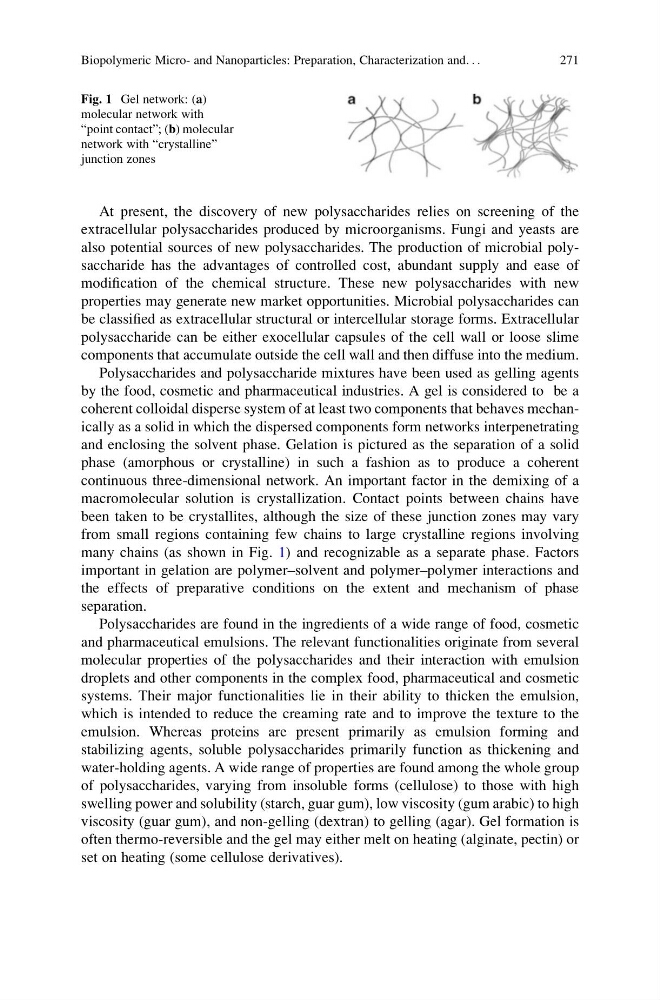
macromolecular solution is crystallization. Contact points between chains have
been taken to be crystallites, although the size of these junction zones may vary
from small regions containing few chains to large crystalline regions involving
many chains (as shown in Fig. 1) and recognizable as a separate phase. Factors
important in gelation are polymer–solvent and polymer–polymer interactions and
the effects of preparative conditions on the extent and mechanism of phase
separation.
Polysaccharides are found in the ingredients of a wide range of food, cosmetic
and pharmaceutical emulsions. The relevant functionalities originate from several
molecular properties of the polysaccharides and their interaction with emulsion
droplets and other components in the complex food, pharmaceutical and cosmetic
systems. Their major functionalities lie in their ability to thicken the emulsion,
which is intended to reduce the creaming rate and to improve the texture to the
emulsion. Whereas proteins are present primarily as emulsion forming and
stabilizing agents, soluble polysaccharides primarily function as thickening and
water-holding agents. A wide range of properties are found among the whole group
of polysaccharides, varying from insoluble forms (cellulose) to those with high
swelling power and solubility (starch, guar gum), low viscosity (gum arabic) to high
viscosity (guar gum), and non-gelling (dextran) to gelling (agar). Gel formation is
often thermo-reversible and the gel may either melt on heating (alginate, pectin) or
set on heating (some cellulose derivatives).
Fig. 1 Gel network: (a)
molecular network with
“point contact”; (b) molecular
network with “crystalline”
junction zones
Biopolymeric Micro- and Nanoparticles: Preparation, Characterization and. . .
271
extracellular polysaccharides produced by microorganisms. Fungi and yeasts are
also potential sources of new polysaccharides. The production of microbial polysaccharide has the advantages of controlled cost, abundant supply and ease of
modification of the chemical structure. These new polysaccharides with new
properties may generate new market opportunities. Microbial polysaccharides can
be classified as extracellular structural or intercellular storage forms. Extracellular
polysaccharide can be either exocellular capsules of the cell wall or loose slime
components that accumulate outside the cell wall and then diffuse into the medium.
Polysaccharides and polysaccharide mixtures have been used as gelling agents
by the food, cosmetic and pharmaceutical industries. A gel is considered to be a
coherent colloidal disperse system of at least two components that behaves mechanically as a solid in which the dispersed components form networks interpenetrating
and enclosing the solvent phase. Gelation is pictured as the separation of a solid
phase (amorphous or crystalline) in such a fashion as to produce a coherent
continuous three-dimensional network. An important factor in the demixing of a
macromolecular solution is crystallization. Contact points between chains have
been taken to be crystallites, although the size of these junction zones may vary
from small regions containing few chains to large crystalline regions involving
many chains (as shown in Fig. 1) and recognizable as a separate phase. Factors
important in gelation are polymer–solvent and polymer–polymer interactions and
the effects of preparative conditions on the extent and mechanism of phase
separation.
Polysaccharides are found in the ingredients of a wide range of food, cosmetic
and pharmaceutical emulsions. The relevant functionalities originate from several
molecular properties of the polysaccharides and their interaction with emulsion
droplets and other components in the complex food, pharmaceutical and cosmetic
systems. Their major functionalities lie in their ability to thicken the emulsion,
which is intended to reduce the creaming rate and to improve the texture to the
emulsion. Whereas proteins are present primarily as emulsion forming and
stabilizing agents, soluble polysaccharides primarily function as thickening and
water-holding agents. A wide range of properties are found among the whole group
of polysaccharides, varying from insoluble forms (cellulose) to those with high
swelling power and solubility (starch, guar gum), low viscosity (gum arabic) to high
viscosity (guar gum), and non-gelling (dextran) to gelling (agar). Gel formation is
often thermo-reversible and the gel may either melt on heating (alginate, pectin) or
set on heating (some cellulose derivatives).
Fig. 1 Gel network: (a)
molecular network with
“point contact”; (b) molecular
network with “crystalline”
junction zones
Biopolymeric Micro- and Nanoparticles: Preparation, Characterization and. . .
271