

size, stability (both physical and chemical), reproducibility, and release kinetics,
with the nature of the drug to be encapsulated (hydrophobic or hydrophilic) and the
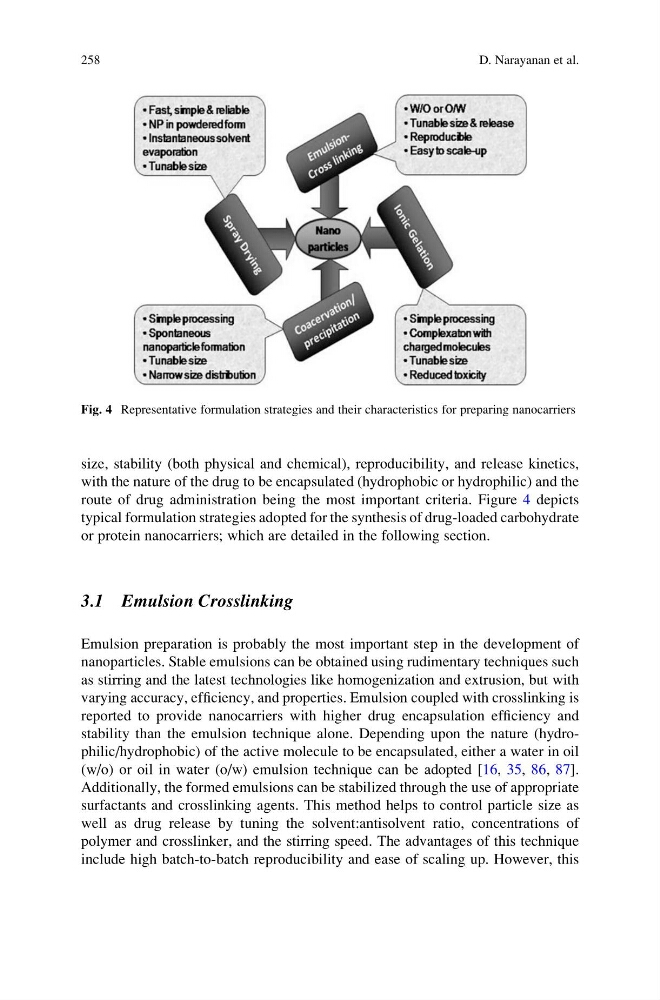
route of drug administration being the most important criteria. Figure 4 depicts
typical formulation strategies adopted for the synthesis of drug-loaded carbohydrate
or protein nanocarriers; which are detailed in the following section.
3.1 Emulsion Crosslinking
Emulsion preparation is probably the most important step in the development of
nanoparticles. Stable emulsions can be obtained using rudimentary techniques such
as stirring and the latest technologies like homogenization and extrusion, but with
varying accuracy, efficiency, and properties. Emulsion coupled with crosslinking is
reported to provide nanocarriers with higher drug encapsulation efficiency and
stability than the emulsion technique alone. Depending upon the nature (hydrophilic/hydrophobic) of the active molecule to be encapsulated, either a water in oil
(w/o) or oil in water (o/w) emulsion technique can be adopted [16, 35, 86, 87].
Additionally, the formed emulsions can be stabilized through the use of appropriate
surfactants and crosslinking agents. This method helps to control particle size as
well as drug release by tuning the solvent:antisolvent ratio, concentrations of
polymer and crosslinker, and the stirring speed. The advantages of this technique
include high batch-to-batch reproducibility and ease of scaling up. However, this
Fig. 4 Representative formulation strategies and their characteristics for preparing nanocarriers
258
D. Narayanan et al.
with the nature of the drug to be encapsulated (hydrophobic or hydrophilic) and the
route of drug administration being the most important criteria. Figure 4 depicts
typical formulation strategies adopted for the synthesis of drug-loaded carbohydrate
or protein nanocarriers; which are detailed in the following section.
3.1 Emulsion Crosslinking
Emulsion preparation is probably the most important step in the development of
nanoparticles. Stable emulsions can be obtained using rudimentary techniques such
as stirring and the latest technologies like homogenization and extrusion, but with
varying accuracy, efficiency, and properties. Emulsion coupled with crosslinking is
reported to provide nanocarriers with higher drug encapsulation efficiency and
stability than the emulsion technique alone. Depending upon the nature (hydrophilic/hydrophobic) of the active molecule to be encapsulated, either a water in oil
(w/o) or oil in water (o/w) emulsion technique can be adopted [16, 35, 86, 87].
Additionally, the formed emulsions can be stabilized through the use of appropriate
surfactants and crosslinking agents. This method helps to control particle size as
well as drug release by tuning the solvent:antisolvent ratio, concentrations of
polymer and crosslinker, and the stirring speed. The advantages of this technique
include high batch-to-batch reproducibility and ease of scaling up. However, this
Fig. 4 Representative formulation strategies and their characteristics for preparing nanocarriers
258
D. Narayanan et al.