

Albumin nanocarriers are naturally stable, and that is one of the main reasons
why they are used for the delivery of nucleotides across the nuclear membrane as
well as to deliver drugs across the blood-brain barrier [48, 110]. Albumin
nanoparticles showed no change in particle size when stored either in aqueous
solution for 6 months at 4
C or as lyophilized powder [111, 112]. Conjugation with
carbohydrates or a high degree of crosslinking could further enhance the stability of
albumin nanocarriers. A simple self-assembled crosslinking of dextran and albumin
with the hydrophobic drug ibuprofen enhanced the stability and drug-loading
capacity of the resulting nanocarrier [113]. Cationic biomaterials such as PEI
have been used for crosslinking the anionic protein BSA, providing protection
against enzymatic degradation [114]. The use of another cationic polymer, PLL,
instead of PEI, for coating BSA nanoparticles enhanced its proteolytic resistance,
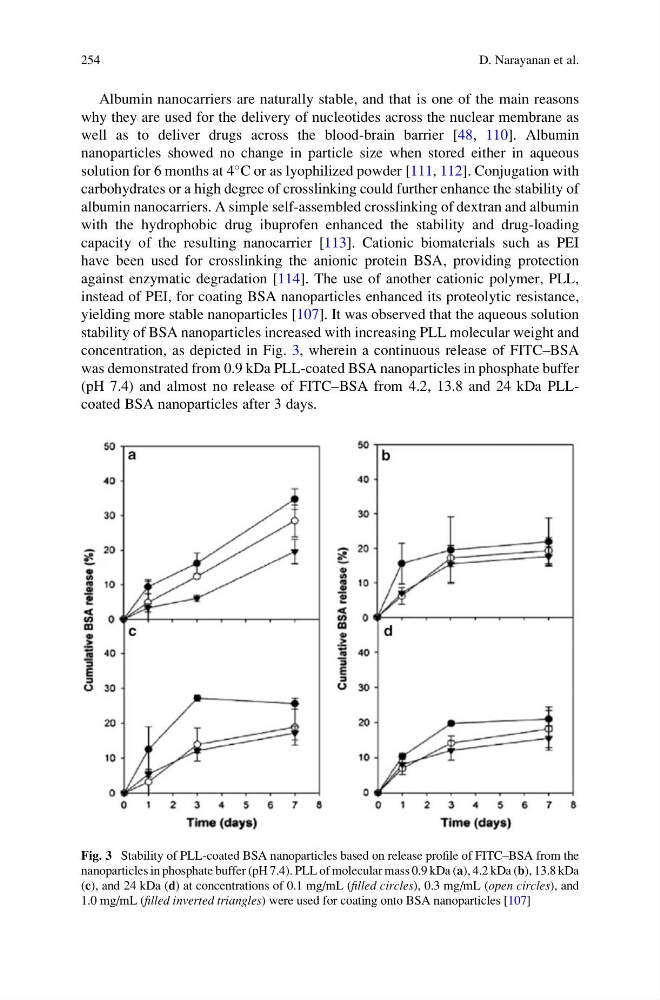
yielding more stable nanoparticles [107]. It was observed that the aqueous solution
stability of BSA nanoparticles increased with increasing PLL molecular weight and
concentration, as depicted in Fig. 3, wherein a continuous release of FITC–BSA
was demonstrated from 0.9 kDa PLL-coated BSA nanoparticles in phosphate buffer
(pH 7.4) and almost no release of FITC–BSA from 4.2, 13.8 and 24 kDa PLLcoated BSA nanoparticles after 3 days.
Fig. 3 Stability of PLL-coated BSA nanoparticles based on release profile of FITC–BSA from the
nanoparticles in phosphate buffer (pH 7.4). PLL of molecular mass 0.9 kDa (a), 4.2 kDa (b), 13.8 kDa
(c), and 24 kDa (d) at concentrations of 0.1 mg/mL (filled circles), 0.3 mg/mL (open circles), and
1.0 mg/mL (filled inverted triangles) were used for coating onto BSA nanoparticles [107]
254
D. Narayanan et al.
why they are used for the delivery of nucleotides across the nuclear membrane as
well as to deliver drugs across the blood-brain barrier [48, 110]. Albumin
nanoparticles showed no change in particle size when stored either in aqueous
solution for 6 months at 4
C or as lyophilized powder [111, 112]. Conjugation with
carbohydrates or a high degree of crosslinking could further enhance the stability of
albumin nanocarriers. A simple self-assembled crosslinking of dextran and albumin
with the hydrophobic drug ibuprofen enhanced the stability and drug-loading
capacity of the resulting nanocarrier [113]. Cationic biomaterials such as PEI
have been used for crosslinking the anionic protein BSA, providing protection
against enzymatic degradation [114]. The use of another cationic polymer, PLL,
instead of PEI, for coating BSA nanoparticles enhanced its proteolytic resistance,
yielding more stable nanoparticles [107]. It was observed that the aqueous solution
stability of BSA nanoparticles increased with increasing PLL molecular weight and
concentration, as depicted in Fig. 3, wherein a continuous release of FITC–BSA
was demonstrated from 0.9 kDa PLL-coated BSA nanoparticles in phosphate buffer
(pH 7.4) and almost no release of FITC–BSA from 4.2, 13.8 and 24 kDa PLLcoated BSA nanoparticles after 3 days.
Fig. 3 Stability of PLL-coated BSA nanoparticles based on release profile of FITC–BSA from the
nanoparticles in phosphate buffer (pH 7.4). PLL of molecular mass 0.9 kDa (a), 4.2 kDa (b), 13.8 kDa
(c), and 24 kDa (d) at concentrations of 0.1 mg/mL (filled circles), 0.3 mg/mL (open circles), and
1.0 mg/mL (filled inverted triangles) were used for coating onto BSA nanoparticles [107]
254
D. Narayanan et al.