

(HGF)-induced intracellular signaling in the breast cancer cell line MBA-MD-231
as potently as free EGCG [161]. EGCG-loaded bovine serum albumin (BSA) NPs
were targeted to prostate cancer cells (PC-3) via folate-mediated targeting:
18.363 mg of folate was conjugated per mg BSA and the uptake of folate-EGCGBSA NP by cultured PC-3 cells was 23.65 times the uptake of EGCG-BSA NPs in a
concentration-dependent manner. The cytotoxicity induced in PC-3 cells by the
targeted folate-EGCG-BSA NPs was higher (82.8%) than that induced by free
EGCG (58.6%) and non-targeted EGCG-BSA NPs (55.1%) [162].
All the above-mentioned studies demonstrate that nanoencapsulation into polymeric carriers could enhance the therapeutic effectiveness of natural agents such as
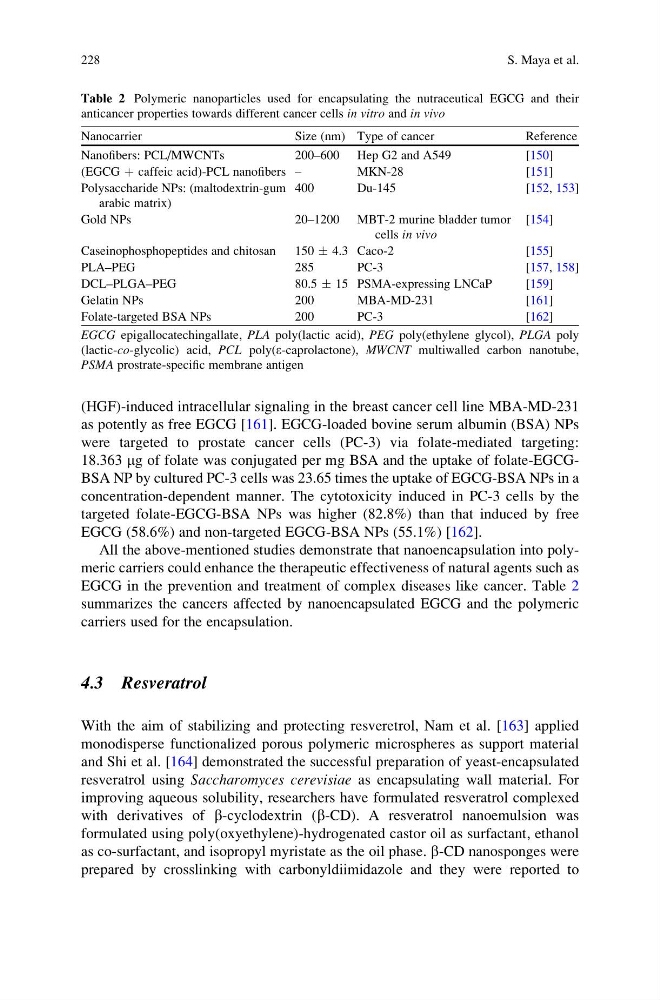
EGCG in the prevention and treatment of complex diseases like cancer. Table 2
summarizes the cancers affected by nanoencapsulated EGCG and the polymeric
carriers used for the encapsulation.
4.3 Resveratrol
With the aim of stabilizing and protecting resveretrol, Nam et al. [163] applied
monodisperse functionalized porous polymeric microspheres as support material
and Shi et al. [164] demonstrated the successful preparation of yeast-encapsulated
resveratrol using Saccharomyces cerevisiae as encapsulating wall material. For
improving aqueous solubility, researchers have formulated resveratrol complexed
with derivatives of b-cyclodextrin (b-CD). A resveratrol nanoemulsion was
formulated using poly(oxyethylene)-hydrogenated castor oil as surfactant, ethanol
as co-surfactant, and isopropyl myristate as the oil phase. b-CD nanosponges were
prepared by crosslinking with carbonyldiimidazole and they were reported to
Table 2 Polymeric nanoparticles used for encapsulating the nutraceutical EGCG and their
anticancer properties towards different cancer cells in vitro and in vivo
Nanocarrier
Size (nm) Type of cancer
Reference
Nanofibers: PCL/MWCNTs
200–600 Hep G2 and A549
[150]
(EGCG þ caffeic acid)-PCL nanofibers –
MKN-28
[151]
Polysaccharide NPs: (maltodextrin-gum
arabic matrix)
400
Du-145
[152, 153]
Gold NPs
20–1200 MBT-2 murine bladder tumor
cells in vivo
[154]
Caseinophosphopeptides and chitosan
150 Æ 4.3 Caco-2
[155]
PLA–PEG
285
PC-3
[157, 158]
DCL–PLGA–PEG
80.5 Æ 15 PSMA-expressing LNCaP
[159]
Gelatin NPs
200
MBA-MD-231
[161]
Folate-targeted BSA NPs
200
PC-3
[162]
EGCG epigallocatechingallate, PLA poly(lactic acid), PEG poly(ethylene glycol), PLGA poly
(lactic-co-glycolic) acid, PCL poly(e-caprolactone), MWCNT multiwalled carbon nanotube,
PSMA prostrate-specific membrane antigen
228
S. Maya et al.
as potently as free EGCG [161]. EGCG-loaded bovine serum albumin (BSA) NPs
were targeted to prostate cancer cells (PC-3) via folate-mediated targeting:
18.363 mg of folate was conjugated per mg BSA and the uptake of folate-EGCGBSA NP by cultured PC-3 cells was 23.65 times the uptake of EGCG-BSA NPs in a
concentration-dependent manner. The cytotoxicity induced in PC-3 cells by the
targeted folate-EGCG-BSA NPs was higher (82.8%) than that induced by free
EGCG (58.6%) and non-targeted EGCG-BSA NPs (55.1%) [162].
All the above-mentioned studies demonstrate that nanoencapsulation into polymeric carriers could enhance the therapeutic effectiveness of natural agents such as
EGCG in the prevention and treatment of complex diseases like cancer. Table 2
summarizes the cancers affected by nanoencapsulated EGCG and the polymeric
carriers used for the encapsulation.
4.3 Resveratrol
With the aim of stabilizing and protecting resveretrol, Nam et al. [163] applied
monodisperse functionalized porous polymeric microspheres as support material
and Shi et al. [164] demonstrated the successful preparation of yeast-encapsulated
resveratrol using Saccharomyces cerevisiae as encapsulating wall material. For
improving aqueous solubility, researchers have formulated resveratrol complexed
with derivatives of b-cyclodextrin (b-CD). A resveratrol nanoemulsion was
formulated using poly(oxyethylene)-hydrogenated castor oil as surfactant, ethanol
as co-surfactant, and isopropyl myristate as the oil phase. b-CD nanosponges were
prepared by crosslinking with carbonyldiimidazole and they were reported to
Table 2 Polymeric nanoparticles used for encapsulating the nutraceutical EGCG and their
anticancer properties towards different cancer cells in vitro and in vivo
Nanocarrier
Size (nm) Type of cancer
Reference
Nanofibers: PCL/MWCNTs
200–600 Hep G2 and A549
[150]
(EGCG þ caffeic acid)-PCL nanofibers –
MKN-28
[151]
Polysaccharide NPs: (maltodextrin-gum
arabic matrix)
400
Du-145
[152, 153]
Gold NPs
20–1200 MBT-2 murine bladder tumor
cells in vivo
[154]
Caseinophosphopeptides and chitosan
150 Æ 4.3 Caco-2
[155]
PLA–PEG
285
PC-3
[157, 158]
DCL–PLGA–PEG
80.5 Æ 15 PSMA-expressing LNCaP
[159]
Gelatin NPs
200
MBA-MD-231
[161]
Folate-targeted BSA NPs
200
PC-3
[162]
EGCG epigallocatechingallate, PLA poly(lactic acid), PEG poly(ethylene glycol), PLGA poly
(lactic-co-glycolic) acid, PCL poly(e-caprolactone), MWCNT multiwalled carbon nanotube,
PSMA prostrate-specific membrane antigen
228
S. Maya et al.