

the plant polyphenols released from the nanofibers. The study concluded that
nanofibers loaded with these potent polyphenols could offer long-term cancer
therapy and could also prevent a recurrence of cancer after surgical operations
[151].
The use of polysaccharide nanoparticles for delivering natural antioxidants
capable of inhibiting tumorigenesis was highlighted by studies on EGCG
encapsulated in carbohydrate particles to preserve its antioxidant properties and
improve its bioavailability. Polysaccharide-based NPs (maltodextrin-gum arabic
matrix) were fabricated and the presence of EGCG within the carbohydrate matrix
demonstrated by the intermolecular dipole–dipole interactions, maintaining its
integrity after the spray-drying process. The study also proved the ability of NPs
to retain the inhibitory effect of EGCG on the proliferative activity of prostate
cancer cells (Du145). The nanoencapsulated EGCG enhanced its inhibitory effect
on cell proliferation (10–20%) at lower concentrations (1–2 mM) compared with
free EGCG [152, 153].
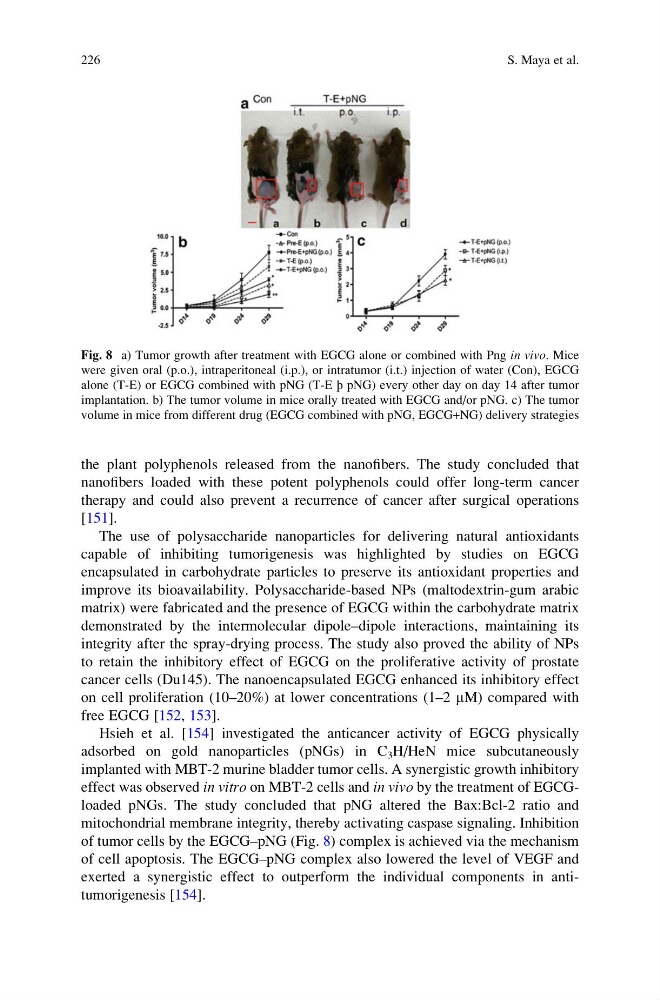
Hsieh et al. [154] investigated the anticancer activity of EGCG physically
adsorbed on gold nanoparticles (pNGs) in C 3 H/HeN mice subcutaneously
implanted with MBT-2 murine bladder tumor cells. A synergistic growth inhibitory
effect was observed in vitro on MBT-2 cells and in vivo by the treatment of EGCGloaded pNGs. The study concluded that pNG altered the Bax:Bcl-2 ratio and
mitochondrial membrane integrity, thereby activating caspase signaling. Inhibition
of tumor cells by the EGCG–pNG (Fig. 8) complex is achieved via the mechanism
of cell apoptosis. The EGCG–pNG complex also lowered the level of VEGF and
exerted a synergistic effect to outperform the individual components in antitumorigenesis [154].
Fig. 8 a) Tumor growth after treatment with EGCG alone or combined with Png in vivo. Mice
were given oral (p.o.), intraperitoneal (i.p.), or intratumor (i.t.) injection of water (Con), EGCG
alone (T-E) or EGCG combined with pNG (T-E þ pNG) every other day on day 14 after tumor
implantation. b) The tumor volume in mice orally treated with EGCG and/or pNG. c) The tumor
volume in mice from different drug (EGCG combined with pNG, EGCG+NG) delivery strategies
226
S. Maya et al.
nanofibers loaded with these potent polyphenols could offer long-term cancer
therapy and could also prevent a recurrence of cancer after surgical operations
[151].
The use of polysaccharide nanoparticles for delivering natural antioxidants
capable of inhibiting tumorigenesis was highlighted by studies on EGCG
encapsulated in carbohydrate particles to preserve its antioxidant properties and
improve its bioavailability. Polysaccharide-based NPs (maltodextrin-gum arabic
matrix) were fabricated and the presence of EGCG within the carbohydrate matrix
demonstrated by the intermolecular dipole–dipole interactions, maintaining its
integrity after the spray-drying process. The study also proved the ability of NPs
to retain the inhibitory effect of EGCG on the proliferative activity of prostate
cancer cells (Du145). The nanoencapsulated EGCG enhanced its inhibitory effect
on cell proliferation (10–20%) at lower concentrations (1–2 mM) compared with
free EGCG [152, 153].
Hsieh et al. [154] investigated the anticancer activity of EGCG physically
adsorbed on gold nanoparticles (pNGs) in C 3 H/HeN mice subcutaneously
implanted with MBT-2 murine bladder tumor cells. A synergistic growth inhibitory
effect was observed in vitro on MBT-2 cells and in vivo by the treatment of EGCGloaded pNGs. The study concluded that pNG altered the Bax:Bcl-2 ratio and
mitochondrial membrane integrity, thereby activating caspase signaling. Inhibition
of tumor cells by the EGCG–pNG (Fig. 8) complex is achieved via the mechanism
of cell apoptosis. The EGCG–pNG complex also lowered the level of VEGF and
exerted a synergistic effect to outperform the individual components in antitumorigenesis [154].
Fig. 8 a) Tumor growth after treatment with EGCG alone or combined with Png in vivo. Mice
were given oral (p.o.), intraperitoneal (i.p.), or intratumor (i.t.) injection of water (Con), EGCG
alone (T-E) or EGCG combined with pNG (T-E þ pNG) every other day on day 14 after tumor
implantation. b) The tumor volume in mice orally treated with EGCG and/or pNG. c) The tumor
volume in mice from different drug (EGCG combined with pNG, EGCG+NG) delivery strategies
226
S. Maya et al.