

Several thousand polyphenolic molecules have been identified in higher plants
and several hundred are found in edible plants. The phytochemicals are mainly plant
polyphenols (chemical substances characterized by more than one phenol unit per
molecule) composed of flavonoids and non-flavonoids. One or more hydroxyl groups
binding to one or more aromatic rings is the structural characteristic of these
polyphenols, which are classified according to the number of phenolic rings and
the structural elements linking to these rings [9–12]. Flavonoids share a common
flavan core formed with 15 carbon atoms, and this class can be divided into flavanols
(e.g. catechins), anthocyanidins (e.g. cyaniding, delphinidin), flavones (e.g. apigenin,
diosmin), flavanones (e.g. naringenin, hesperitin) and chalcones (e.g. phloretin).
The non-flavonoids contain an aromatic ring with one or more hydroxyl groups.
Non-flavonoids include stilbene (e.g. trans-resveratrol), phenolic acids (e.g. caffeic
acid, gallic acid), saponin (e.g. ginsenoside), and other polyphenols such as curcumin
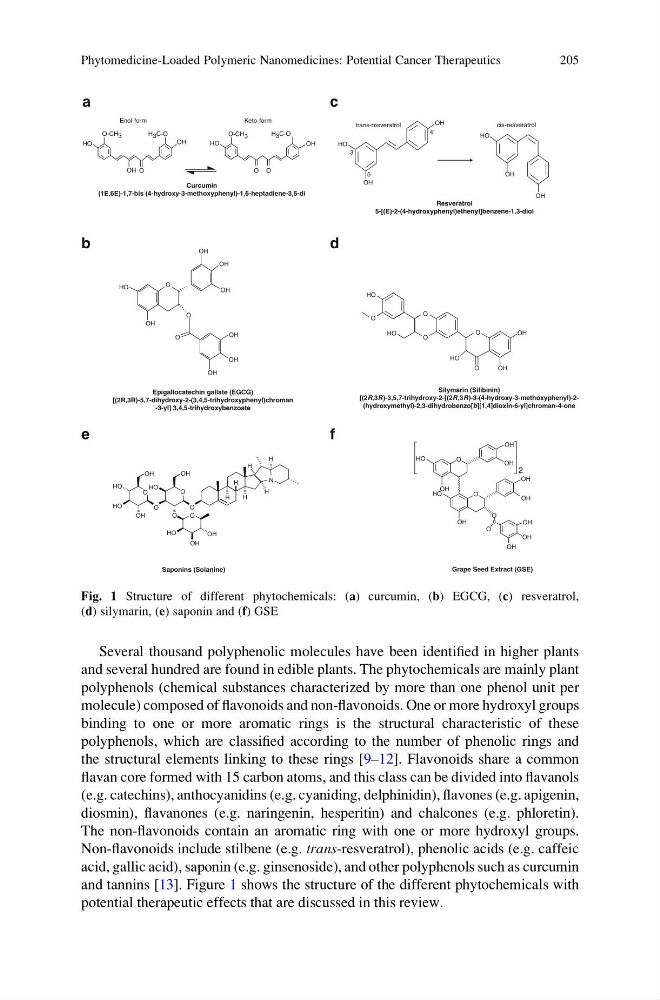
and tannins [13]. Figure 1 shows the structure of the different phytochemicals with
potential therapeutic effects that are discussed in this review.
Enol-form
Keto-form
HO
HO
OH O
O O
OH
OH
O-CH 3
O-CH 3
H 3 C-O
H 3 C-O
Curcumin
(1E,6E)-1,7-bis (4-hydroxy-3-methoxyphenyl)-1,6-heptadiene-3,5-di
OH
OH
OH
OH
OH
HO
HO
HO
HO
O
O
O
O
O
O
H
H
H
H
H
N
H
Saponins (Solanine)
a
e
HO
OH
OH
OH
OH
OH
OH
OH
O
O
O
Epigallocatechin gallate (EGCG)
[(2R,3R)-5,7-dihydroxy-2-(3,4,5-trihydroxyphenyl)chroman
-3-yl] 3,4,5-trihydroxybenzoate
b
OH
OH
OH
OH
HO
HO
3
5
4’
trans-resveratrol
cis-resveratrol
Resveratrol
5-[(E)-2-(4-hydroxyphenyl)ethenyl]benzene-1,3-diol
Grape Seed Extract (GSE)
HO
O
OH
OH
OH
OH
OH
OH
OH
HO
OH
OH
O
O
c
O
2
HO
HO
HO
OH
OH
O
O
O
O
O
Silymarin (Silibinin)
[(2R,3R)-3,5,7-trihydroxy-2-[(2R,3R)-3-(4-hydroxy-3-methoxyphenyl)-2(hydroxymethyl)-2,3-dihydrobenzo[b][1,4]dioxin-6-yl]chroman-4-one
c
d
f
Fig. 1 Structure of different phytochemicals: (a) curcumin, (b) EGCG, (c) resveratrol,
(d) silymarin, (e) saponin and (f) GSE
Phytomedicine-Loaded Polymeric Nanomedicines: Potential Cancer Therapeutics
205
and several hundred are found in edible plants. The phytochemicals are mainly plant
polyphenols (chemical substances characterized by more than one phenol unit per
molecule) composed of flavonoids and non-flavonoids. One or more hydroxyl groups
binding to one or more aromatic rings is the structural characteristic of these
polyphenols, which are classified according to the number of phenolic rings and
the structural elements linking to these rings [9–12]. Flavonoids share a common
flavan core formed with 15 carbon atoms, and this class can be divided into flavanols
(e.g. catechins), anthocyanidins (e.g. cyaniding, delphinidin), flavones (e.g. apigenin,
diosmin), flavanones (e.g. naringenin, hesperitin) and chalcones (e.g. phloretin).
The non-flavonoids contain an aromatic ring with one or more hydroxyl groups.
Non-flavonoids include stilbene (e.g. trans-resveratrol), phenolic acids (e.g. caffeic
acid, gallic acid), saponin (e.g. ginsenoside), and other polyphenols such as curcumin
and tannins [13]. Figure 1 shows the structure of the different phytochemicals with
potential therapeutic effects that are discussed in this review.
Enol-form
Keto-form
HO
HO
OH O
O O
OH
OH
O-CH 3
O-CH 3
H 3 C-O
H 3 C-O
Curcumin
(1E,6E)-1,7-bis (4-hydroxy-3-methoxyphenyl)-1,6-heptadiene-3,5-di
OH
OH
OH
OH
OH
HO
HO
HO
HO
O
O
O
O
O
O
H
H
H
H
H
N
H
Saponins (Solanine)
a
e
HO
OH
OH
OH
OH
OH
OH
OH
O
O
O
Epigallocatechin gallate (EGCG)
[(2R,3R)-5,7-dihydroxy-2-(3,4,5-trihydroxyphenyl)chroman
-3-yl] 3,4,5-trihydroxybenzoate
b
OH
OH
OH
OH
HO
HO
3
5
4’
trans-resveratrol
cis-resveratrol
Resveratrol
5-[(E)-2-(4-hydroxyphenyl)ethenyl]benzene-1,3-diol
Grape Seed Extract (GSE)
HO
O
OH
OH
OH
OH
OH
OH
OH
HO
OH
OH
O
O
c
O
2
HO
HO
HO
OH
OH
O
O
O
O
O
Silymarin (Silibinin)
[(2R,3R)-3,5,7-trihydroxy-2-[(2R,3R)-3-(4-hydroxy-3-methoxyphenyl)-2(hydroxymethyl)-2,3-dihydrobenzo[b][1,4]dioxin-6-yl]chroman-4-one
c
d
f
Fig. 1 Structure of different phytochemicals: (a) curcumin, (b) EGCG, (c) resveratrol,
(d) silymarin, (e) saponin and (f) GSE
Phytomedicine-Loaded Polymeric Nanomedicines: Potential Cancer Therapeutics
205