

macromolecular chain of CTS can be stiff as well as having the ability to stabilize a
liquid crystalline phase in acetic acid solution [124]. The stiffness of the macromolecular chain of CTS is very sensitive to pH and a small change in pH can change
the properties of the chain. The application of CTS and its derivatives to nonviral
gene delivery has been described in many papers, and Gerrit gives an overview of
transfection studies that have been performed recently using CTS as transfection
agent [125]. Many researchers have also attempted to modify the properties of CTS.
The novel properties of CTS make it a versatile biomaterial for cell therapy, tissue
engineering, and gene therapy. It is believed that these diverse approaches for
regenerative medicine will produce materials with the required properties for the
future [126]. For biomedical applications, CTS hydrogels and networks (for
instance, interpenetrating polymer networks) formed by aggregation or complexation have been developed [127]. CTS-based products have also been used for the
delivery of chemotherapeutics such as antibiotics, antiparasitics, anesthetics,
painkillers, and growth promotants to mucosal epithelium for absorption for local
or systemic activity [128].
CTS-derived products have found wide application in cosmetic formulations and
these products are highly commercialized. Interesting characteristics that render
CTS suitable for biomedical applications are a minimal foreign body reaction, an
intrinsic antibacterial nature, and the ability to be molded into various geometries
and forms such as porous structures that are suitable for cell ingrowth and
osteoconduction. Due to its favorable gelling properties, CTS can deliver morphogenic factors and pharmaceutical agents in a controlled fashion. Its cationic nature
allows it to form a complex with DNA molecules, making it an ideal candidate for
gene delivery strategies [118, 129–131]. Covalent crosslinking of CTS leads to the
O
H
O
H
HO
H
NHCOCH 3
H
O
OH
O
H
H
HO
H
NHCOCH 3
H
O
HO
aq NaOH
Partial Deacetylation
Chitin
O
H
H
HO
H
NHCOCH 3
H
O
OH
O
H
O
H
HO
H
NH 2
H
O
OH
O
H
H
HO
H
NHCOCH 3
H
O
HO
O
H
H
HO
H
NH 2
H
O
OH
Chitosan
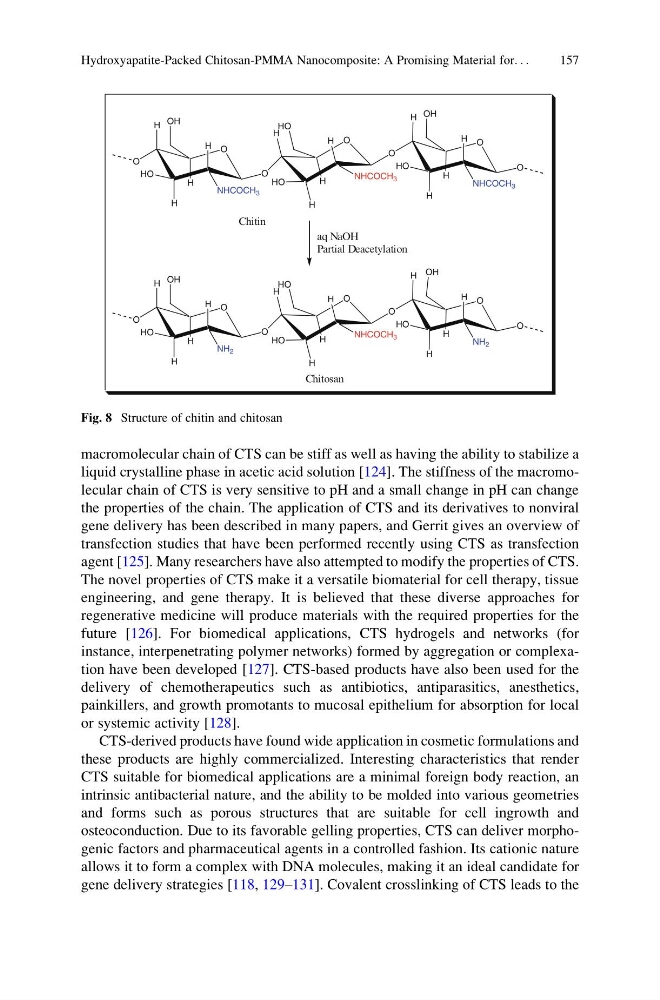
Fig. 8 Structure of chitin and chitosan
Hydroxyapatite-Packed Chitosan-PMMA Nanocomposite: A Promising Material for. . .
157
liquid crystalline phase in acetic acid solution [124]. The stiffness of the macromolecular chain of CTS is very sensitive to pH and a small change in pH can change
the properties of the chain. The application of CTS and its derivatives to nonviral
gene delivery has been described in many papers, and Gerrit gives an overview of
transfection studies that have been performed recently using CTS as transfection
agent [125]. Many researchers have also attempted to modify the properties of CTS.
The novel properties of CTS make it a versatile biomaterial for cell therapy, tissue
engineering, and gene therapy. It is believed that these diverse approaches for
regenerative medicine will produce materials with the required properties for the
future [126]. For biomedical applications, CTS hydrogels and networks (for
instance, interpenetrating polymer networks) formed by aggregation or complexation have been developed [127]. CTS-based products have also been used for the
delivery of chemotherapeutics such as antibiotics, antiparasitics, anesthetics,
painkillers, and growth promotants to mucosal epithelium for absorption for local
or systemic activity [128].
CTS-derived products have found wide application in cosmetic formulations and
these products are highly commercialized. Interesting characteristics that render
CTS suitable for biomedical applications are a minimal foreign body reaction, an
intrinsic antibacterial nature, and the ability to be molded into various geometries
and forms such as porous structures that are suitable for cell ingrowth and
osteoconduction. Due to its favorable gelling properties, CTS can deliver morphogenic factors and pharmaceutical agents in a controlled fashion. Its cationic nature
allows it to form a complex with DNA molecules, making it an ideal candidate for
gene delivery strategies [118, 129–131]. Covalent crosslinking of CTS leads to the
O
H
O
H
HO
H
NHCOCH 3
H
O
OH
O
H
H
HO
H
NHCOCH 3
H
O
HO
aq NaOH
Partial Deacetylation
Chitin
O
H
H
HO
H
NHCOCH 3
H
O
OH
O
H
O
H
HO
H
NH 2
H
O
OH
O
H
H
HO
H
NHCOCH 3
H
O
HO
O
H
H
HO
H
NH 2
H
O
OH
Chitosan
Fig. 8 Structure of chitin and chitosan
Hydroxyapatite-Packed Chitosan-PMMA Nanocomposite: A Promising Material for. . .
157