

for drugs, enzymes, protein, genes, and catalysts [169–174]. HPNSPs have a large
surface-to-volume ratio, low effective density, and many other advantageous
properties in comparison to cylindrical HPNSs, which makes them suitable for
applications in encapsulation, catalysis, controlled drug delivery, and imaging.
HPNSPs from various polymeric materials have been developed. Here, some
hollow chitosan-based nanospheres will be described. HPNSPs have been prepared
by suspension polymerization and emulsion polymerization, and from core–shell
nanoparticles, self-assembly, template-directed synthesis, and electrospinning.
Among them, water–oil–water (W/O/W) emulsion polymerization is a convenient
and economical means for the preparation of hollow polymeric micro- or
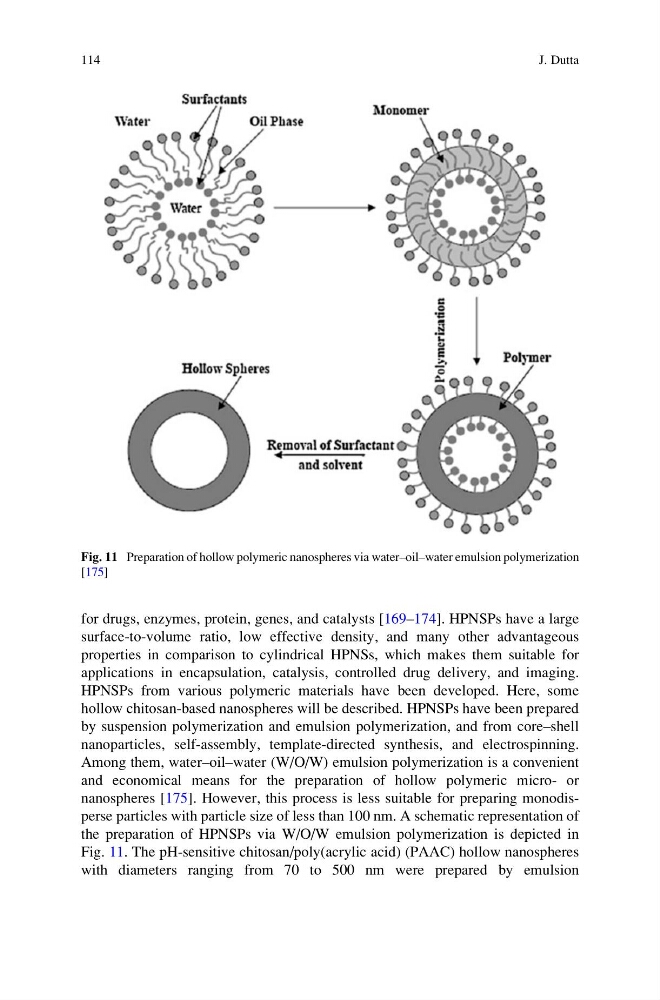
nanospheres [175]. However, this process is less suitable for preparing monodisperse particles with particle size of less than 100 nm. A schematic representation of
the preparation of HPNSPs via W/O/W emulsion polymerization is depicted in
Fig. 11. The pH-sensitive chitosan/poly(acrylic acid) (PAAC) hollow nanospheres
with diameters ranging from 70 to 500 nm were prepared by emulsion
Fig. 11 Preparation of hollow polymeric nanospheres via water–oil–water emulsion polymerization
[175]
114
J. Dutta
surface-to-volume ratio, low effective density, and many other advantageous
properties in comparison to cylindrical HPNSs, which makes them suitable for
applications in encapsulation, catalysis, controlled drug delivery, and imaging.
HPNSPs from various polymeric materials have been developed. Here, some
hollow chitosan-based nanospheres will be described. HPNSPs have been prepared
by suspension polymerization and emulsion polymerization, and from core–shell
nanoparticles, self-assembly, template-directed synthesis, and electrospinning.
Among them, water–oil–water (W/O/W) emulsion polymerization is a convenient
and economical means for the preparation of hollow polymeric micro- or
nanospheres [175]. However, this process is less suitable for preparing monodisperse particles with particle size of less than 100 nm. A schematic representation of
the preparation of HPNSPs via W/O/W emulsion polymerization is depicted in
Fig. 11. The pH-sensitive chitosan/poly(acrylic acid) (PAAC) hollow nanospheres
with diameters ranging from 70 to 500 nm were prepared by emulsion
Fig. 11 Preparation of hollow polymeric nanospheres via water–oil–water emulsion polymerization
[175]
114
J. Dutta