

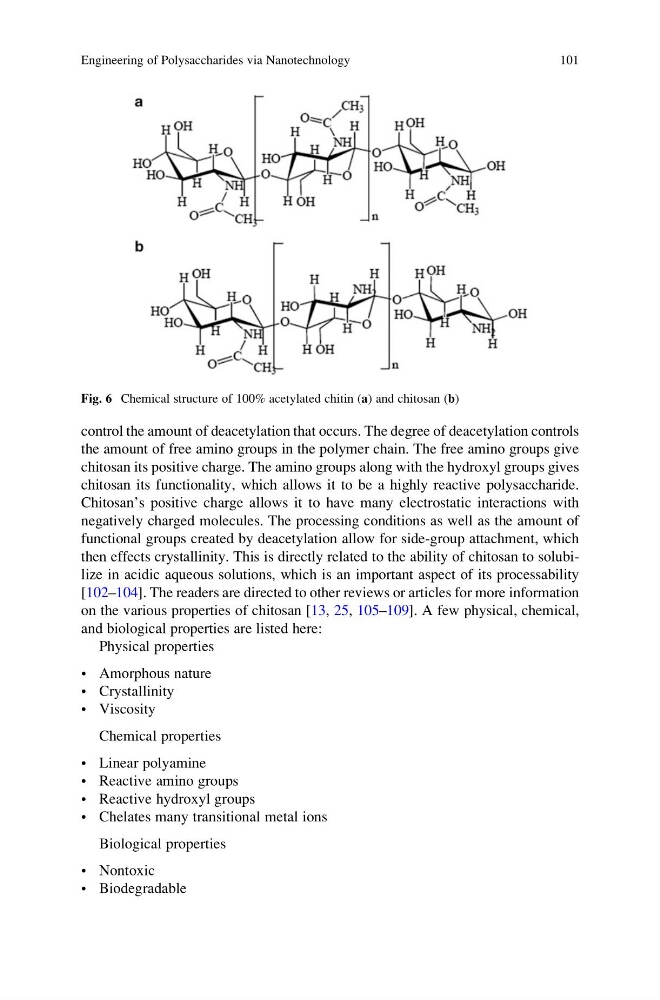
control the amount of deacetylation that occurs. The degree of deacetylation controls
the amount of free amino groups in the polymer chain. The free amino groups give
chitosan its positive charge. The amino groups along with the hydroxyl groups gives
chitosan its functionality, which allows it to be a highly reactive polysaccharide.
Chitosan’s positive charge allows it to have many electrostatic interactions with
negatively charged molecules. The processing conditions as well as the amount of
functional groups created by deacetylation allow for side-group attachment, which
then effects crystallinity. This is directly related to the ability of chitosan to solubilize in acidic aqueous solutions, which is an important aspect of its processability
[102–104]. The readers are directed to other reviews or articles for more information
on the various properties of chitosan [13, 25, 105–109]. A few physical, chemical,
and biological properties are listed here:
Physical properties
• Amorphous nature
• Crystallinity
• Viscosity
Chemical properties
• Linear polyamine
• Reactive amino groups
• Reactive hydroxyl groups
• Chelates many transitional metal ions
Biological properties
• Nontoxic
• Biodegradable
Fig. 6 Chemical structure of 100% acetylated chitin (a) and chitosan (b)
Engineering of Polysaccharides via Nanotechnology
101
the amount of free amino groups in the polymer chain. The free amino groups give
chitosan its positive charge. The amino groups along with the hydroxyl groups gives
chitosan its functionality, which allows it to be a highly reactive polysaccharide.
Chitosan’s positive charge allows it to have many electrostatic interactions with
negatively charged molecules. The processing conditions as well as the amount of
functional groups created by deacetylation allow for side-group attachment, which
then effects crystallinity. This is directly related to the ability of chitosan to solubilize in acidic aqueous solutions, which is an important aspect of its processability
[102–104]. The readers are directed to other reviews or articles for more information
on the various properties of chitosan [13, 25, 105–109]. A few physical, chemical,
and biological properties are listed here:
Physical properties
• Amorphous nature
• Crystallinity
• Viscosity
Chemical properties
• Linear polyamine
• Reactive amino groups
• Reactive hydroxyl groups
• Chelates many transitional metal ions
Biological properties
• Nontoxic
• Biodegradable
Fig. 6 Chemical structure of 100% acetylated chitin (a) and chitosan (b)
Engineering of Polysaccharides via Nanotechnology
101