

4 Some Biochemical Reflections on Information and Communication
81
to consider the nuclear organization, while knowing in principle that one can recover the complementary portrait in the more complex world of the light carrier via
the Generalized Master Equation.
The intimate relation between the guardians of the blue print (DNA-RNA) and
the proteins as responsible for the business of life, see Refs. [40, 41], prompts
the establishment of a nested code, where the codon triplets defines the actual
amino acid and the sequence of amino acids builds the protein. Note that SzentGyörgyi [40, 41], already more than 70 years ago, did postulate electron conduction
along the main polypeptide chain of the main protein, a hypothesis that the scientific community did not originally accept, see e.g. Ref. [42]. It was, however,
corroborated by Ladik and Ye [43] half a century later. Incidentally we have here
a clear indication of the mirroring symmetry between the non-equilibrium nuclear
degrees of freedom and the electronic motion. The proton tunnelling movement in
the hydrogen bond is, at this juncture, commensurate with electron transfer through
several different proteins, similar to the situation in photosynthesis or the case of
oxidation-reduction enzymes. As will be seen below, this relationship calls for an
encoding that incorporates at the same time the molecular-, the super-molecular and
the cellular levels.
4.4 The Nested Code and the Cell Quality Factor
The puzzle or question: why are there four bases in DNA and what role is played by
the natural selection, NS, of the coding form has been belaboured on and off since
the origin of the work of Watson and Crick, see e.g. Ref. [44] for various inherent
constraining requirements on the coding system itself considering the efficiency of
performing the code’s biological roles. As seen below, we will attempt to go beyond the model of a linear sequence of symbols “under the constraint of a constant
number of units in a symbol pool”, Ref. [44], and assemble a more flexible scheme
based on non-commutative factorizations of the STN-graph.
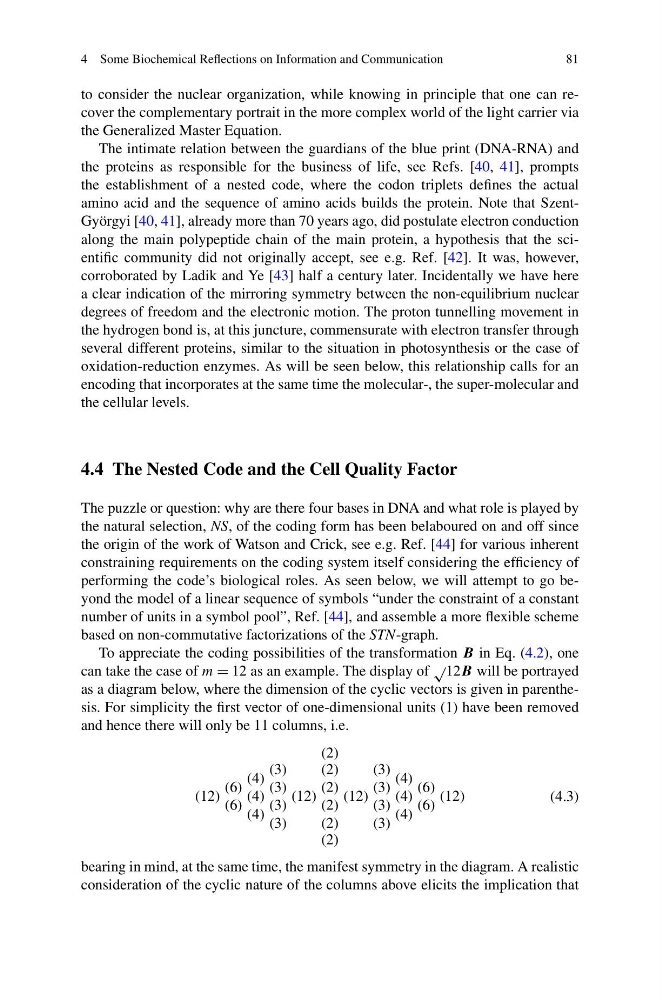
To appreciate the coding possibilities of the transformation B in Eq. (4.2), one
can take the case of m = 12 as an example. The display of
√ 12B will be portrayed
as a diagram below, where the dimension of the cyclic vectors is given in parenthesis. For simplicity the first vector of one-dimensional units (1) have been removed
and hence there will only be 11 columns, i.e.
(2)
(3)
(2)
(3)
(4)
( 4)
(6)
(3)
(2)
(3)
(6)
(12)
(4)
(12)
(12)
(4)
(12)
(6)
(3)
(2)
(3)
(6)
(4)
( 4)
(3)
(2)
(3)
(2)
(4.3)
bearing in mind, at the same time, the manifest symmetry in the diagram. A realistic
consideration of the cyclic nature of the columns above elicits the implication that
81
to consider the nuclear organization, while knowing in principle that one can recover the complementary portrait in the more complex world of the light carrier via
the Generalized Master Equation.
The intimate relation between the guardians of the blue print (DNA-RNA) and
the proteins as responsible for the business of life, see Refs. [40, 41], prompts
the establishment of a nested code, where the codon triplets defines the actual
amino acid and the sequence of amino acids builds the protein. Note that SzentGyörgyi [40, 41], already more than 70 years ago, did postulate electron conduction
along the main polypeptide chain of the main protein, a hypothesis that the scientific community did not originally accept, see e.g. Ref. [42]. It was, however,
corroborated by Ladik and Ye [43] half a century later. Incidentally we have here
a clear indication of the mirroring symmetry between the non-equilibrium nuclear
degrees of freedom and the electronic motion. The proton tunnelling movement in
the hydrogen bond is, at this juncture, commensurate with electron transfer through
several different proteins, similar to the situation in photosynthesis or the case of
oxidation-reduction enzymes. As will be seen below, this relationship calls for an
encoding that incorporates at the same time the molecular-, the super-molecular and
the cellular levels.
4.4 The Nested Code and the Cell Quality Factor
The puzzle or question: why are there four bases in DNA and what role is played by
the natural selection, NS, of the coding form has been belaboured on and off since
the origin of the work of Watson and Crick, see e.g. Ref. [44] for various inherent
constraining requirements on the coding system itself considering the efficiency of
performing the code’s biological roles. As seen below, we will attempt to go beyond the model of a linear sequence of symbols “under the constraint of a constant
number of units in a symbol pool”, Ref. [44], and assemble a more flexible scheme
based on non-commutative factorizations of the STN-graph.
To appreciate the coding possibilities of the transformation B in Eq. (4.2), one
can take the case of m = 12 as an example. The display of
√ 12B will be portrayed
as a diagram below, where the dimension of the cyclic vectors is given in parenthesis. For simplicity the first vector of one-dimensional units (1) have been removed
and hence there will only be 11 columns, i.e.
(2)
(3)
(2)
(3)
(4)
( 4)
(6)
(3)
(2)
(3)
(6)
(12)
(4)
(12)
(12)
(4)
(12)
(6)
(3)
(2)
(3)
(6)
(4)
( 4)
(3)
(2)
(3)
(2)
(4.3)
bearing in mind, at the same time, the manifest symmetry in the diagram. A realistic
consideration of the cyclic nature of the columns above elicits the implication that