

4 Some Biochemical Reflections on Information and Communication
79
of medicine, but it also brings up new challenges, such as what differentiates various somatic cells from each other and how does the cell in a stable culture environment, including other cells of similar mode (homeostasis), communicate its tasks
and responsibilities to the cell nucleus thereby starting the appropriate program to
generate the necessary information in agreement with its position in the hierarchy
of the organism.
In Appendices A and B, we have examined the dynamics of the DNA structure of
the cell nucleus and on the next level described the evolution of the cell. The central
request for information concerns the cellular signal opening up the program stored
in the cell nucleus. In the search for answers one recognizes the conditions related to
one of Darwin’s basic evolutionary mechanism, i.e. Natural Selection, NS. In the entropic language of Shannon the constraints of the signal probability, and further the
dynamics of the signal generator is entailed, while maintaining the far from equilibrium situation. In consequence one must incorporate simultaneously, thermo-,
morpho-, and teleodynamics, using the term self-organization more or less synonymously with morphodynamics. In other words, therefore, self-organisation is the
expression of the intrinsic thermodynamics of the STN constitution that gets “articulated” within a specific non-equilibrium boundary condition. NS, quoting Ref. [10],
is a function of the organization of the system’s internal non-equilibrium dynamics
with respect to non-intrinsic external conditions.
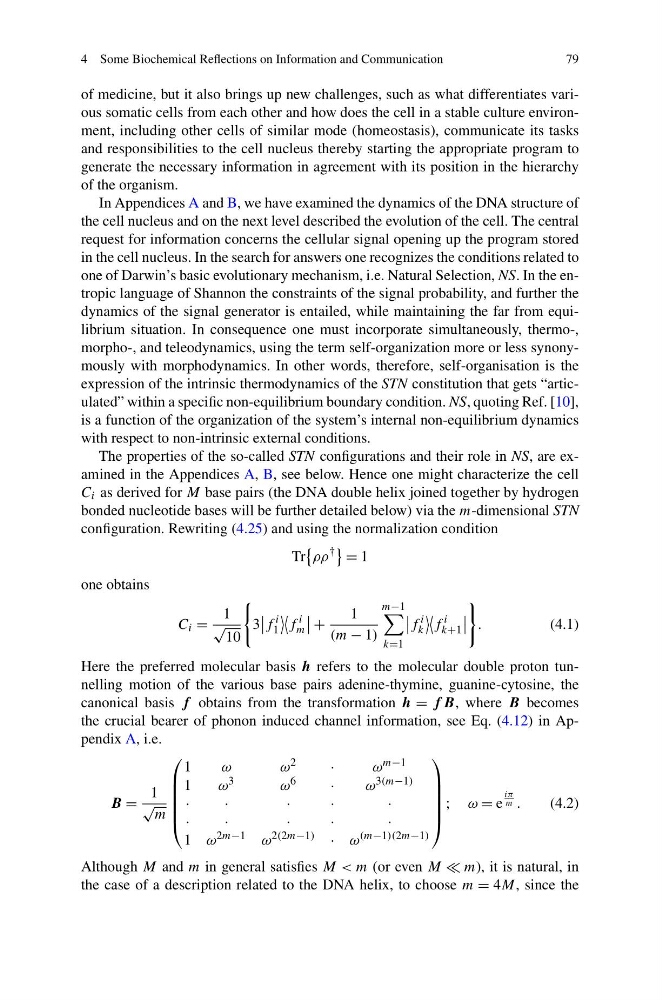
The properties of the so-called STN configurations and their role in NS, are examined in the Appendices A, B, see below. Hence one might characterize the cell
C i as derived for M base pairs (the DNA double helix joined together by hydrogen
bonded nucleotide bases will be further detailed below) via the m-dimensional STN
configuration. Rewriting (4.25) and using the normalization condition
Tr
ρρ
†
= 1
one obtains
C i =
1
√
10
3
f
i
1
f
i
m
+
1
(m − 1)
m−1
k=1
f
i
k
f
i
k+1
.
(4.1)
Here the preferred molecular basis h refers to the molecular double proton tunnelling motion of the various base pairs adenine-thymine, guanine-cytosine, the
canonical basis f obtains from the transformation h = f B, where B becomes
the crucial bearer of phonon induced channel information, see Eq. (4.12) in Appendix A, i.e.
B =
1
√
m
⎛
⎜
⎜
⎜
⎜
⎝
1
ω
ω 2
·
ω m−1
1
ω 3
ω 6
·
ω 3(m−1)
·
·
·
·
·
·
·
·
·
·
1 ω 2m−1 ω 2(2m−1) · ω (m−1)(2m−1)
⎞
⎟
⎟
⎟
⎟
⎠
; ω = e
iπ
m .
(4.2)
Although M and m in general satisfies M < m (or even M m), it is natural, in
the case of a description related to the DNA helix, to choose m = 4M, since the
79
of medicine, but it also brings up new challenges, such as what differentiates various somatic cells from each other and how does the cell in a stable culture environment, including other cells of similar mode (homeostasis), communicate its tasks
and responsibilities to the cell nucleus thereby starting the appropriate program to
generate the necessary information in agreement with its position in the hierarchy
of the organism.
In Appendices A and B, we have examined the dynamics of the DNA structure of
the cell nucleus and on the next level described the evolution of the cell. The central
request for information concerns the cellular signal opening up the program stored
in the cell nucleus. In the search for answers one recognizes the conditions related to
one of Darwin’s basic evolutionary mechanism, i.e. Natural Selection, NS. In the entropic language of Shannon the constraints of the signal probability, and further the
dynamics of the signal generator is entailed, while maintaining the far from equilibrium situation. In consequence one must incorporate simultaneously, thermo-,
morpho-, and teleodynamics, using the term self-organization more or less synonymously with morphodynamics. In other words, therefore, self-organisation is the
expression of the intrinsic thermodynamics of the STN constitution that gets “articulated” within a specific non-equilibrium boundary condition. NS, quoting Ref. [10],
is a function of the organization of the system’s internal non-equilibrium dynamics
with respect to non-intrinsic external conditions.
The properties of the so-called STN configurations and their role in NS, are examined in the Appendices A, B, see below. Hence one might characterize the cell
C i as derived for M base pairs (the DNA double helix joined together by hydrogen
bonded nucleotide bases will be further detailed below) via the m-dimensional STN
configuration. Rewriting (4.25) and using the normalization condition
Tr
ρρ
†
= 1
one obtains
C i =
1
√
10
3
f
i
1
f
i
m
+
1
(m − 1)
m−1
k=1
f
i
k
f
i
k+1
.
(4.1)
Here the preferred molecular basis h refers to the molecular double proton tunnelling motion of the various base pairs adenine-thymine, guanine-cytosine, the
canonical basis f obtains from the transformation h = f B, where B becomes
the crucial bearer of phonon induced channel information, see Eq. (4.12) in Appendix A, i.e.
B =
1
√
m
⎛
⎜
⎜
⎜
⎜
⎝
1
ω
ω 2
·
ω m−1
1
ω 3
ω 6
·
ω 3(m−1)
·
·
·
·
·
·
·
·
·
·
1 ω 2m−1 ω 2(2m−1) · ω (m−1)(2m−1)
⎞
⎟
⎟
⎟
⎟
⎠
; ω = e
iπ
m .
(4.2)
Although M and m in general satisfies M < m (or even M m), it is natural, in
the case of a description related to the DNA helix, to choose m = 4M, since the