

76
E.J. Brändas
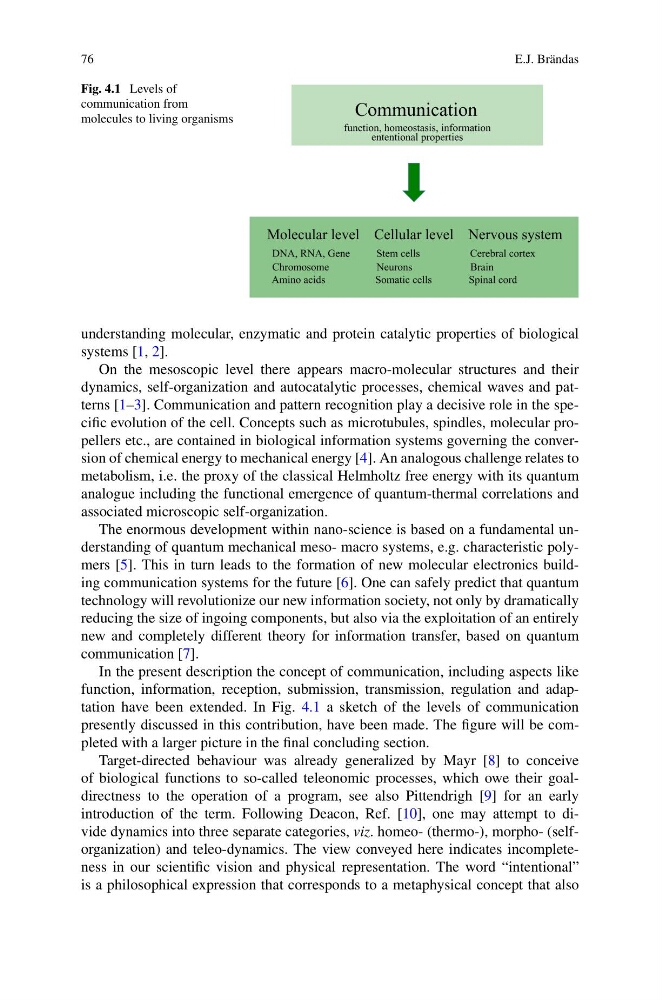
Fig. 4.1 Levels of
communication from
molecules to living organisms
understanding molecular, enzymatic and protein catalytic properties of biological
systems [1, 2].
On the mesoscopic level there appears macro-molecular structures and their
dynamics, self-organization and autocatalytic processes, chemical waves and patterns [1–3]. Communication and pattern recognition play a decisive role in the specific evolution of the cell. Concepts such as microtubules, spindles, molecular propellers etc., are contained in biological information systems governing the conversion of chemical energy to mechanical energy [4]. An analogous challenge relates to
metabolism, i.e. the proxy of the classical Helmholtz free energy with its quantum
analogue including the functional emergence of quantum-thermal correlations and
associated microscopic self-organization.
The enormous development within nano-science is based on a fundamental understanding of quantum mechanical meso- macro systems, e.g. characteristic polymers [5]. This in turn leads to the formation of new molecular electronics building communication systems for the future [6]. One can safely predict that quantum
technology will revolutionize our new information society, not only by dramatically
reducing the size of ingoing components, but also via the exploitation of an entirely
new and completely different theory for information transfer, based on quantum
communication [7].
In the present description the concept of communication, including aspects like
function, information, reception, submission, transmission, regulation and adaptation have been extended. In Fig. 4.1 a sketch of the levels of communication
presently discussed in this contribution, have been made. The figure will be completed with a larger picture in the final concluding section.
Target-directed behaviour was already generalized by Mayr [8] to conceive
of biological functions to so-called teleonomic processes, which owe their goaldirectness to the operation of a program, see also Pittendrigh [9] for an early
introduction of the term. Following Deacon, Ref. [10], one may attempt to divide dynamics into three separate categories, viz. homeo- (thermo-), morpho- (selforganization) and teleo-dynamics. The view conveyed here indicates incompleteness in our scientific vision and physical representation. The word “intentional”
is a philosophical expression that corresponds to a metaphysical concept that also
E.J. Brändas
Fig. 4.1 Levels of
communication from
molecules to living organisms
understanding molecular, enzymatic and protein catalytic properties of biological
systems [1, 2].
On the mesoscopic level there appears macro-molecular structures and their
dynamics, self-organization and autocatalytic processes, chemical waves and patterns [1–3]. Communication and pattern recognition play a decisive role in the specific evolution of the cell. Concepts such as microtubules, spindles, molecular propellers etc., are contained in biological information systems governing the conversion of chemical energy to mechanical energy [4]. An analogous challenge relates to
metabolism, i.e. the proxy of the classical Helmholtz free energy with its quantum
analogue including the functional emergence of quantum-thermal correlations and
associated microscopic self-organization.
The enormous development within nano-science is based on a fundamental understanding of quantum mechanical meso- macro systems, e.g. characteristic polymers [5]. This in turn leads to the formation of new molecular electronics building communication systems for the future [6]. One can safely predict that quantum
technology will revolutionize our new information society, not only by dramatically
reducing the size of ingoing components, but also via the exploitation of an entirely
new and completely different theory for information transfer, based on quantum
communication [7].
In the present description the concept of communication, including aspects like
function, information, reception, submission, transmission, regulation and adaptation have been extended. In Fig. 4.1 a sketch of the levels of communication
presently discussed in this contribution, have been made. The figure will be completed with a larger picture in the final concluding section.
Target-directed behaviour was already generalized by Mayr [8] to conceive
of biological functions to so-called teleonomic processes, which owe their goaldirectness to the operation of a program, see also Pittendrigh [9] for an early
introduction of the term. Following Deacon, Ref. [10], one may attempt to divide dynamics into three separate categories, viz. homeo- (thermo-), morpho- (selforganization) and teleo-dynamics. The view conveyed here indicates incompleteness in our scientific vision and physical representation. The word “intentional”
is a philosophical expression that corresponds to a metaphysical concept that also