

50
M. Svrˇ cek
while the remaining 80 % consisted of rotational and translational contributions, even if considering molecules at rest, i.e. they neither rotate nor move.
This comparison is very important because the field equations used in the theory of solids and derived from the B-O approximation, kept only the first term in
(2.30), which is in complete contrast to the Born-Handy ansatz. From the identity of (2.29) and (2.30), we can clearly see how the mechanical and the field
approaches get by differently with the inaccurate determination of the centre of
gravity, however, eventually leading to the same results, i.e. that the mechanical
Born-Handy ansatz is equivalent to the relativistic field correction.
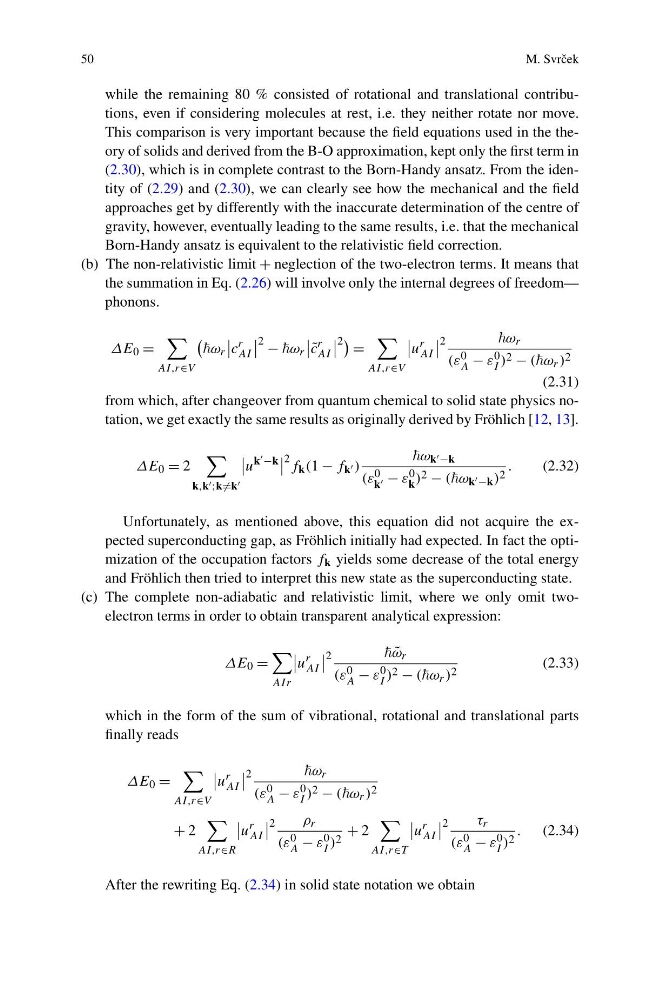
(b) The non-relativistic limit + neglection of the two-electron terms. It means that
the summation in Eq. (2.26) will involve only the internal degrees of freedom—
phonons.
ΔE 0 =
AI,r∈V
ω r
c
r
AI
2 − ω r
˜
c
r
AI
2 =
AI,r∈V
u
r
AI
2
ω r
(ε 0
A − ε 0
I ) 2 − (ω r ) 2
(2.31)
from which, after changeover from quantum chemical to solid state physics notation, we get exactly the same results as originally derived by Fröhlich [12, 13].
ΔE 0 = 2
k,k ;k =k
u
k −k
2 f k (1 − f k )
ω k −k
(ε 0
k − ε 0
k ) 2 − (ω k −k ) 2
.
(2.32)
Unfortunately, as mentioned above, this equation did not acquire the expected superconducting gap, as Fröhlich initially had expected. In fact the optimization of the occupation factors f k yields some decrease of the total energy
and Fröhlich then tried to interpret this new state as the superconducting state.
(c) The complete non-adiabatic and relativistic limit, where we only omit twoelectron terms in order to obtain transparent analytical expression:
ΔE 0 =
AI r
u
r
AI
2
˜
ω r
(ε 0
A − ε 0
I ) 2 − (ω r ) 2
(2.33)
which in the form of the sum of vibrational, rotational and translational parts
finally reads
ΔE 0 =
AI,r∈V
u
r
AI
2
ω r
(ε 0
A − ε 0
I ) 2 − (ω r ) 2
+ 2
AI,r∈R
u
r
AI
2
ρ r
(ε 0
A − ε 0
I ) 2
+ 2
AI,r∈T
u
r
AI
2
τ r
(ε 0
A − ε 0
I ) 2
. (2.34)
After the rewriting Eq. (2.34) in solid state notation we obtain
M. Svrˇ cek
while the remaining 80 % consisted of rotational and translational contributions, even if considering molecules at rest, i.e. they neither rotate nor move.
This comparison is very important because the field equations used in the theory of solids and derived from the B-O approximation, kept only the first term in
(2.30), which is in complete contrast to the Born-Handy ansatz. From the identity of (2.29) and (2.30), we can clearly see how the mechanical and the field
approaches get by differently with the inaccurate determination of the centre of
gravity, however, eventually leading to the same results, i.e. that the mechanical
Born-Handy ansatz is equivalent to the relativistic field correction.
(b) The non-relativistic limit + neglection of the two-electron terms. It means that
the summation in Eq. (2.26) will involve only the internal degrees of freedom—
phonons.
ΔE 0 =
AI,r∈V
ω r
c
r
AI
2 − ω r
˜
c
r
AI
2 =
AI,r∈V
u
r
AI
2
ω r
(ε 0
A − ε 0
I ) 2 − (ω r ) 2
(2.31)
from which, after changeover from quantum chemical to solid state physics notation, we get exactly the same results as originally derived by Fröhlich [12, 13].
ΔE 0 = 2
k,k ;k =k
u
k −k
2 f k (1 − f k )
ω k −k
(ε 0
k − ε 0
k ) 2 − (ω k −k ) 2
.
(2.32)
Unfortunately, as mentioned above, this equation did not acquire the expected superconducting gap, as Fröhlich initially had expected. In fact the optimization of the occupation factors f k yields some decrease of the total energy
and Fröhlich then tried to interpret this new state as the superconducting state.
(c) The complete non-adiabatic and relativistic limit, where we only omit twoelectron terms in order to obtain transparent analytical expression:
ΔE 0 =
AI r
u
r
AI
2
˜
ω r
(ε 0
A − ε 0
I ) 2 − (ω r ) 2
(2.33)
which in the form of the sum of vibrational, rotational and translational parts
finally reads
ΔE 0 =
AI,r∈V
u
r
AI
2
ω r
(ε 0
A − ε 0
I ) 2 − (ω r ) 2
+ 2
AI,r∈R
u
r
AI
2
ρ r
(ε 0
A − ε 0
I ) 2
+ 2
AI,r∈T
u
r
AI
2
τ r
(ε 0
A − ε 0
I ) 2
. (2.34)
After the rewriting Eq. (2.34) in solid state notation we obtain