

48
M. Svrˇ cek
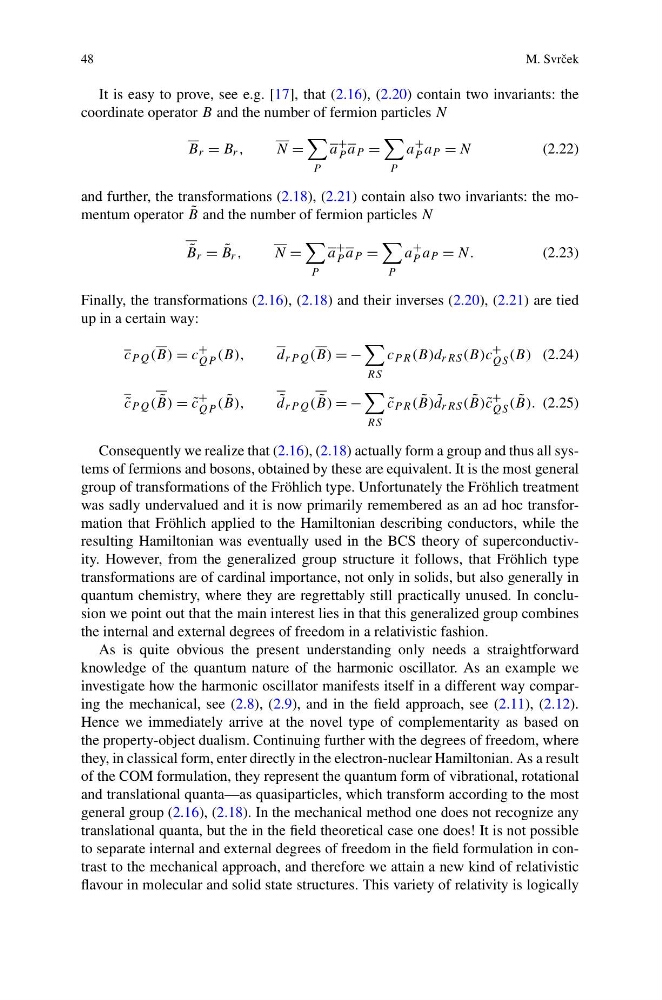
It is easy to prove, see e.g. [17], that (2.16), (2.20) contain two invariants: the
coordinate operator B and the number of fermion particles N
B r = B r ,
N =
P
a
+
P a P =
P
a
+
P a P = N
(2.22)
and further, the transformations (2.18), (2.21) contain also two invariants: the momentum operator ˜
B and the number of fermion particles N
˜
B r = ˜
B r ,
N =
P
a
+
P a P =
P
a
+
P a P = N.
(2.23)
Finally, the transformations (2.16), (2.18) and their inverses (2.20), (2.21) are tied
up in a certain way:
c P Q (B) = c
+
QP (B),
d rP Q (B) = −
RS
c P R (B)d rRS (B)c
+
QS (B) (2.24)
˜
c P Q ( ˜
B) = ˜
c
+
QP ( ˜
B),
˜
d rP Q ( ˜
B) = −
RS
˜
c P R ( ˜
B) ˜
d rRS ( ˜
B) ˜
c
+
QS ( ˜
B). (2.25)
Consequently we realize that (2.16), (2.18) actually form a group and thus all systems of fermions and bosons, obtained by these are equivalent. It is the most general
group of transformations of the Fröhlich type. Unfortunately the Fröhlich treatment
was sadly undervalued and it is now primarily remembered as an ad hoc transformation that Fröhlich applied to the Hamiltonian describing conductors, while the
resulting Hamiltonian was eventually used in the BCS theory of superconductivity. However, from the generalized group structure it follows, that Fröhlich type
transformations are of cardinal importance, not only in solids, but also generally in
quantum chemistry, where they are regrettably still practically unused. In conclusion we point out that the main interest lies in that this generalized group combines
the internal and external degrees of freedom in a relativistic fashion.
As is quite obvious the present understanding only needs a straightforward
knowledge of the quantum nature of the harmonic oscillator. As an example we
investigate how the harmonic oscillator manifests itself in a different way comparing the mechanical, see (2.8), (2.9), and in the field approach, see (2.11), (2.12).
Hence we immediately arrive at the novel type of complementarity as based on
the property-object dualism. Continuing further with the degrees of freedom, where
they, in classical form, enter directly in the electron-nuclear Hamiltonian. As a result
of the COM formulation, they represent the quantum form of vibrational, rotational
and translational quanta—as quasiparticles, which transform according to the most
general group (2.16), (2.18). In the mechanical method one does not recognize any
translational quanta, but the in the field theoretical case one does! It is not possible
to separate internal and external degrees of freedom in the field formulation in contrast to the mechanical approach, and therefore we attain a new kind of relativistic
flavour in molecular and solid state structures. This variety of relativity is logically
M. Svrˇ cek
It is easy to prove, see e.g. [17], that (2.16), (2.20) contain two invariants: the
coordinate operator B and the number of fermion particles N
B r = B r ,
N =
P
a
+
P a P =
P
a
+
P a P = N
(2.22)
and further, the transformations (2.18), (2.21) contain also two invariants: the momentum operator ˜
B and the number of fermion particles N
˜
B r = ˜
B r ,
N =
P
a
+
P a P =
P
a
+
P a P = N.
(2.23)
Finally, the transformations (2.16), (2.18) and their inverses (2.20), (2.21) are tied
up in a certain way:
c P Q (B) = c
+
QP (B),
d rP Q (B) = −
RS
c P R (B)d rRS (B)c
+
QS (B) (2.24)
˜
c P Q ( ˜
B) = ˜
c
+
QP ( ˜
B),
˜
d rP Q ( ˜
B) = −
RS
˜
c P R ( ˜
B) ˜
d rRS ( ˜
B) ˜
c
+
QS ( ˜
B). (2.25)
Consequently we realize that (2.16), (2.18) actually form a group and thus all systems of fermions and bosons, obtained by these are equivalent. It is the most general
group of transformations of the Fröhlich type. Unfortunately the Fröhlich treatment
was sadly undervalued and it is now primarily remembered as an ad hoc transformation that Fröhlich applied to the Hamiltonian describing conductors, while the
resulting Hamiltonian was eventually used in the BCS theory of superconductivity. However, from the generalized group structure it follows, that Fröhlich type
transformations are of cardinal importance, not only in solids, but also generally in
quantum chemistry, where they are regrettably still practically unused. In conclusion we point out that the main interest lies in that this generalized group combines
the internal and external degrees of freedom in a relativistic fashion.
As is quite obvious the present understanding only needs a straightforward
knowledge of the quantum nature of the harmonic oscillator. As an example we
investigate how the harmonic oscillator manifests itself in a different way comparing the mechanical, see (2.8), (2.9), and in the field approach, see (2.11), (2.12).
Hence we immediately arrive at the novel type of complementarity as based on
the property-object dualism. Continuing further with the degrees of freedom, where
they, in classical form, enter directly in the electron-nuclear Hamiltonian. As a result
of the COM formulation, they represent the quantum form of vibrational, rotational
and translational quanta—as quasiparticles, which transform according to the most
general group (2.16), (2.18). In the mechanical method one does not recognize any
translational quanta, but the in the field theoretical case one does! It is not possible
to separate internal and external degrees of freedom in the field formulation in contrast to the mechanical approach, and therefore we attain a new kind of relativistic
flavour in molecular and solid state structures. This variety of relativity is logically