

38
B. Sutcliffe and R.G. Woolley
One can’t do anything very useful with the direct integral expression (1.67) for
ˆ
H o apart from adding it onto the κ 4 term, which just returns us to the full problem.
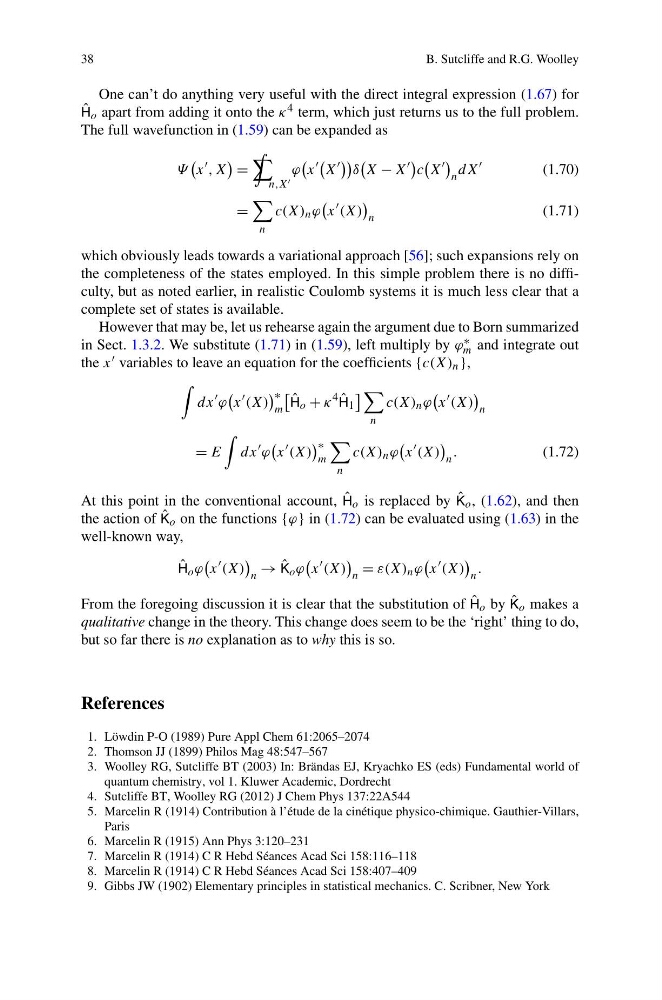
The full wavefunction in (1.59) can be expanded as
Ψ
x
, X
=
n,X
ϕ
x
X
δ
X − X
c
X
n
dX
(1.70)
=
n
c(X) n ϕ
x
(X)
n
(1.71)
which obviously leads towards a variational approach [56]; such expansions rely on
the completeness of the states employed. In this simple problem there is no difficulty, but as noted earlier, in realistic Coulomb systems it is much less clear that a
complete set of states is available.
However that may be, let us rehearse again the argument due to Born summarized
in Sect. 1.3.2. We substitute (1.71) in (1.59), left multiply by ϕ ∗
m and integrate out
the x variables to leave an equation for the coefficients {c(X) n },
dx
ϕ
x
(X)
∗
m
ˆ
H o + κ
4 ˆ
H 1
n
c(X) n ϕ
x
(X)
n
= E
dx
ϕ
x
(X)
∗
m
n
c(X) n ϕ
x
(X)
n
.
(1.72)
At this point in the conventional account, ˆ
H o is replaced by ˆ
K o , (1.62), and then
the action of ˆ
K o on the functions {ϕ} in (1.72) can be evaluated using (1.63) in the
well-known way,
ˆ
H o ϕ
x
(X)
n
→ ˆ
K o ϕ
x
(X)
n
= ε(X) n ϕ
x
(X)
n
.
From the foregoing discussion it is clear that the substitution of ˆ
H o by ˆ
K o makes a
qualitative change in the theory. This change does seem to be the ‘right’ thing to do,
but so far there is no explanation as to why this is so.
References
1. Löwdin P-O (1989) Pure Appl Chem 61:2065–2074
2. Thomson JJ (1899) Philos Mag 48:547–567
3. Woolley RG, Sutcliffe BT (2003) In: Brändas EJ, Kryachko ES (eds) Fundamental world of
quantum chemistry, vol 1. Kluwer Academic, Dordrecht
4. Sutcliffe BT, Woolley RG (2012) J Chem Phys 137:22A544
5. Marcelin R (1914) Contribution à l’étude de la cinétique physico-chimique. Gauthier-Villars,
Paris
6. Marcelin R (1915) Ann Phys 3:120–231
7. Marcelin R (1914) C R Hebd Séances Acad Sci 158:116–118
8. Marcelin R (1914) C R Hebd Séances Acad Sci 158:407–409
9. Gibbs JW (1902) Elementary principles in statistical mechanics. C. Scribner, New York
B. Sutcliffe and R.G. Woolley
One can’t do anything very useful with the direct integral expression (1.67) for
ˆ
H o apart from adding it onto the κ 4 term, which just returns us to the full problem.
The full wavefunction in (1.59) can be expanded as
Ψ
x
, X
=
n,X
ϕ
x
X
δ
X − X
c
X
n
dX
(1.70)
=
n
c(X) n ϕ
x
(X)
n
(1.71)
which obviously leads towards a variational approach [56]; such expansions rely on
the completeness of the states employed. In this simple problem there is no difficulty, but as noted earlier, in realistic Coulomb systems it is much less clear that a
complete set of states is available.
However that may be, let us rehearse again the argument due to Born summarized
in Sect. 1.3.2. We substitute (1.71) in (1.59), left multiply by ϕ ∗
m and integrate out
the x variables to leave an equation for the coefficients {c(X) n },
dx
ϕ
x
(X)
∗
m
ˆ
H o + κ
4 ˆ
H 1
n
c(X) n ϕ
x
(X)
n
= E
dx
ϕ
x
(X)
∗
m
n
c(X) n ϕ
x
(X)
n
.
(1.72)
At this point in the conventional account, ˆ
H o is replaced by ˆ
K o , (1.62), and then
the action of ˆ
K o on the functions {ϕ} in (1.72) can be evaluated using (1.63) in the
well-known way,
ˆ
H o ϕ
x
(X)
n
→ ˆ
K o ϕ
x
(X)
n
= ε(X) n ϕ
x
(X)
n
.
From the foregoing discussion it is clear that the substitution of ˆ
H o by ˆ
K o makes a
qualitative change in the theory. This change does seem to be the ‘right’ thing to do,
but so far there is no explanation as to why this is so.
References
1. Löwdin P-O (1989) Pure Appl Chem 61:2065–2074
2. Thomson JJ (1899) Philos Mag 48:547–567
3. Woolley RG, Sutcliffe BT (2003) In: Brändas EJ, Kryachko ES (eds) Fundamental world of
quantum chemistry, vol 1. Kluwer Academic, Dordrecht
4. Sutcliffe BT, Woolley RG (2012) J Chem Phys 137:22A544
5. Marcelin R (1914) Contribution à l’étude de la cinétique physico-chimique. Gauthier-Villars,
Paris
6. Marcelin R (1915) Ann Phys 3:120–231
7. Marcelin R (1914) C R Hebd Séances Acad Sci 158:116–118
8. Marcelin R (1914) C R Hebd Séances Acad Sci 158:407–409
9. Gibbs JW (1902) Elementary principles in statistical mechanics. C. Scribner, New York