

1 The Potential Energy Surface in Molecular Quantum Mechanics
31
and nuclei interacting with quantized radiation in the low-energy regime is an active area of research in mathematical physics concerned with the stability of matter,
the existence of the thermodynamic limit etc., but with no particular reference to
features of chemical interest [78–82].
The presentation of a presumed exact bound state solution of the Schrödinger
Coulomb Hamiltonian as a product of electronic and nuclear factors has been considered both by Hunter [83] and, more recently, by Gross et al. [84]. For present
purposes the Hunter approach will be employed on the translationally invariant form
of the internal Hamiltonian, given earlier (in Sect. 1.3.3). Were the exact solution
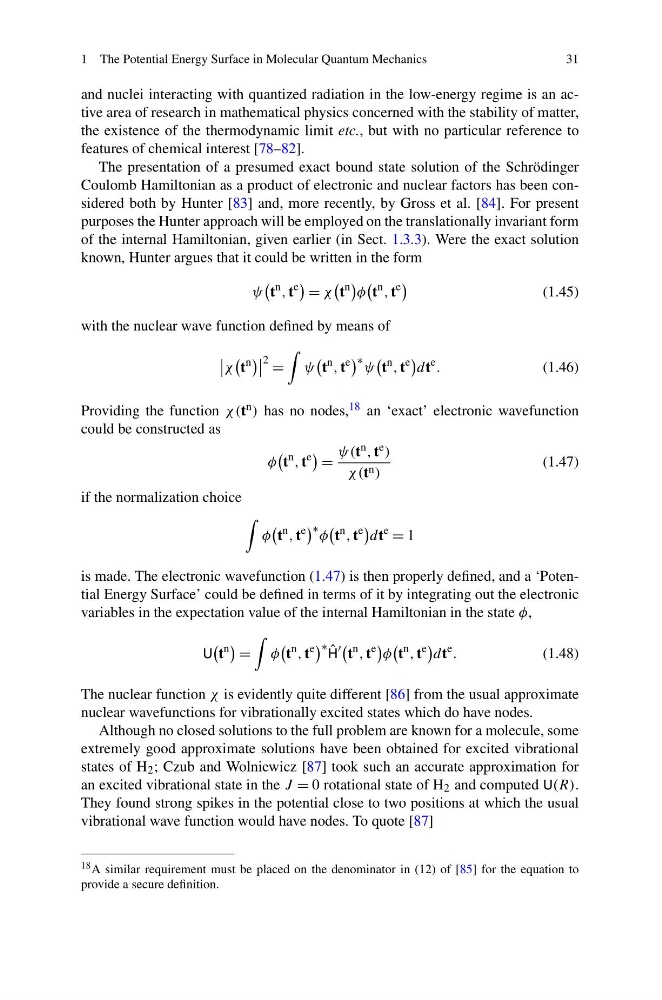
known, Hunter argues that it could be written in the form
ψ
t
n , t
e
= χ
t
n
φ
t
n , t
e
(1.45)
with the nuclear wave function defined by means of
χ
t
n
2 =
ψ
t
n , t
e
∗ ψ
t
n , t
e
dt
e .
(1.46)
Providing the function χ(t n ) has no nodes, 18 an ‘exact’ electronic wavefunction
could be constructed as
φ
t
n , t
e
=
ψ(t n , t e )
χ(t n )
(1.47)
if the normalization choice
φ
t
n , t
e
∗ φ
t
n , t
e
dt
e
= 1
is made. The electronic wavefunction (1.47) is then properly defined, and a ‘Potential Energy Surface’ could be defined in terms of it by integrating out the electronic
variables in the expectation value of the internal Hamiltonian in the state φ,
U
t
n
=
φ
t
n , t
e
∗ ˆ
H
t
n , t
e
φ
t
n , t
e
dt
e .
(1.48)
The nuclear function χ is evidently quite different [86] from the usual approximate
nuclear wavefunctions for vibrationally excited states which do have nodes.
Although no closed solutions to the full problem are known for a molecule, some
extremely good approximate solutions have been obtained for excited vibrational
states of H 2 ; Czub and Wolniewicz [87] took such an accurate approximation for
an excited vibrational state in the J = 0 rotational state of H 2 and computed U(R).
They found strong spikes in the potential close to two positions at which the usual
vibrational wave function would have nodes. To quote [87]
18 A similar requirement must be placed on the denominator in (12) of [85] for the equation to
provide a secure definition.
31
and nuclei interacting with quantized radiation in the low-energy regime is an active area of research in mathematical physics concerned with the stability of matter,
the existence of the thermodynamic limit etc., but with no particular reference to
features of chemical interest [78–82].
The presentation of a presumed exact bound state solution of the Schrödinger
Coulomb Hamiltonian as a product of electronic and nuclear factors has been considered both by Hunter [83] and, more recently, by Gross et al. [84]. For present
purposes the Hunter approach will be employed on the translationally invariant form
of the internal Hamiltonian, given earlier (in Sect. 1.3.3). Were the exact solution
known, Hunter argues that it could be written in the form
ψ
t
n , t
e
= χ
t
n
φ
t
n , t
e
(1.45)
with the nuclear wave function defined by means of
χ
t
n
2 =
ψ
t
n , t
e
∗ ψ
t
n , t
e
dt
e .
(1.46)
Providing the function χ(t n ) has no nodes, 18 an ‘exact’ electronic wavefunction
could be constructed as
φ
t
n , t
e
=
ψ(t n , t e )
χ(t n )
(1.47)
if the normalization choice
φ
t
n , t
e
∗ φ
t
n , t
e
dt
e
= 1
is made. The electronic wavefunction (1.47) is then properly defined, and a ‘Potential Energy Surface’ could be defined in terms of it by integrating out the electronic
variables in the expectation value of the internal Hamiltonian in the state φ,
U
t
n
=
φ
t
n , t
e
∗ ˆ
H
t
n , t
e
φ
t
n , t
e
dt
e .
(1.48)
The nuclear function χ is evidently quite different [86] from the usual approximate
nuclear wavefunctions for vibrationally excited states which do have nodes.
Although no closed solutions to the full problem are known for a molecule, some
extremely good approximate solutions have been obtained for excited vibrational
states of H 2 ; Czub and Wolniewicz [87] took such an accurate approximation for
an excited vibrational state in the J = 0 rotational state of H 2 and computed U(R).
They found strong spikes in the potential close to two positions at which the usual
vibrational wave function would have nodes. To quote [87]
18 A similar requirement must be placed on the denominator in (12) of [85] for the equation to
provide a secure definition.