

356
T. Miyakawa et al.
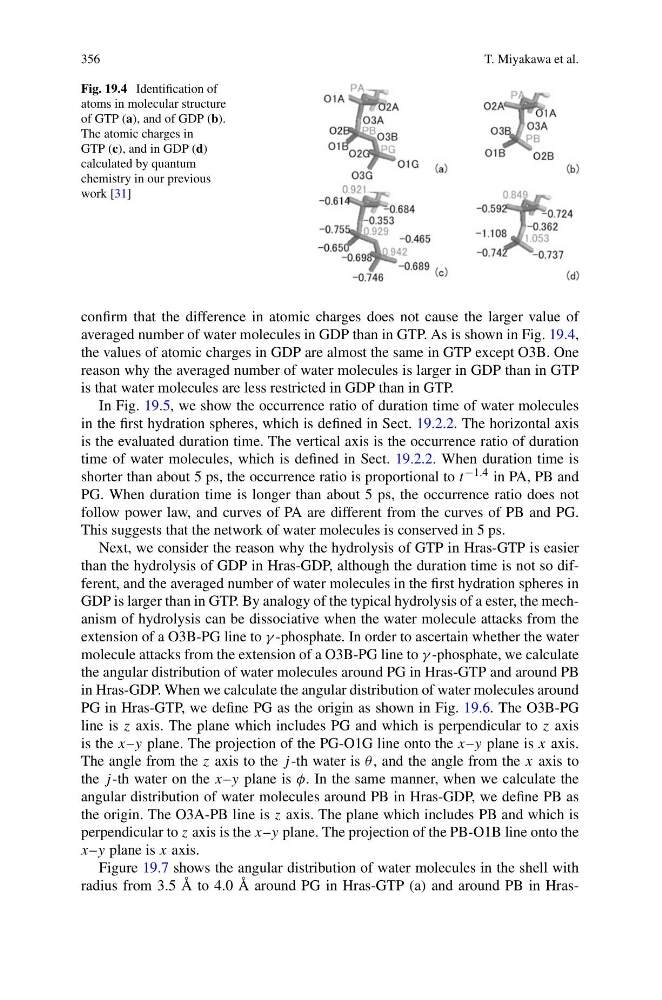
Fig. 19.4 Identification of
atoms in molecular structure
of GTP (a), and of GDP (b).
The atomic charges in
GTP (c), and in GDP (d)
calculated by quantum
chemistry in our previous
work [31]
confirm that the difference in atomic charges does not cause the larger value of
averaged number of water molecules in GDP than in GTP. As is shown in Fig. 19.4,
the values of atomic charges in GDP are almost the same in GTP except O3B. One
reason why the averaged number of water molecules is larger in GDP than in GTP
is that water molecules are less restricted in GDP than in GTP.
In Fig. 19.5, we show the occurrence ratio of duration time of water molecules
in the first hydration spheres, which is defined in Sect. 19.2.2. The horizontal axis
is the evaluated duration time. The vertical axis is the occurrence ratio of duration
time of water molecules, which is defined in Sect. 19.2.2. When duration time is
shorter than about 5 ps, the occurrence ratio is proportional to t −1.4 in PA, PB and
PG. When duration time is longer than about 5 ps, the occurrence ratio does not
follow power law, and curves of PA are different from the curves of PB and PG.
This suggests that the network of water molecules is conserved in 5 ps.
Next, we consider the reason why the hydrolysis of GTP in Hras-GTP is easier
than the hydrolysis of GDP in Hras-GDP, although the duration time is not so different, and the averaged number of water molecules in the first hydration spheres in
GDP is larger than in GTP. By analogy of the typical hydrolysis of a ester, the mechanism of hydrolysis can be dissociative when the water molecule attacks from the
extension of a O3B-PG line to γ -phosphate. In order to ascertain whether the water
molecule attacks from the extension of a O3B-PG line to γ -phosphate, we calculate
the angular distribution of water molecules around PG in Hras-GTP and around PB
in Hras-GDP. When we calculate the angular distribution of water molecules around
PG in Hras-GTP, we define PG as the origin as shown in Fig. 19.6. The O3B-PG
line is z axis. The plane which includes PG and which is perpendicular to z axis
is the x–y plane. The projection of the PG-O1G line onto the x–y plane is x axis.
The angle from the z axis to the j -th water is θ , and the angle from the x axis to
the j -th water on the x–y plane is φ. In the same manner, when we calculate the
angular distribution of water molecules around PB in Hras-GDP, we define PB as
the origin. The O3A-PB line is z axis. The plane which includes PB and which is
perpendicular to z axis is the x–y plane. The projection of the PB-O1B line onto the
x–y plane is x axis.
Figure 19.7 shows the angular distribution of water molecules in the shell with
radius from 3.5 Å to 4.0 Å around PG in Hras-GTP (a) and around PB in Hras-
T. Miyakawa et al.
Fig. 19.4 Identification of
atoms in molecular structure
of GTP (a), and of GDP (b).
The atomic charges in
GTP (c), and in GDP (d)
calculated by quantum
chemistry in our previous
work [31]
confirm that the difference in atomic charges does not cause the larger value of
averaged number of water molecules in GDP than in GTP. As is shown in Fig. 19.4,
the values of atomic charges in GDP are almost the same in GTP except O3B. One
reason why the averaged number of water molecules is larger in GDP than in GTP
is that water molecules are less restricted in GDP than in GTP.
In Fig. 19.5, we show the occurrence ratio of duration time of water molecules
in the first hydration spheres, which is defined in Sect. 19.2.2. The horizontal axis
is the evaluated duration time. The vertical axis is the occurrence ratio of duration
time of water molecules, which is defined in Sect. 19.2.2. When duration time is
shorter than about 5 ps, the occurrence ratio is proportional to t −1.4 in PA, PB and
PG. When duration time is longer than about 5 ps, the occurrence ratio does not
follow power law, and curves of PA are different from the curves of PB and PG.
This suggests that the network of water molecules is conserved in 5 ps.
Next, we consider the reason why the hydrolysis of GTP in Hras-GTP is easier
than the hydrolysis of GDP in Hras-GDP, although the duration time is not so different, and the averaged number of water molecules in the first hydration spheres in
GDP is larger than in GTP. By analogy of the typical hydrolysis of a ester, the mechanism of hydrolysis can be dissociative when the water molecule attacks from the
extension of a O3B-PG line to γ -phosphate. In order to ascertain whether the water
molecule attacks from the extension of a O3B-PG line to γ -phosphate, we calculate
the angular distribution of water molecules around PG in Hras-GTP and around PB
in Hras-GDP. When we calculate the angular distribution of water molecules around
PG in Hras-GTP, we define PG as the origin as shown in Fig. 19.6. The O3B-PG
line is z axis. The plane which includes PG and which is perpendicular to z axis
is the x–y plane. The projection of the PG-O1G line onto the x–y plane is x axis.
The angle from the z axis to the j -th water is θ , and the angle from the x axis to
the j -th water on the x–y plane is φ. In the same manner, when we calculate the
angular distribution of water molecules around PB in Hras-GDP, we define PB as
the origin. The O3A-PB line is z axis. The plane which includes PB and which is
perpendicular to z axis is the x–y plane. The projection of the PB-O1B line onto the
x–y plane is x axis.
Figure 19.7 shows the angular distribution of water molecules in the shell with
radius from 3.5 Å to 4.0 Å around PG in Hras-GTP (a) and around PB in Hras-