

1 The Potential Energy Surface in Molecular Quantum Mechanics
19
so that after dropping the uninteresting kinetic energy for the overall centre-of-mass,
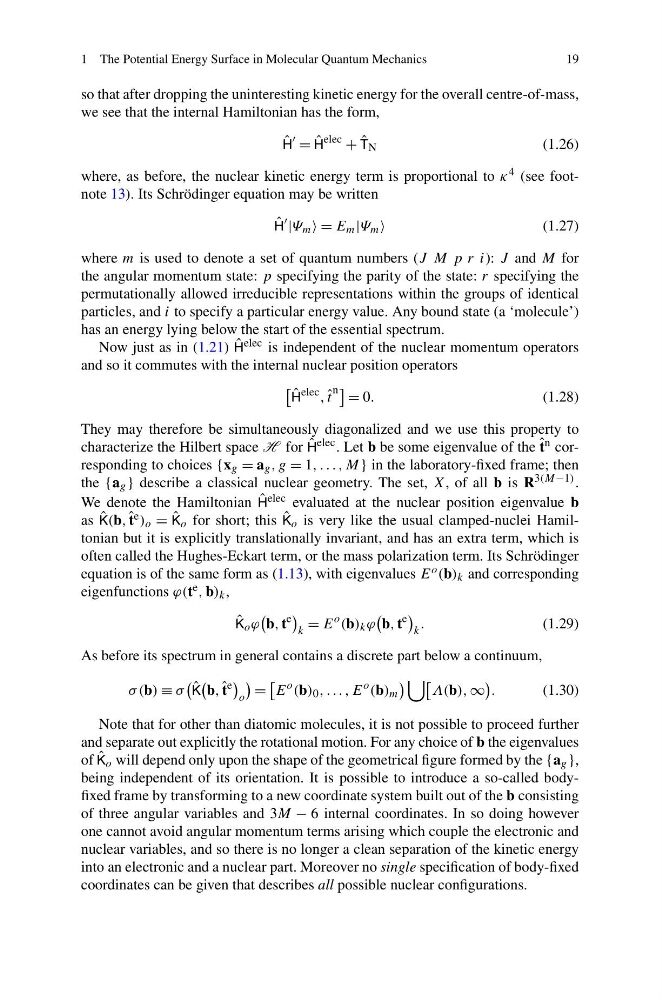
we see that the internal Hamiltonian has the form,
ˆ
H
= ˆ
H
elec
+ ˆ
T N
(1.26)
where, as before, the nuclear kinetic energy term is proportional to κ 4 (see footnote 13). Its Schrödinger equation may be written
ˆ
H
|Ψ m = E m |Ψ m
(1.27)
where m is used to denote a set of quantum numbers (J M p r i): J and M for
the angular momentum state: p specifying the parity of the state: r specifying the
permutationally allowed irreducible representations within the groups of identical
particles, and i to specify a particular energy value. Any bound state (a ‘molecule’)
has an energy lying below the start of the essential spectrum.
Now just as in (1.21) ˆ
H elec is independent of the nuclear momentum operators
and so it commutes with the internal nuclear position operators
ˆ
H
elec , ˆ
t
n = 0.
(1.28)
They may therefore be simultaneously diagonalized and we use this property to
characterize the Hilbert space H for ˆ
H elec . Let b be some eigenvalue of the ˆ t n corresponding to choices {x g = a g , g = 1, . . . , M} in the laboratory-fixed frame; then
the {a g } describe a classical nuclear geometry. The set, X, of all b is R 3(M−1) .
We denote the Hamiltonian ˆ
H elec evaluated at the nuclear position eigenvalue b
as ˆ
K(b, ˆ t e ) o = ˆ
K o for short; this ˆ
K o is very like the usual clamped-nuclei Hamiltonian but it is explicitly translationally invariant, and has an extra term, which is
often called the Hughes-Eckart term, or the mass polarization term. Its Schrödinger
equation is of the same form as (1.13), with eigenvalues E o (b) k and corresponding
eigenfunctions ϕ(t e , b) k ,
ˆ
K o ϕ
b, t
e
k
= E
o (b) k ϕ
b, t
e
k
.
(1.29)
As before its spectrum in general contains a discrete part below a continuum,
σ (b) ≡ σ
ˆ
K
b, ˆ t
e
o
=
E
o (b) 0 , . . . , E
o (b) m
Λ(b), ∞
.
(1.30)
Note that for other than diatomic molecules, it is not possible to proceed further
and separate out explicitly the rotational motion. For any choice of b the eigenvalues
of ˆ
K o will depend only upon the shape of the geometrical figure formed by the {a g },
being independent of its orientation. It is possible to introduce a so-called bodyfixed frame by transforming to a new coordinate system built out of the b consisting
of three angular variables and 3M − 6 internal coordinates. In so doing however
one cannot avoid angular momentum terms arising which couple the electronic and
nuclear variables, and so there is no longer a clean separation of the kinetic energy
into an electronic and a nuclear part. Moreover no single specification of body-fixed
coordinates can be given that describes all possible nuclear configurations.
19
so that after dropping the uninteresting kinetic energy for the overall centre-of-mass,
we see that the internal Hamiltonian has the form,
ˆ
H
= ˆ
H
elec
+ ˆ
T N
(1.26)
where, as before, the nuclear kinetic energy term is proportional to κ 4 (see footnote 13). Its Schrödinger equation may be written
ˆ
H
|Ψ m = E m |Ψ m
(1.27)
where m is used to denote a set of quantum numbers (J M p r i): J and M for
the angular momentum state: p specifying the parity of the state: r specifying the
permutationally allowed irreducible representations within the groups of identical
particles, and i to specify a particular energy value. Any bound state (a ‘molecule’)
has an energy lying below the start of the essential spectrum.
Now just as in (1.21) ˆ
H elec is independent of the nuclear momentum operators
and so it commutes with the internal nuclear position operators
ˆ
H
elec , ˆ
t
n = 0.
(1.28)
They may therefore be simultaneously diagonalized and we use this property to
characterize the Hilbert space H for ˆ
H elec . Let b be some eigenvalue of the ˆ t n corresponding to choices {x g = a g , g = 1, . . . , M} in the laboratory-fixed frame; then
the {a g } describe a classical nuclear geometry. The set, X, of all b is R 3(M−1) .
We denote the Hamiltonian ˆ
H elec evaluated at the nuclear position eigenvalue b
as ˆ
K(b, ˆ t e ) o = ˆ
K o for short; this ˆ
K o is very like the usual clamped-nuclei Hamiltonian but it is explicitly translationally invariant, and has an extra term, which is
often called the Hughes-Eckart term, or the mass polarization term. Its Schrödinger
equation is of the same form as (1.13), with eigenvalues E o (b) k and corresponding
eigenfunctions ϕ(t e , b) k ,
ˆ
K o ϕ
b, t
e
k
= E
o (b) k ϕ
b, t
e
k
.
(1.29)
As before its spectrum in general contains a discrete part below a continuum,
σ (b) ≡ σ
ˆ
K
b, ˆ t
e
o
=
E
o (b) 0 , . . . , E
o (b) m
Λ(b), ∞
.
(1.30)
Note that for other than diatomic molecules, it is not possible to proceed further
and separate out explicitly the rotational motion. For any choice of b the eigenvalues
of ˆ
K o will depend only upon the shape of the geometrical figure formed by the {a g },
being independent of its orientation. It is possible to introduce a so-called bodyfixed frame by transforming to a new coordinate system built out of the b consisting
of three angular variables and 3M − 6 internal coordinates. In so doing however
one cannot avoid angular momentum terms arising which couple the electronic and
nuclear variables, and so there is no longer a clean separation of the kinetic energy
into an electronic and a nuclear part. Moreover no single specification of body-fixed
coordinates can be given that describes all possible nuclear configurations.