

10
B. Sutcliffe and R.G. Woolley
the quantum conditions simply cannot be applied 5 because the integrals in (1.6) do
not exist [28]. We also know that the r −1 singularity in the classical potential energy can lead to pathological dynamics in which a particle is neither confined to a
bounded region, nor escapes to infinity for good. If the two-body interaction V (r)
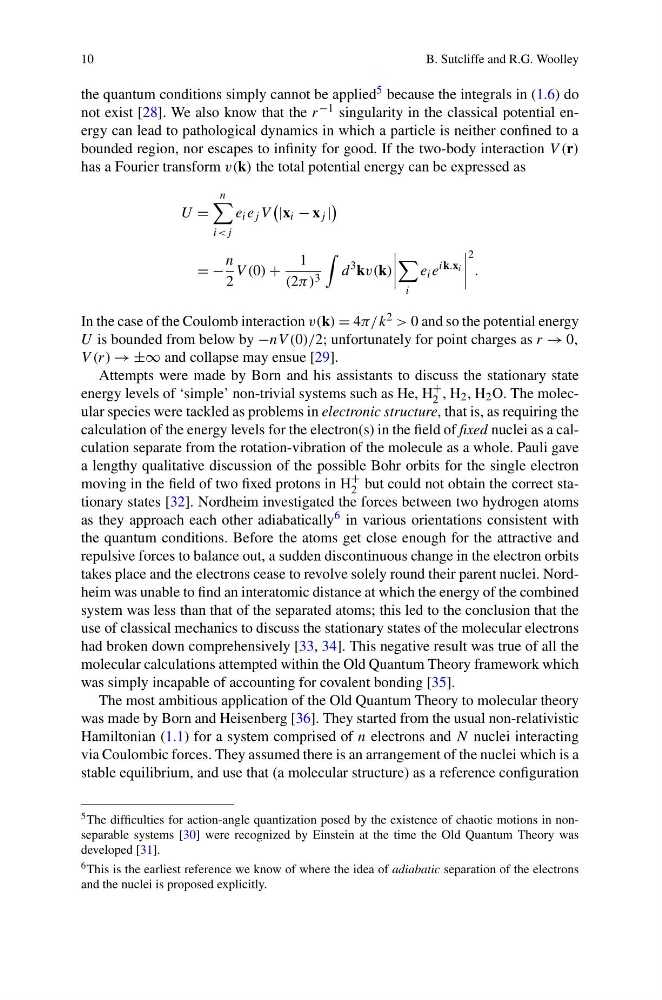
has a Fourier transform v(k) the total potential energy can be expressed as
U =
n
i
|x i − x j |
= −
n
2
V (0) +
1
(2π) 3
d
3 kv(k)
i
e i e
ik.x i
2
.
In the case of the Coulomb interaction v(k) = 4π/k 2 > 0 and so the potential energy
U is bounded from below by −nV (0)/2; unfortunately for point charges as r → 0,
V (r) → ±∞ and collapse may ensue [29].
Attempts were made by Born and his assistants to discuss the stationary state
energy levels of ‘simple’ non-trivial systems such as He, H
+
2 , H 2 , H 2 O. The molecular species were tackled as problems in electronic structure, that is, as requiring the
calculation of the energy levels for the electron(s) in the field of fixed nuclei as a calculation separate from the rotation-vibration of the molecule as a whole. Pauli gave
a lengthy qualitative discussion of the possible Bohr orbits for the single electron
moving in the field of two fixed protons in H
+
2 but could not obtain the correct stationary states [32]. Nordheim investigated the forces between two hydrogen atoms
as they approach each other adiabatically 6 in various orientations consistent with
the quantum conditions. Before the atoms get close enough for the attractive and
repulsive forces to balance out, a sudden discontinuous change in the electron orbits
takes place and the electrons cease to revolve solely round their parent nuclei. Nordheim was unable to find an interatomic distance at which the energy of the combined
system was less than that of the separated atoms; this led to the conclusion that the
use of classical mechanics to discuss the stationary states of the molecular electrons
had broken down comprehensively [33, 34]. This negative result was true of all the
molecular calculations attempted within the Old Quantum Theory framework which
was simply incapable of accounting for covalent bonding [35].
The most ambitious application of the Old Quantum Theory to molecular theory
was made by Born and Heisenberg [36]. They started from the usual non-relativistic
Hamiltonian (1.1) for a system comprised of n electrons and N nuclei interacting
via Coulombic forces. They assumed there is an arrangement of the nuclei which is a
stable equilibrium, and use that (a molecular structure) as a reference configuration
5 The difficulties for action-angle quantization posed by the existence of chaotic motions in nonseparable systems [30] were recognized by Einstein at the time the Old Quantum Theory was
developed [31].
6 This is the earliest reference we know of where the idea of adiabatic separation of the electrons
and the nuclei is proposed explicitly.
B. Sutcliffe and R.G. Woolley
the quantum conditions simply cannot be applied 5 because the integrals in (1.6) do
not exist [28]. We also know that the r −1 singularity in the classical potential energy can lead to pathological dynamics in which a particle is neither confined to a
bounded region, nor escapes to infinity for good. If the two-body interaction V (r)
has a Fourier transform v(k) the total potential energy can be expressed as
U =
n
i
|x i − x j |
= −
n
2
V (0) +
1
(2π) 3
d
3 kv(k)
i
e i e
ik.x i
2
.
In the case of the Coulomb interaction v(k) = 4π/k 2 > 0 and so the potential energy
U is bounded from below by −nV (0)/2; unfortunately for point charges as r → 0,
V (r) → ±∞ and collapse may ensue [29].
Attempts were made by Born and his assistants to discuss the stationary state
energy levels of ‘simple’ non-trivial systems such as He, H
+
2 , H 2 , H 2 O. The molecular species were tackled as problems in electronic structure, that is, as requiring the
calculation of the energy levels for the electron(s) in the field of fixed nuclei as a calculation separate from the rotation-vibration of the molecule as a whole. Pauli gave
a lengthy qualitative discussion of the possible Bohr orbits for the single electron
moving in the field of two fixed protons in H
+
2 but could not obtain the correct stationary states [32]. Nordheim investigated the forces between two hydrogen atoms
as they approach each other adiabatically 6 in various orientations consistent with
the quantum conditions. Before the atoms get close enough for the attractive and
repulsive forces to balance out, a sudden discontinuous change in the electron orbits
takes place and the electrons cease to revolve solely round their parent nuclei. Nordheim was unable to find an interatomic distance at which the energy of the combined
system was less than that of the separated atoms; this led to the conclusion that the
use of classical mechanics to discuss the stationary states of the molecular electrons
had broken down comprehensively [33, 34]. This negative result was true of all the
molecular calculations attempted within the Old Quantum Theory framework which
was simply incapable of accounting for covalent bonding [35].
The most ambitious application of the Old Quantum Theory to molecular theory
was made by Born and Heisenberg [36]. They started from the usual non-relativistic
Hamiltonian (1.1) for a system comprised of n electrons and N nuclei interacting
via Coulombic forces. They assumed there is an arrangement of the nuclei which is a
stable equilibrium, and use that (a molecular structure) as a reference configuration
5 The difficulties for action-angle quantization posed by the existence of chaotic motions in nonseparable systems [30] were recognized by Einstein at the time the Old Quantum Theory was
developed [31].
6 This is the earliest reference we know of where the idea of adiabatic separation of the electrons
and the nuclei is proposed explicitly.