

12 Hydrogen in Light-Metal Cage Assemblies: Towards a Nanofoam Storage
213
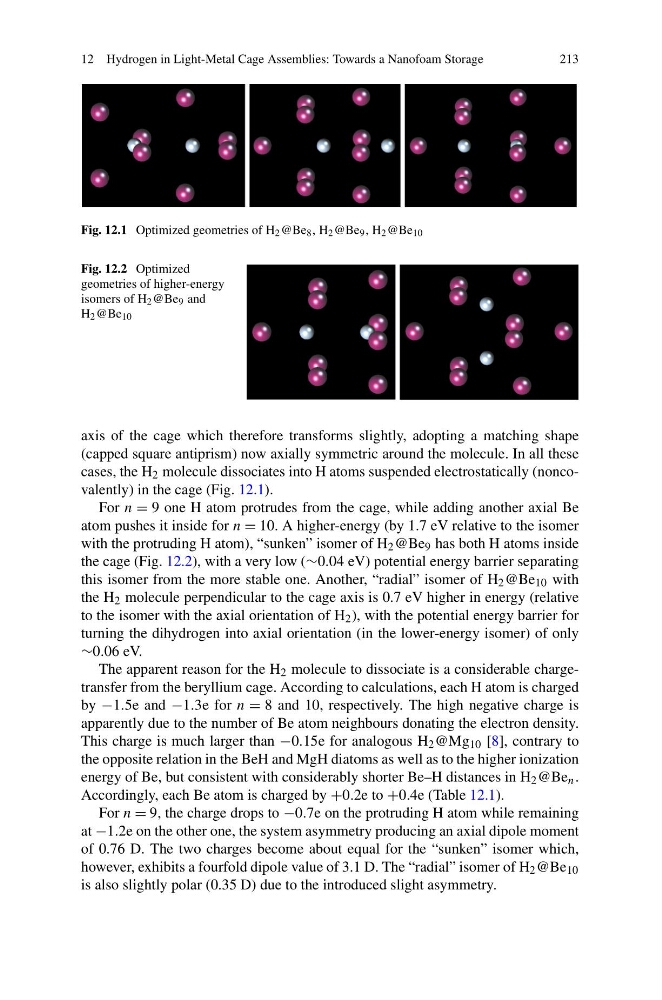
Fig. 12.1 Optimized geometries of H 2 @Be 8 , H 2 @Be 9 , H 2 @Be 10
Fig. 12.2 Optimized
geometries of higher-energy
isomers of H 2 @Be 9 and
H 2 @Be 10
axis of the cage which therefore transforms slightly, adopting a matching shape
(capped square antiprism) now axially symmetric around the molecule. In all these
cases, the H 2 molecule dissociates into H atoms suspended electrostatically (noncovalently) in the cage (Fig. 12.1).
For n = 9 one H atom protrudes from the cage, while adding another axial Be
atom pushes it inside for n = 10. A higher-energy (by 1.7 eV relative to the isomer
with the protruding H atom), “sunken” isomer of H 2 @Be 9 has both H atoms inside
the cage (Fig. 12.2), with a very low (∼0.04 eV) potential energy barrier separating
this isomer from the more stable one. Another, “radial” isomer of H 2 @Be 10 with
the H 2 molecule perpendicular to the cage axis is 0.7 eV higher in energy (relative
to the isomer with the axial orientation of H 2 ), with the potential energy barrier for
turning the dihydrogen into axial orientation (in the lower-energy isomer) of only
∼0.06 eV.
The apparent reason for the H 2 molecule to dissociate is a considerable chargetransfer from the beryllium cage. According to calculations, each H atom is charged
by −1.5e and −1.3e for n = 8 and 10, respectively. The high negative charge is
apparently due to the number of Be atom neighbours donating the electron density.
This charge is much larger than −0.15e for analogous H 2 @Mg 10 [8], contrary to
the opposite relation in the BeH and MgH diatoms as well as to the higher ionization
energy of Be, but consistent with considerably shorter Be–H distances in H 2 @Be n .
Accordingly, each Be atom is charged by +0.2e to +0.4e (Table 12.1).
For n = 9, the charge drops to −0.7e on the protruding H atom while remaining
at −1.2e on the other one, the system asymmetry producing an axial dipole moment
of 0.76 D. The two charges become about equal for the “sunken” isomer which,
however, exhibits a fourfold dipole value of 3.1 D. The “radial” isomer of H 2 @Be 10
is also slightly polar (0.35 D) due to the introduced slight asymmetry.
213
Fig. 12.1 Optimized geometries of H 2 @Be 8 , H 2 @Be 9 , H 2 @Be 10
Fig. 12.2 Optimized
geometries of higher-energy
isomers of H 2 @Be 9 and
H 2 @Be 10
axis of the cage which therefore transforms slightly, adopting a matching shape
(capped square antiprism) now axially symmetric around the molecule. In all these
cases, the H 2 molecule dissociates into H atoms suspended electrostatically (noncovalently) in the cage (Fig. 12.1).
For n = 9 one H atom protrudes from the cage, while adding another axial Be
atom pushes it inside for n = 10. A higher-energy (by 1.7 eV relative to the isomer
with the protruding H atom), “sunken” isomer of H 2 @Be 9 has both H atoms inside
the cage (Fig. 12.2), with a very low (∼0.04 eV) potential energy barrier separating
this isomer from the more stable one. Another, “radial” isomer of H 2 @Be 10 with
the H 2 molecule perpendicular to the cage axis is 0.7 eV higher in energy (relative
to the isomer with the axial orientation of H 2 ), with the potential energy barrier for
turning the dihydrogen into axial orientation (in the lower-energy isomer) of only
∼0.06 eV.
The apparent reason for the H 2 molecule to dissociate is a considerable chargetransfer from the beryllium cage. According to calculations, each H atom is charged
by −1.5e and −1.3e for n = 8 and 10, respectively. The high negative charge is
apparently due to the number of Be atom neighbours donating the electron density.
This charge is much larger than −0.15e for analogous H 2 @Mg 10 [8], contrary to
the opposite relation in the BeH and MgH diatoms as well as to the higher ionization
energy of Be, but consistent with considerably shorter Be–H distances in H 2 @Be n .
Accordingly, each Be atom is charged by +0.2e to +0.4e (Table 12.1).
For n = 9, the charge drops to −0.7e on the protruding H atom while remaining
at −1.2e on the other one, the system asymmetry producing an axial dipole moment
of 0.76 D. The two charges become about equal for the “sunken” isomer which,
however, exhibits a fourfold dipole value of 3.1 D. The “radial” isomer of H 2 @Be 10
is also slightly polar (0.35 D) due to the introduced slight asymmetry.