

198
Y.-W. Huang et al.
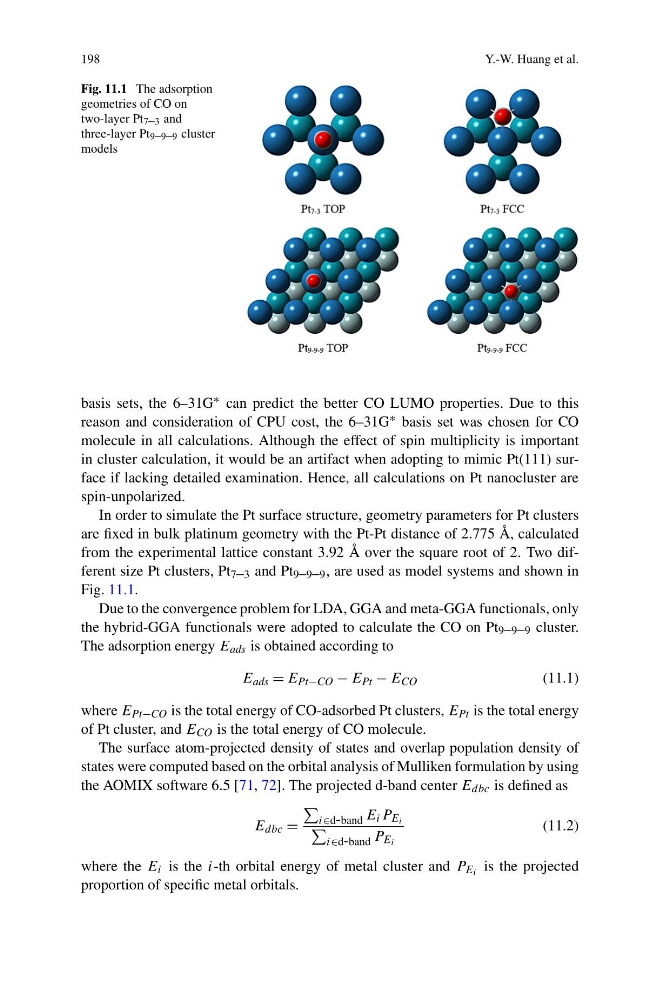
Fig. 11.1 The adsorption
geometries of CO on
two-layer Pt 7–3 and
three-layer Pt 9–9–9 cluster
models
basis sets, the 6–31G ∗ can predict the better CO LUMO properties. Due to this
reason and consideration of CPU cost, the 6–31G ∗ basis set was chosen for CO
molecule in all calculations. Although the effect of spin multiplicity is important
in cluster calculation, it would be an artifact when adopting to mimic Pt(111) surface if lacking detailed examination. Hence, all calculations on Pt nanocluster are
spin-unpolarized.
In order to simulate the Pt surface structure, geometry parameters for Pt clusters
are fixed in bulk platinum geometry with the Pt-Pt distance of 2.775 Å, calculated
from the experimental lattice constant 3.92 Å over the square root of 2. Two different size Pt clusters, Pt 7–3 and Pt 9–9–9 , are used as model systems and shown in
Fig. 11.1.
Due to the convergence problem for LDA, GGA and meta-GGA functionals, only
the hybrid-GGA functionals were adopted to calculate the CO on Pt 9–9–9 cluster.
The adsorption energy E ads is obtained according to
E ads = E Pt−CO − E Pt − E CO
(11.1)
where E Pt−CO is the total energy of CO-adsorbed Pt clusters, E Pt is the total energy
of Pt cluster, and E CO is the total energy of CO molecule.
The surface atom-projected density of states and overlap population density of
states were computed based on the orbital analysis of Mulliken formulation by using
the AOMIX software 6.5 [71, 72]. The projected d-band center E dbc is defined as
E dbc =
i∈d-band E i P E i
i∈d-band P E i
(11.2)
where the E i is the i-th orbital energy of metal cluster and P E i is the projected
proportion of specific metal orbitals.
Y.-W. Huang et al.
Fig. 11.1 The adsorption
geometries of CO on
two-layer Pt 7–3 and
three-layer Pt 9–9–9 cluster
models
basis sets, the 6–31G ∗ can predict the better CO LUMO properties. Due to this
reason and consideration of CPU cost, the 6–31G ∗ basis set was chosen for CO
molecule in all calculations. Although the effect of spin multiplicity is important
in cluster calculation, it would be an artifact when adopting to mimic Pt(111) surface if lacking detailed examination. Hence, all calculations on Pt nanocluster are
spin-unpolarized.
In order to simulate the Pt surface structure, geometry parameters for Pt clusters
are fixed in bulk platinum geometry with the Pt-Pt distance of 2.775 Å, calculated
from the experimental lattice constant 3.92 Å over the square root of 2. Two different size Pt clusters, Pt 7–3 and Pt 9–9–9 , are used as model systems and shown in
Fig. 11.1.
Due to the convergence problem for LDA, GGA and meta-GGA functionals, only
the hybrid-GGA functionals were adopted to calculate the CO on Pt 9–9–9 cluster.
The adsorption energy E ads is obtained according to
E ads = E Pt−CO − E Pt − E CO
(11.1)
where E Pt−CO is the total energy of CO-adsorbed Pt clusters, E Pt is the total energy
of Pt cluster, and E CO is the total energy of CO molecule.
The surface atom-projected density of states and overlap population density of
states were computed based on the orbital analysis of Mulliken formulation by using
the AOMIX software 6.5 [71, 72]. The projected d-band center E dbc is defined as
E dbc =
i∈d-band E i P E i
i∈d-band P E i
(11.2)
where the E i is the i-th orbital energy of metal cluster and P E i is the projected
proportion of specific metal orbitals.