

9 Operator Perturbation Theory for Atomic Systems
171
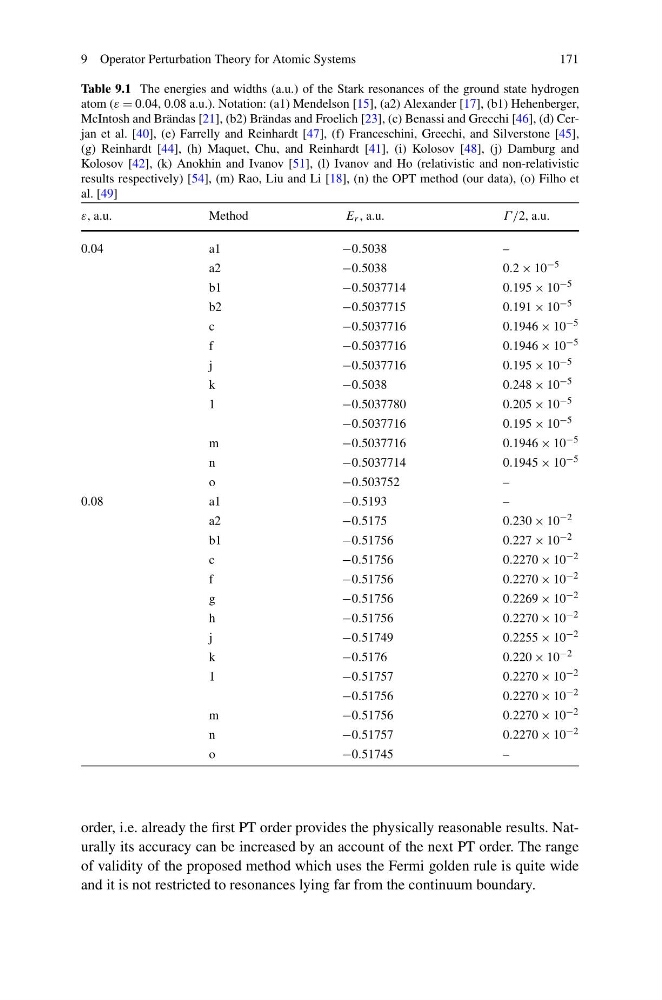
Table 9.1 The energies and widths (a.u.) of the Stark resonances of the ground state hydrogen
atom (ε = 0.04, 0.08 a.u.). Notation: (a1) Mendelson [15], (a2) Alexander [17], (b1) Hehenberger,
McIntosh and Brändas [21], (b2) Brändas and Froelich [23], (c) Benassi and Grecchi [46], (d) Cerjan et al. [40], (e) Farrelly and Reinhardt [47], (f) Franceschini, Greechi, and Silverstone [45],
(g) Reinhardt [44], (h) Maquet, Chu, and Reinhardt [41], (i) Kolosov [48], (j) Damburg and
Kolosov [42], (k) Anokhin and Ivanov [51], (l) Ivanov and Ho (relativistic and non-relativistic
results respectively) [54], (m) Rao, Liu and Li [18], (n) the OPT method (our data), (o) Filho et
al. [49]
ε, a.u.
Method
E r , a.u.
Γ /2, a.u.
0.04
a1
−0.5038
–
a2
−0.5038
0.2 × 10 −5
b1
−0.5037714
0.195 × 10 −5
b2
−0.5037715
0.191 × 10 −5
c
−0.5037716
0.1946 × 10 −5
f
−0.5037716
0.1946 × 10 −5
j
−0.5037716
0.195 × 10 −5
k
−0.5038
0.248 × 10 −5
1
−0.5037780
0.205 × 10 −5
−0.5037716
0.195 × 10 −5
m
−0.5037716
0.1946 × 10 −5
n
−0.5037714
0.1945 × 10 −5
o
−0.503752
–
0.08
a1
−0.5193
–
a2
−0.5175
0.230 × 10 −2
b1
−0.51756
0.227 × 10 −2
c
−0.51756
0.2270 × 10 −2
f
−0.51756
0.2270 × 10 −2
g
−0.51756
0.2269 × 10 −2
h
−0.51756
0.2270 × 10 −2
j
−0.51749
0.2255 × 10 −2
k
−0.5176
0.220 × 10 −2
1
−0.51757
0.2270 × 10 −2
−0.51756
0.2270 × 10 −2
m
−0.51756
0.2270 × 10 −2
n
−0.51757
0.2270 × 10 −2
o
−0.51745
–
order, i.e. already the first PT order provides the physically reasonable results. Naturally its accuracy can be increased by an account of the next PT order. The range
of validity of the proposed method which uses the Fermi golden rule is quite wide
and it is not restricted to resonances lying far from the continuum boundary.
171
Table 9.1 The energies and widths (a.u.) of the Stark resonances of the ground state hydrogen
atom (ε = 0.04, 0.08 a.u.). Notation: (a1) Mendelson [15], (a2) Alexander [17], (b1) Hehenberger,
McIntosh and Brändas [21], (b2) Brändas and Froelich [23], (c) Benassi and Grecchi [46], (d) Cerjan et al. [40], (e) Farrelly and Reinhardt [47], (f) Franceschini, Greechi, and Silverstone [45],
(g) Reinhardt [44], (h) Maquet, Chu, and Reinhardt [41], (i) Kolosov [48], (j) Damburg and
Kolosov [42], (k) Anokhin and Ivanov [51], (l) Ivanov and Ho (relativistic and non-relativistic
results respectively) [54], (m) Rao, Liu and Li [18], (n) the OPT method (our data), (o) Filho et
al. [49]
ε, a.u.
Method
E r , a.u.
Γ /2, a.u.
0.04
a1
−0.5038
–
a2
−0.5038
0.2 × 10 −5
b1
−0.5037714
0.195 × 10 −5
b2
−0.5037715
0.191 × 10 −5
c
−0.5037716
0.1946 × 10 −5
f
−0.5037716
0.1946 × 10 −5
j
−0.5037716
0.195 × 10 −5
k
−0.5038
0.248 × 10 −5
1
−0.5037780
0.205 × 10 −5
−0.5037716
0.195 × 10 −5
m
−0.5037716
0.1946 × 10 −5
n
−0.5037714
0.1945 × 10 −5
o
−0.503752
–
0.08
a1
−0.5193
–
a2
−0.5175
0.230 × 10 −2
b1
−0.51756
0.227 × 10 −2
c
−0.51756
0.2270 × 10 −2
f
−0.51756
0.2270 × 10 −2
g
−0.51756
0.2269 × 10 −2
h
−0.51756
0.2270 × 10 −2
j
−0.51749
0.2255 × 10 −2
k
−0.5176
0.220 × 10 −2
1
−0.51757
0.2270 × 10 −2
−0.51756
0.2270 × 10 −2
m
−0.51756
0.2270 × 10 −2
n
−0.51757
0.2270 × 10 −2
o
−0.51745
–
order, i.e. already the first PT order provides the physically reasonable results. Naturally its accuracy can be increased by an account of the next PT order. The range
of validity of the proposed method which uses the Fermi golden rule is quite wide
and it is not restricted to resonances lying far from the continuum boundary.