

164
A.V. Glushkov
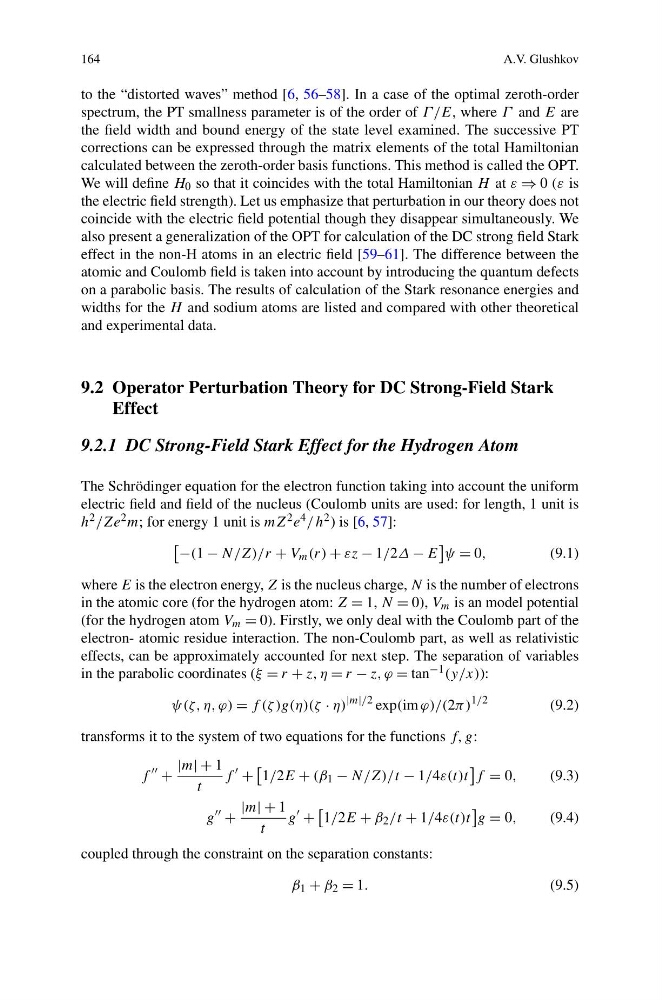
to the “distorted waves” method [6, 56–58]. In a case of the optimal zeroth-order
spectrum, the PT smallness parameter is of the order of Γ /E, where Γ and E are
the field width and bound energy of the state level examined. The successive PT
corrections can be expressed through the matrix elements of the total Hamiltonian
calculated between the zeroth-order basis functions. This method is called the OPT.
We will define H 0 so that it coincides with the total Hamiltonian H at ε ⇒ 0 (ε is
the electric field strength). Let us emphasize that perturbation in our theory does not
coincide with the electric field potential though they disappear simultaneously. We
also present a generalization of the OPT for calculation of the DC strong field Stark
effect in the non-H atoms in an electric field [59–61]. The difference between the
atomic and Coulomb field is taken into account by introducing the quantum defects
on a parabolic basis. The results of calculation of the Stark resonance energies and
widths for the H and sodium atoms are listed and compared with other theoretical
and experimental data.
9.2 Operator Perturbation Theory for DC Strong-Field Stark
Effect
9.2.1 DC Strong-Field Stark Effect for the Hydrogen Atom
The Schrödinger equation for the electron function taking into account the uniform
electric field and field of the nucleus (Coulomb units are used: for length, 1 unit is
h 2 /Ze 2 m; for energy 1 unit is mZ 2 e 4 /h 2 ) is [6, 57]:
−(1 − N/Z)/r + V m (r) + εz − 1/2Δ − E
ψ = 0,
(9.1)
where E is the electron energy, Z is the nucleus charge, N is the number of electrons
in the atomic core (for the hydrogen atom: Z = 1, N = 0), V m is an model potential
(for the hydrogen atom V m = 0). Firstly, we only deal with the Coulomb part of the
electron- atomic residue interaction. The non-Coulomb part, as well as relativistic
effects, can be approximately accounted for next step. The separation of variables
in the parabolic coordinates (ξ = r + z, η = r − z, ϕ = tan −1 (y/x)):
ψ(ζ, η, ϕ) = f (ζ )g(η)(ζ · η)
|m|/2 exp(im ϕ)/(2π)
1/2
(9.2)
transforms it to the system of two equations for the functions f, g:
f
+
|m| + 1
t
f
+
1/2E + (β 1 − N/Z)/t − 1/4ε(t)t
f = 0,
(9.3)
g
+
|m| + 1
t
g
+
1/2E + β 2 /t + 1/4ε(t)t
g = 0,
(9.4)
coupled through the constraint on the separation constants:
β 1 + β 2 = 1.
(9.5)
A.V. Glushkov
to the “distorted waves” method [6, 56–58]. In a case of the optimal zeroth-order
spectrum, the PT smallness parameter is of the order of Γ /E, where Γ and E are
the field width and bound energy of the state level examined. The successive PT
corrections can be expressed through the matrix elements of the total Hamiltonian
calculated between the zeroth-order basis functions. This method is called the OPT.
We will define H 0 so that it coincides with the total Hamiltonian H at ε ⇒ 0 (ε is
the electric field strength). Let us emphasize that perturbation in our theory does not
coincide with the electric field potential though they disappear simultaneously. We
also present a generalization of the OPT for calculation of the DC strong field Stark
effect in the non-H atoms in an electric field [59–61]. The difference between the
atomic and Coulomb field is taken into account by introducing the quantum defects
on a parabolic basis. The results of calculation of the Stark resonance energies and
widths for the H and sodium atoms are listed and compared with other theoretical
and experimental data.
9.2 Operator Perturbation Theory for DC Strong-Field Stark
Effect
9.2.1 DC Strong-Field Stark Effect for the Hydrogen Atom
The Schrödinger equation for the electron function taking into account the uniform
electric field and field of the nucleus (Coulomb units are used: for length, 1 unit is
h 2 /Ze 2 m; for energy 1 unit is mZ 2 e 4 /h 2 ) is [6, 57]:
−(1 − N/Z)/r + V m (r) + εz − 1/2Δ − E
ψ = 0,
(9.1)
where E is the electron energy, Z is the nucleus charge, N is the number of electrons
in the atomic core (for the hydrogen atom: Z = 1, N = 0), V m is an model potential
(for the hydrogen atom V m = 0). Firstly, we only deal with the Coulomb part of the
electron- atomic residue interaction. The non-Coulomb part, as well as relativistic
effects, can be approximately accounted for next step. The separation of variables
in the parabolic coordinates (ξ = r + z, η = r − z, ϕ = tan −1 (y/x)):
ψ(ζ, η, ϕ) = f (ζ )g(η)(ζ · η)
|m|/2 exp(im ϕ)/(2π)
1/2
(9.2)
transforms it to the system of two equations for the functions f, g:
f
+
|m| + 1
t
f
+
1/2E + (β 1 − N/Z)/t − 1/4ε(t)t
f = 0,
(9.3)
g
+
|m| + 1
t
g
+
1/2E + β 2 /t + 1/4ε(t)t
g = 0,
(9.4)
coupled through the constraint on the separation constants:
β 1 + β 2 = 1.
(9.5)