

154
S. Rashev and D.C. Moule
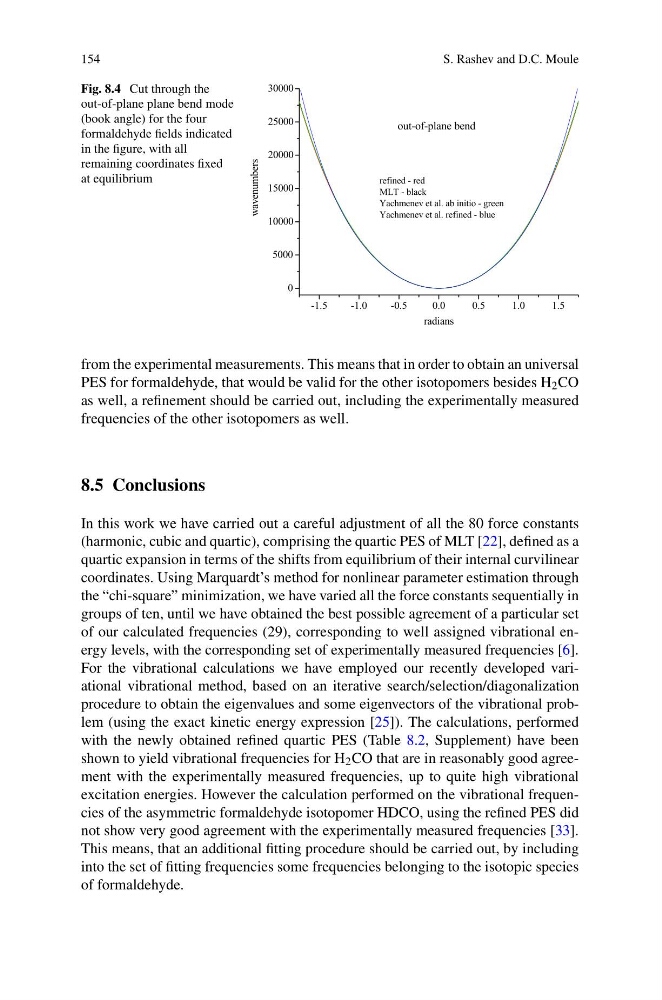
Fig. 8.4 Cut through the
out-of-plane plane bend mode
(book angle) for the four
formaldehyde fields indicated
in the figure, with all
remaining coordinates fixed
at equilibrium
from the experimental measurements. This means that in order to obtain an universal
PES for formaldehyde, that would be valid for the other isotopomers besides H 2 CO
as well, a refinement should be carried out, including the experimentally measured
frequencies of the other isotopomers as well.
8.5 Conclusions
In this work we have carried out a careful adjustment of all the 80 force constants
(harmonic, cubic and quartic), comprising the quartic PES of MLT [22], defined as a
quartic expansion in terms of the shifts from equilibrium of their internal curvilinear
coordinates. Using Marquardt’s method for nonlinear parameter estimation through
the “chi-square” minimization, we have varied all the force constants sequentially in
groups of ten, until we have obtained the best possible agreement of a particular set
of our calculated frequencies (29), corresponding to well assigned vibrational energy levels, with the corresponding set of experimentally measured frequencies [6].
For the vibrational calculations we have employed our recently developed variational vibrational method, based on an iterative search/selection/diagonalization
procedure to obtain the eigenvalues and some eigenvectors of the vibrational problem (using the exact kinetic energy expression [25]). The calculations, performed
with the newly obtained refined quartic PES (Table 8.2, Supplement) have been
shown to yield vibrational frequencies for H 2 CO that are in reasonably good agreement with the experimentally measured frequencies, up to quite high vibrational
excitation energies. However the calculation performed on the vibrational frequencies of the asymmetric formaldehyde isotopomer HDCO, using the refined PES did
not show very good agreement with the experimentally measured frequencies [33].
This means, that an additional fitting procedure should be carried out, by including
into the set of fitting frequencies some frequencies belonging to the isotopic species
of formaldehyde.
S. Rashev and D.C. Moule
Fig. 8.4 Cut through the
out-of-plane plane bend mode
(book angle) for the four
formaldehyde fields indicated
in the figure, with all
remaining coordinates fixed
at equilibrium
from the experimental measurements. This means that in order to obtain an universal
PES for formaldehyde, that would be valid for the other isotopomers besides H 2 CO
as well, a refinement should be carried out, including the experimentally measured
frequencies of the other isotopomers as well.
8.5 Conclusions
In this work we have carried out a careful adjustment of all the 80 force constants
(harmonic, cubic and quartic), comprising the quartic PES of MLT [22], defined as a
quartic expansion in terms of the shifts from equilibrium of their internal curvilinear
coordinates. Using Marquardt’s method for nonlinear parameter estimation through
the “chi-square” minimization, we have varied all the force constants sequentially in
groups of ten, until we have obtained the best possible agreement of a particular set
of our calculated frequencies (29), corresponding to well assigned vibrational energy levels, with the corresponding set of experimentally measured frequencies [6].
For the vibrational calculations we have employed our recently developed variational vibrational method, based on an iterative search/selection/diagonalization
procedure to obtain the eigenvalues and some eigenvectors of the vibrational problem (using the exact kinetic energy expression [25]). The calculations, performed
with the newly obtained refined quartic PES (Table 8.2, Supplement) have been
shown to yield vibrational frequencies for H 2 CO that are in reasonably good agreement with the experimentally measured frequencies, up to quite high vibrational
excitation energies. However the calculation performed on the vibrational frequencies of the asymmetric formaldehyde isotopomer HDCO, using the refined PES did
not show very good agreement with the experimentally measured frequencies [33].
This means, that an additional fitting procedure should be carried out, by including
into the set of fitting frequencies some frequencies belonging to the isotopic species
of formaldehyde.