

7 Spin Torque and Zeta Force in Allene-Type Molecules
135
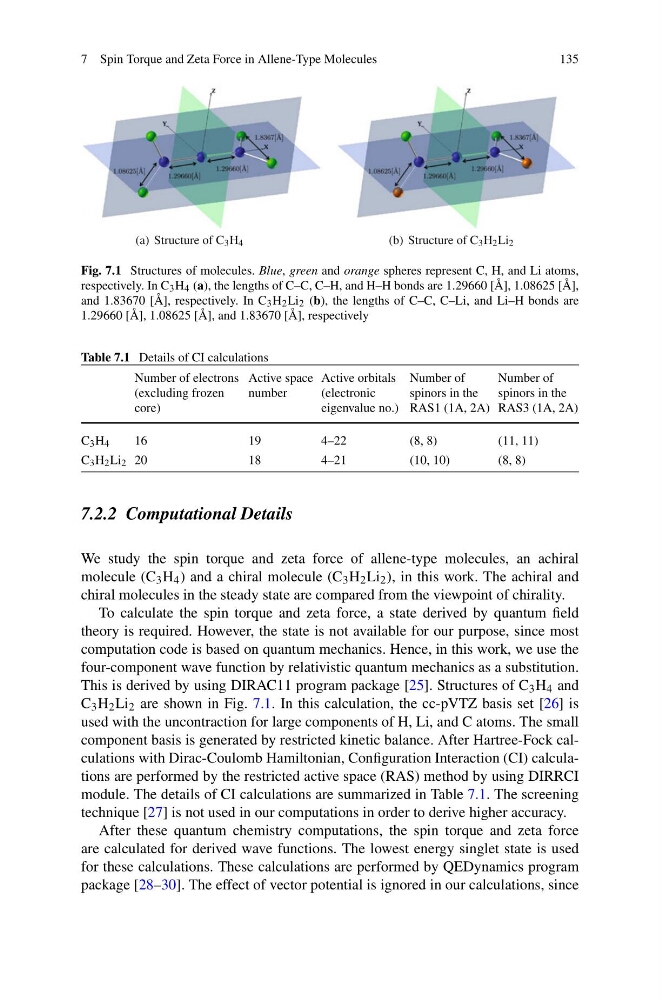
Fig. 7.1 Structures of molecules. Blue, green and orange spheres represent C, H, and Li atoms,
respectively. In C 3 H 4 (a), the lengths of C–C, C–H, and H–H bonds are 1.29660 [Å], 1.08625 [Å],
and 1.83670 [Å], respectively. In C 3 H 2 Li 2 (b), the lengths of C–C, C–Li, and Li–H bonds are
1.29660 [Å], 1.08625 [Å], and 1.83670 [Å], respectively
Table 7.1 Details of CI calculations
Number of electrons
(excluding frozen
core)
Active space
number
Active orbitals
(electronic
eigenvalue no.)
Number of
spinors in the
RAS1 (1A, 2A)
Number of
spinors in the
RAS3 (1A, 2A)
C 3 H 4
16
19
4–22
(8, 8)
(11, 11)
C 3 H 2 Li 2 20
18
4–21
(10, 10)
(8, 8)
7.2.2 Computational Details
We study the spin torque and zeta force of allene-type molecules, an achiral
molecule (C 3 H 4 ) and a chiral molecule (C 3 H 2 Li 2 ), in this work. The achiral and
chiral molecules in the steady state are compared from the viewpoint of chirality.
To calculate the spin torque and zeta force, a state derived by quantum field
theory is required. However, the state is not available for our purpose, since most
computation code is based on quantum mechanics. Hence, in this work, we use the
four-component wave function by relativistic quantum mechanics as a substitution.
This is derived by using DIRAC11 program package [25]. Structures of C 3 H 4 and
C 3 H 2 Li 2 are shown in Fig. 7.1. In this calculation, the cc-pVTZ basis set [26] is
used with the uncontraction for large components of H, Li, and C atoms. The small
component basis is generated by restricted kinetic balance. After Hartree-Fock calculations with Dirac-Coulomb Hamiltonian, Configuration Interaction (CI) calculations are performed by the restricted active space (RAS) method by using DIRRCI
module. The details of CI calculations are summarized in Table 7.1. The screening
technique [27] is not used in our computations in order to derive higher accuracy.
After these quantum chemistry computations, the spin torque and zeta force
are calculated for derived wave functions. The lowest energy singlet state is used
for these calculations. These calculations are performed by QEDynamics program
package [28–30]. The effect of vector potential is ignored in our calculations, since
135
Fig. 7.1 Structures of molecules. Blue, green and orange spheres represent C, H, and Li atoms,
respectively. In C 3 H 4 (a), the lengths of C–C, C–H, and H–H bonds are 1.29660 [Å], 1.08625 [Å],
and 1.83670 [Å], respectively. In C 3 H 2 Li 2 (b), the lengths of C–C, C–Li, and Li–H bonds are
1.29660 [Å], 1.08625 [Å], and 1.83670 [Å], respectively
Table 7.1 Details of CI calculations
Number of electrons
(excluding frozen
core)
Active space
number
Active orbitals
(electronic
eigenvalue no.)
Number of
spinors in the
RAS1 (1A, 2A)
Number of
spinors in the
RAS3 (1A, 2A)
C 3 H 4
16
19
4–22
(8, 8)
(11, 11)
C 3 H 2 Li 2 20
18
4–21
(10, 10)
(8, 8)
7.2.2 Computational Details
We study the spin torque and zeta force of allene-type molecules, an achiral
molecule (C 3 H 4 ) and a chiral molecule (C 3 H 2 Li 2 ), in this work. The achiral and
chiral molecules in the steady state are compared from the viewpoint of chirality.
To calculate the spin torque and zeta force, a state derived by quantum field
theory is required. However, the state is not available for our purpose, since most
computation code is based on quantum mechanics. Hence, in this work, we use the
four-component wave function by relativistic quantum mechanics as a substitution.
This is derived by using DIRAC11 program package [25]. Structures of C 3 H 4 and
C 3 H 2 Li 2 are shown in Fig. 7.1. In this calculation, the cc-pVTZ basis set [26] is
used with the uncontraction for large components of H, Li, and C atoms. The small
component basis is generated by restricted kinetic balance. After Hartree-Fock calculations with Dirac-Coulomb Hamiltonian, Configuration Interaction (CI) calculations are performed by the restricted active space (RAS) method by using DIRRCI
module. The details of CI calculations are summarized in Table 7.1. The screening
technique [27] is not used in our computations in order to derive higher accuracy.
After these quantum chemistry computations, the spin torque and zeta force
are calculated for derived wave functions. The lowest energy singlet state is used
for these calculations. These calculations are performed by QEDynamics program
package [28–30]. The effect of vector potential is ignored in our calculations, since