

than that of FAl(Bif f ) 3
À and comparable to MeB(C 6 F 5 ) 3
À
. The results obtained
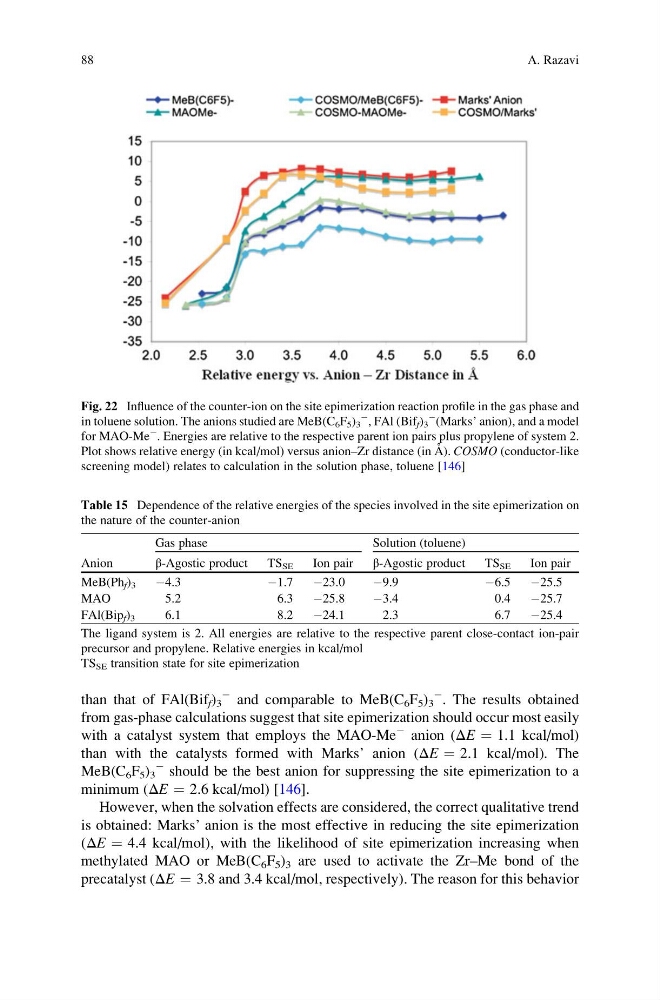
from gas-phase calculations suggest that site epimerization should occur most easily
with a catalyst system that employs the MAO-Me
À anion (ΔE ¼ 1.1 kcal/mol)
than with the catalysts formed with Marks’ anion (ΔE ¼ 2.1 kcal/mol). The
MeB(C 6 F 5 ) 3
À should be the best anion for suppressing the site epimerization to a
minimum (ΔE ¼ 2.6 kcal/mol) [146].
However, when the solvation effects are considered, the correct qualitative trend
is obtained: Marks’ anion is the most effective in reducing the site epimerization
(ΔE ¼ 4.4 kcal/mol), with the likelihood of site epimerization increasing when
methylated MAO or MeB(C 6 F 5 ) 3 are used to activate the Zr–Me bond of the
precatalyst (ΔE ¼ 3.8 and 3.4 kcal/mol, respectively). The reason for this behavior
Fig. 22 Influence of the counter-ion on the site epimerization reaction profile in the gas phase and
in toluene solution. The anions studied are MeB(C 6 F 5 ) 3
À , FAl (Bif f ) 3
À (Marks’ anion), and a model
for MAO-Me
À
. Energies are relative to the respective parent ion pairs plus propylene of system 2.
Plot shows relative energy (in kcal/mol) versus anion–Zr distance (in A ˚ ). COSMO (conductor-like
screening model) relates to calculation in the solution phase, toluene [146]
Table 15 Dependence of the relative energies of the species involved in the site epimerization on
the nature of the counter-anion
Anion
Gas phase
Solution (toluene)
β-Agostic product
TS SE
Ion pair
β-Agostic product
TS SE
Ion pair
MeB(Ph f ) 3
À4.3
À1.7
À23.0
À9.9
À6.5
À25.5
MAO
5.2
6.3
À25.8
À3.4
0.4
À25.7
FAl(Bip f ) 3
6.1
8.2
À24.1
2.3
6.7
À25.4
The ligand system is 2. All energies are relative to the respective parent close-contact ion-pair
precursor and propylene. Relative energies in kcal/mol
TS SE transition state for site epimerization
88
A. Razavi
À and comparable to MeB(C 6 F 5 ) 3
À
. The results obtained
from gas-phase calculations suggest that site epimerization should occur most easily
with a catalyst system that employs the MAO-Me
À anion (ΔE ¼ 1.1 kcal/mol)
than with the catalysts formed with Marks’ anion (ΔE ¼ 2.1 kcal/mol). The
MeB(C 6 F 5 ) 3
À should be the best anion for suppressing the site epimerization to a
minimum (ΔE ¼ 2.6 kcal/mol) [146].
However, when the solvation effects are considered, the correct qualitative trend
is obtained: Marks’ anion is the most effective in reducing the site epimerization
(ΔE ¼ 4.4 kcal/mol), with the likelihood of site epimerization increasing when
methylated MAO or MeB(C 6 F 5 ) 3 are used to activate the Zr–Me bond of the
precatalyst (ΔE ¼ 3.8 and 3.4 kcal/mol, respectively). The reason for this behavior
Fig. 22 Influence of the counter-ion on the site epimerization reaction profile in the gas phase and
in toluene solution. The anions studied are MeB(C 6 F 5 ) 3
À , FAl (Bif f ) 3
À (Marks’ anion), and a model
for MAO-Me
À
. Energies are relative to the respective parent ion pairs plus propylene of system 2.
Plot shows relative energy (in kcal/mol) versus anion–Zr distance (in A ˚ ). COSMO (conductor-like
screening model) relates to calculation in the solution phase, toluene [146]
Table 15 Dependence of the relative energies of the species involved in the site epimerization on
the nature of the counter-anion
Anion
Gas phase
Solution (toluene)
β-Agostic product
TS SE
Ion pair
β-Agostic product
TS SE
Ion pair
MeB(Ph f ) 3
À4.3
À1.7
À23.0
À9.9
À6.5
À25.5
MAO
5.2
6.3
À25.8
À3.4
0.4
À25.7
FAl(Bip f ) 3
6.1
8.2
À24.1
2.3
6.7
À25.4
The ligand system is 2. All energies are relative to the respective parent close-contact ion-pair
precursor and propylene. Relative energies in kcal/mol
TS SE transition state for site epimerization
88
A. Razavi